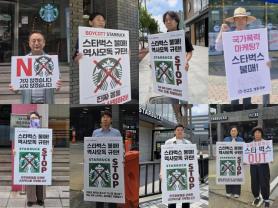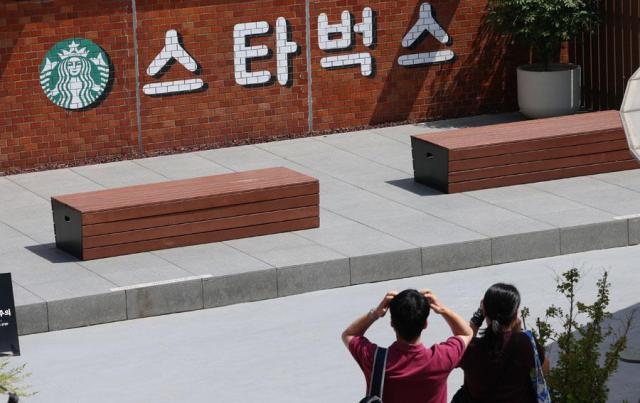
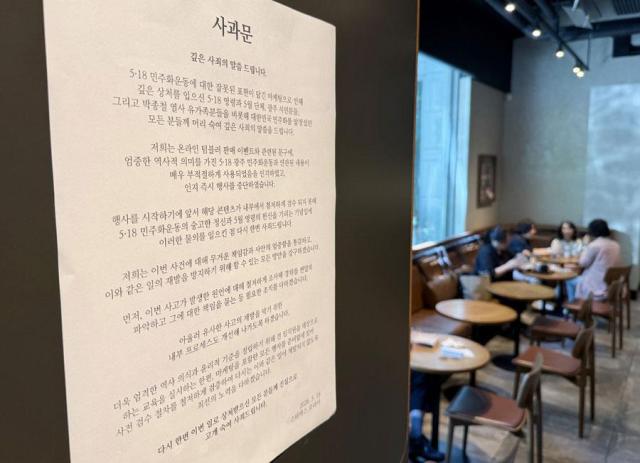
The American coffee chain has already thrown in the towel, pulling its marketing campaign and posting an apology on its website. Shinsegae Group, the retail conglomerate that manages Starbucks in South Korea, also sacked its chief executive Sohn Jeong-hyun for "inappropriate marketing."
Shinsegae chairman Chung Yong-jin also issued a public apology, saying the marketing "deeply hurt the public, bereaved families, and victims of the May 18 democratic movement." Yet the controversy it sparked shows no sign of dying down.
What appeared to be a routine product promotion has since turned into a major dispute after it was accused of evoking some of South Korea's most sensitive historical tragedies. It all began when Starbucks Korea launched a so-called "Tank Day" campaign promoting its line of tumblers last Monday, the 46th anniversary of the 1980 democratic uprising in Gwangju against the military dictatorship under Chun Doo-hwan, who deployed troops and tanks to suppress protesters in the southwestern city.
Adding fuel to the fire, fresh allegations emerged over a 2024 promotion in which Starbucks Korea had advertised its "Siren Classic Mug" on April 16, the very anniversary of the 2014 Sewol ferry disaster that killed more than 300 people, mostly students.
The Siren is a mythological sea creature that lures sailors to their deaths and has been Starbucks' global logo since its founding in 1971. Critics argued that promoting a "Siren" product on that day, whatever the intent, was an insensitive coincidence.
Government ministries have also declared they will not use Starbucks products and have encouraged state-run agencies and others to join them.
But the main opposition People Power Party (PPP) hit back, saying that while Starbucks' latest marketing was inappropriate, it was not the president's job to lead a boycott against a private company. He accused the government and the ruling Democratic Party (DP) of going too far, saying they were using the controversy to woo voters ahead of the upcoming local elections, particularly by appealing to those in Gwangju, a region that still bears deep scars from the 1980 uprising.
Despite widespread calls for a boycott, Starbucks Korea remains popular. According to industry data, its products continued to rank among the top brands on Kakao's mobile gift voucher platform, a position it has held for seven consecutive years.
Whether it leaves a lasting dent in Starbucks Korea's business remains to be seen. For now, the controversy has become a stark reminder of how a single tone-deaf marketing move can collide with a nation's deepest wounds, and how quickly a cup of coffee can become a political battleground.
Copyright ⓒ Aju Press All rights reserved.