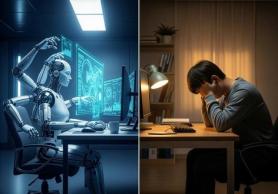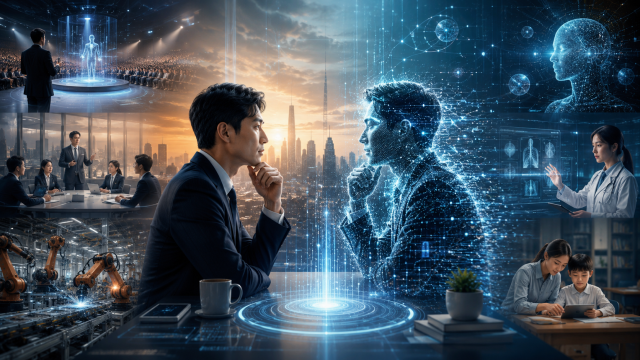
It is not a chatbot. It is, by design, another him.
The Wall Street Journal has been documenting a wave of these AI digital twins among US executives, and the pattern is consistent. Leaders feed their emails, interviews, lectures and management philosophy into a model and produce a working double — one that coaches employees, supports performance reviews and speaks at conferences in their place. Zoom's Eric Yuan has floated sending his twin to meetings. Bridgewater's Ray Dalio has built one to dispense his investment thinking on demand.
The clearest example of what this does inside a company is at Greif, a US industrial packaging firm. Chief human resources officer Bala Sathyanarayanan says his twin, "BalaBot," has interacted with more than 3,300 employees, who consult it on sensitive matters such as managing underperformers and planning careers. One employee was credited with growing into a leader on coaching the AI provided.
That is the shift worth paying attention to. The steam engine extended human muscle. The personal computer extended human work. The digital twin extends human judgment — and copies it without limit. A person's experience, once capped at 24 hours a day and one room at a time, can now run in many places at once.
It also moves what a company is made of. Factories and capital were once the core assets, then data and platforms. Now the experience inside an employee's head is being converted into an asset the company can hold. The competitive question becomes uncomfortable: who has best turned their best people into software?
The uncomfortable questions don't stop there. Who owns the twin when the employee quits — the person, or the company? What stops a firm from keeping the double and letting the human go? U.S. workers are already pushing back at having their entire way of thinking absorbed into a model. And the technology still hallucinates: Reid AI has given answers the real Hoffman wouldn't, down to the wrong favorite ice cream. An AI that misstates an employment rule or a medical instruction is not a curiosity but a liability, and the law has not caught up.
For now, the honest framing is narrower than replacement. The twin reallocates time rather than eliminating the person — routine handled by the AI, judgment and creation left to the human. Whether companies hold that line, or use it as cover for cutting headcount, is a choice, not a feature of the technology.
For South Korea, the case is sharper than for most. A society aging this fast loses decades of expertise every time a veteran retires, and the knowledge usually leaves with them. A digital twin can hold it — the manufacturing master's technique, the doctor's clinical pattern, the reporter's method and judgment — and pass it to the next generation in a usable form. In a country short on workers and long on accumulated skill, preserving that skill is not a luxury.
Journalism is no exception. A model trained on a veteran reporter's prose, sourcing instincts and editorial judgment could change how juniors are trained and how copy is checked. An AI carrying a foreign-affairs analyst's framework could track the U.S.-China contest or Middle East shifts in real time. The advantage stops being how many articles a newsroom produces and starts being how much of its irreplaceable human judgment it can encode.
South Korean firms are positioned for it. Samsung Electronics is pushing on-device AI, SK hynix is supplying the memory the AI buildout runs on, and Naver and Kakao are building Korean-language enterprise agents. The twin services — for executives, bankers, analysts, lawyers, journalists — are the logical next product.
But the technology arrives with three obligations attached, and they are easy to skip. Keep it human-centered: a twin should extend a person's reach, not erase the person. Settle data sovereignty: an employee's knowledge is theirs, and ownership and compensation have to be written down before the model is trained, not after. And fix responsibility on a human: when the twin gets it wrong, a person answers for it, not the software.
The digital twin is going to become mainstream, and agentic AI — systems that plan and act on their own — will speed it up. The open question is not whether the technology works. It is whether the companies deploying it use the time it frees to do something more human, or simply to do the same things with fewer people. The winner of this era won't be whoever builds the fastest machine. It will be whoever is clearest about what the machine is for.
Copyright ⓒ Aju Press All rights reserved.