

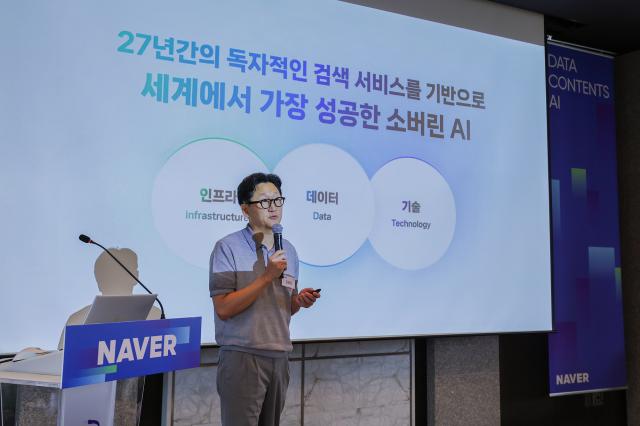
"Google pays 80 billion won annually to use content from the U.S. community Reddit. The era where content is a weapon will continue, and companies with high-quality data will survive in the generative AI competition," said Kim Kwang-hyun, Naver's Chief Data and Content Officer (CDO). He emphasized that Naver's 27 years of accumulated search technology and data-content ecosystem will be key competitive advantages in the AI era. The content assets built on Naver's platforms, such as Knowledge iN, blogs, and cafes, have fueled its growth in the search market and are expected to serve as differentiated strengths in the AI landscape.
On May 28, Naver hosted a media roundtable at The Plaza Hotel in Seoul, focusing on its data and content strategy in the AI era. Kim Kwang-hyun, along with Lee Il-koo, head of content services, and Kim Sang-beom, head of the search platform, presented strategies to enhance the content and creator ecosystem and strengthen AI search service competitiveness.
Naver appointed Kim Kwang-hyun as CDO earlier this year. He joined Naver in 2000 as a search developer and has held various roles related to search, including heading the search platform until last year. His role is expected to extend beyond improving existing search quality to connecting content and data within and outside Naver to enhance AI service competitiveness.
Kim highlighted that Naver has clear differentiators compared to Google in the South Korean market. While Google's strength lies in global search data, Naver excels in lifestyle search data from Korean users and original user-generated content (UGC). He noted that Naver can secure a significant advantage in vertical areas such as shopping, local searches, and reservations, where search leads to execution.
"When ChatGPT first emerged, the market's reaction was astonishing, but after the launch of Google Gemini, the usage of ChatGPT has somewhat declined. The quality of content queries based on Google's search capabilities has created this difference," Kim said, adding, "Korean users still prefer Naver search because it provides the best information for daily needs, making Naver distinctly different from Google in terms of content quality."
In line with this, Naver plans to invest 1 trillion won over the next five years to develop its content ecosystem. The company believes that the competition among global AI platforms will increasingly depend on the quality of data and service competitiveness rather than just the performance of the models themselves.
Naver is also launching the AI fellowship program 'Naver Mate,' which will select 3,000 creators monthly and provide approximately 20 billion won annually to support their activities, aiming to strengthen UGC. Kim pointed out the need for Naver to establish independent competitiveness to prevent high-quality Korean content from flowing to overseas platforms.
He remarked, "Recently, Korean content has been accumulating on foreign platforms like YouTube and Instagram, and we need to consider whether this is a desirable direction in the long term. By striving for coexistence with creators and improving the platform to accumulate quality content domestically, Naver and South Korea can lay the groundwork for new growth not only in the current AI era but also in future technological changes."
Naver also unveiled its strategy to enhance AI search service competitiveness, aiming to implement an 'AI integrated agent.' The core of this strategy is a 'product-native large language model (LLM)' designed and optimized for specific service scenarios, differing from existing general-purpose models.
Kim reiterated that Naver AI has distinct advantages over Google AI in vertical search areas. Naver has accumulated vertical search data that allows for execution from product search to purchase and delivery, and the company plans to focus its capabilities in this area.
He stated, "Just as OpenAI aimed for artificial general intelligence (AGI) from the start, Naver has also contemplated whether to pursue AGI. The biggest differentiator of Naver AI compared to Google AI is vertical search. Naver is likely the only company globally that can complete a service from product search to purchase and reservation within a single platform."
Additionally, Naver plans to expand its AI search offerings with the upcoming launch of 'Smart Lens,' a camera-based search service, following the release of 'AI Briefing' in March and the beta version of 'AI Tab' last month. Smart Lens will enable direct connections from visual searches to purchase execution.
According to Naver, AI Briefing currently has 30 million monthly users, and AI Tab surpassed 3 million cumulative users within a month of its beta launch. The officially launched AI Tab next month will expand its user base from Naver Plus membership subscribers to all users. This is expected to enhance the synergy of generative AI search across Smart Lens, AI Briefing, and AI Tab.
* This article has been translated by AI.
Copyright ⓒ Aju Press All rights reserved.