

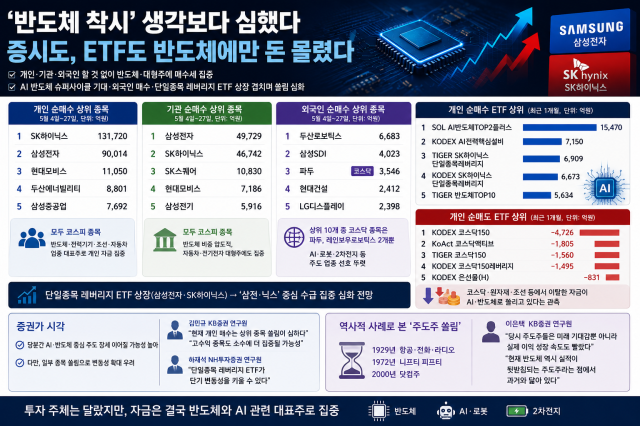
The flow of funds in the stock market this year can be summarized as a "semiconductor black hole." Analysts suggest that the buying frenzy for semiconductors among individual, institutional, and foreign investors has intensified the phenomenon of "semiconductor illusion," making the overall market gains appear larger than they are.
According to the financial investment industry on May 28, the trading volume of Samsung Electronics and SK Hynix has rapidly increased, now accounting for nearly half of the total trading volume on the KOSPI. The expectation of a supercycle in AI semiconductors, combined with foreign buying, has led to a concentration of funds in specific stocks. The listing of single-stock leveraged ETFs for Samsung Electronics and SK Hynix has further intensified this trend of concentration around these two companies.
The Korea Exchange reported that both individual and institutional investors have focused their funds on large-cap stocks in the semiconductor sector. From May 4 to May 27, SK Hynix topped the list of net purchases by individuals with 13.172 trillion won, followed by Samsung Electronics with 9.014 trillion won. Other notable stocks included Hyundai Mobis (1.105 trillion won), Doosan Enerbility (880.1 billion won), and Samsung Heavy Industries (769.2 billion won).
During the same period, institutional investors also heavily purchased Samsung Electronics (4.9729 trillion won) and SK Hynix (4.6742 trillion won), with SK Square (1.083 trillion won), Hyundai Mobis (718.6 billion won), and Samsung Electro-Mechanics (591.6 billion won) following. While foreign capital showed some diversification with investments in Doosan Robotics (668.3 billion won), Samsung SDI (402.3 billion won), and Pado (354.6 billion won), a clear preference for leading sectors such as AI, robotics, and secondary batteries was evident. Analysts noted that despite differing investment entities, funds ultimately concentrated on semiconductor and AI-related stocks.
The ETF market also reflects a severe concentration on AI and semiconductor themes. According to Koscom ETF CHECK, the top net purchase by individuals in the past month was the SOL AI Semiconductor TOP2 Plus, which attracted 1.547 trillion won. Other top performers included KODEX AI Power Core Facilities (3rd, 715 billion won), TIGER SK Hynix Single Stock Leverage (4th, 690.9 billion won), KODEX SK Hynix Single Stock Leverage (5th, 667.3 billion won), and TIGER Semiconductor TOP10 (7th, 563.4 billion won). More than half of the top 10 ETFs were semiconductor-related products.
In contrast, there was a noticeable outflow of funds from KOSDAQ and commodity-related ETFs. KODEX KOSDAQ 150 (472.6 billion won), KoAct KOSDAQ Active (180.5 billion won), TIGER KOSDAQ 150 (156 billion won), and KODEX KOSDAQ 150 Leverage (149.5 billion won) were among the top net sales by individuals. Additionally, selling pressure was observed in ETFs related to silver futures, gold bullion, and shipbuilding.
Market analysts believe that the dominance of AI and semiconductor stocks is likely to continue for the foreseeable future. There are concerns that the concentration of funds in a few stocks like Samsung Electronics and SK Hynix could increase market volatility. Kim Min-kyu, a researcher at KB Securities, stated, "Currently, individual buying is heavily concentrated on top stocks," adding that high-return stocks are also likely to become concentrated among a few. NH Investment & Securities researcher Ha Jae-seok also predicted, "Single-stock leveraged ETFs could amplify short-term volatility."
* This article has been translated by AI.
Copyright ⓒ Aju Press All rights reserved.