

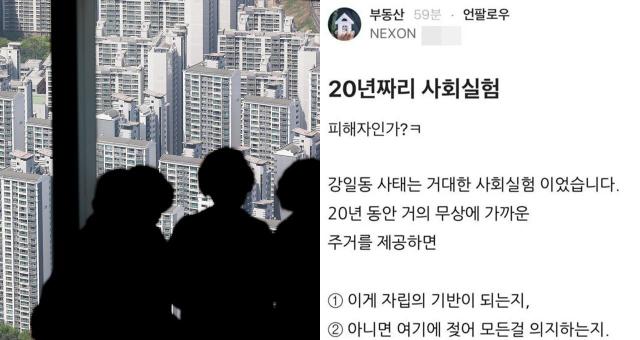
A public housing crisis in Gangil-dong, Seoul, has reignited the debate over welfare and self-sufficiency.
Recently, an anonymous post on the workplace community platform "Blind" claimed that the Gangil-dong situation was a "massive social experiment." The author, identified as A, stated, "Providing nearly free housing for 20 years raises the question of whether it fosters independence or leads to dependency. The conclusion is that despite 20 years of affordable rent, residents have not become self-sufficient."
A continued, "Instead, they seem to want to remain in public housing, becoming accustomed to relying on others (taxes) to solve their housing issues." This post quickly gained traction amid ongoing controversies surrounding the renewal and eviction of long-term public housing residents in Gangil-dong. Some residents expressed their distress, saying, "We have built a community here for over 20 years, and now we are being forced out." Critics online argued that public housing has effectively transformed into a permanent living solution.
Comments from netizens included, "This experiment shows that increasing welfare can lead to dependency rather than motivation to work harder," and, "Public housing should be a stepping stone to independence, not a permanent residence." Others remarked, "Taxpayer support has only increased dependency," and, "Twenty years is ample time to prepare for independence."
The debate has expanded beyond the issue of rental housing, touching on broader concerns about housing inequality and welfare policy in South Korea. There is ongoing disagreement about whether long-term public housing should focus on supporting independence or prioritizing stable housing rights.
Meanwhile, the Seoul city government and the SH Corporation stated they are proceeding with legal standards and supply principles regarding contracts and resettlement related to the Gangil-dong public housing. However, as public sentiment intensifies, discussions about the role and sustainability of the public housing system are expected to continue for the foreseeable future.
* This article has been translated by AI.
Copyright ⓒ Aju Press All rights reserved.