

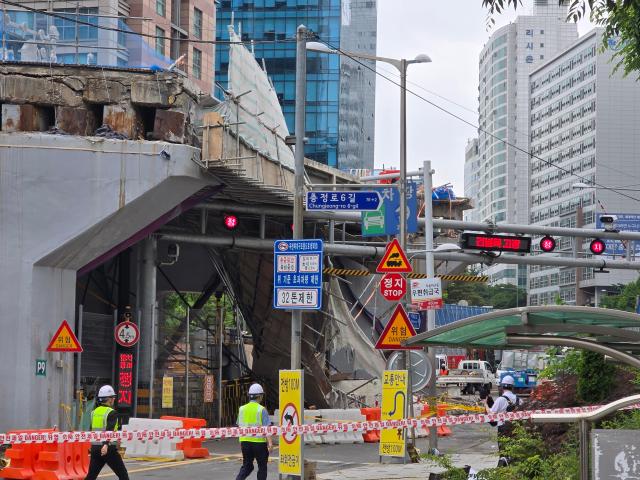
Demolition work on the Seosomun Overpass in Seoul, which collapsed and resulted in three fatalities, resumed early on May 29, four days after the incident. While the bridge deck and girders have been removed, the demand for transportation ahead of the weekend has caused train operations, including KTX services, to drop to a low of 70%, leading to significant passenger disruptions.
On May 29, the Ministry of Land, Infrastructure and Transport announced that all 16 girders, which posed the greatest safety risk to the demolition work, had been safely removed. Following the accident, the ministry activated a central accident response headquarters composed of experts from relevant agencies and has held eight situational assessment meetings to develop and implement a demolition plan.
To minimize traffic congestion over the weekend, the response headquarters is making a concerted effort to resume operations on the Gyeongui Line by May 30. The government plans to complete the remaining demolition work by 5 a.m. tomorrow, along with the restoration of the overhead lines and tracks, to ensure a safe recovery of the site.
The Seoul Western District Office of the Ministry of Employment and Labor held a meeting the previous evening to review and conditionally approve the demolition plan submitted by the city. Consequently, the previously halted recovery and demolition work resumed at midnight on May 29.
To minimize the risk of structural collapse, the city deployed four excavators equipped with hydraulic crushers instead of cranes. After intensive work, the upper structure of the overpass was completely crushed and removed by around 5 a.m. on May 29. Korea Railroad Corporation (KORAIL) will now proceed with the restoration and inspection of tracks and overhead lines to gradually normalize train operations.
Despite the swift progress on-site, the increase in train services ahead of the weekend has caused the overall train operation rate to drop to 73.7%, raising concerns about further disruptions to passenger and freight services.
According to KORAIL, a total of 542 train services were operated on this day, a decrease of 193 services compared to the usual 735, resulting in a significant drop in the operation rate. This figure is considerably lower than the rates of 80.8% and 82.3% recorded on the day after the accident and the day before, respectively.
In particular, high-speed trains like KTX operated only 270 services, down by 113 from normal, resulting in an operation rate of 70.5%. Ongoing track closures between Haengsin Station and Seoul Station, as well as between Seoul Station and Cheongnyangni Station, have led to unavoidable delays. Regular trains (Saemaul and Mugunghwa) also saw their operation rate drop to 77.3%, with Mugunghwa services limited to routes up to Daejeon Station and Seo Daejeon Station on the Gyeongbu, Honam, and Jeolla lines.
Subway services in the metropolitan area also faced disruptions. Train operations on the Gyeongui-Jungang Line between Seoul and Susaek have been suspended for four days due to blocked access to the northern train depot at Seoul Station. Additionally, the subway Line 2 between Hongdae and Euljiro was temporarily limited from the first train of the day for safety inspections before returning to normal operations.
As passenger inconvenience peaked, ticket counters at Seoul Station and Yongsan Station experienced severe congestion as travelers sought to change their travel plans or voiced complaints. KORAIL urged passengers to check train operation statuses through the mobile app 'KORAIL Talk' or the website before traveling.
A KORAIL official stated, "The change in demolition methods by the city is expected to shorten the time for debris removal, allowing for an earlier entry into the restoration phase. However, while we aim to complete facility restoration by around 5 a.m. on Saturday, immediate resumption of 100% operations according to the regular schedule will be challenging due to necessary procedures like test runs. We anticipate that all trains, including KTX, will return to normal operations by the 31st."
* This article has been translated by AI.
Copyright ⓒ Aju Press All rights reserved.