


The OECD has projected that South Korea's economy will grow by 2.6% this year, driven by a surge in semiconductor exports.
According to the Ministry of Finance and Economy on June 3, the OECD raised its growth forecast for South Korea by 0.9 percentage points in its World Economic Outlook report. This marks the largest increase among the G20 nations. However, the forecast for next year has been lowered by 0.2 percentage points to 1.9%.
Previously, the South Korean government, the Bank of Korea, and the Korea Development Institute (KDI) had also revised their growth forecasts for this year to the mid-2% range. Reflecting the economic boom, the KOSPI index has surpassed 8,000, and the current account surplus for the first quarter reached a record $73.3 billion.
The OECD noted that the expansion in exports, particularly in semiconductors, has propelled overall economic growth and private investment in South Korea. It also projected that consumer spending will gradually recover, with both prices and volumes of exports increasing since the beginning of the year.
Private investment has significantly benefited from the semiconductor sector. The OECD stated, "Private investment in South Korea is increasing, particularly in semiconductors," and added that by the end of this year, investment growth is expected to spread to other sectors, maintaining a strong performance. It also forecasted a gradual recovery in consumer spending from this year into next year, influenced by supplementary budget measures.
The nominal economic growth rate for this year, adjusted for the GDP deflator, is expected to be 10.4%, while the general government debt-to-GDP ratio has been revised down by 4.8 percentage points to 50.2% compared to projections made last December.
Consumer prices are anticipated to average 2.6% this year, influenced by the ongoing conflict in the Middle East. However, inflation rates are expected to return to target levels starting next year. The OECD believes that measures such as the maximum price cap on oil products and reductions in fuel taxes will help alleviate inflationary pressures caused by energy supply shocks.
Nonetheless, an OECD official cautioned that these measures could increase the persistence of inflationary pressures and recommended a gradual phase-out.
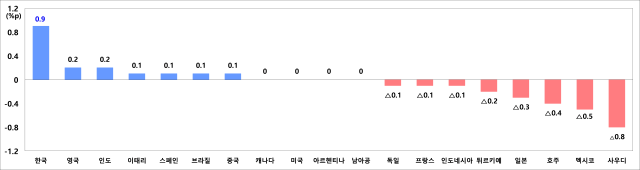
In contrast, the global economic outlook remains bleak.
The OECD has lowered its global growth forecast for this year to 2.8%, down 0.1 percentage points from its March estimate. It attributed this downgrade to soaring energy prices and trade disruptions caused by the blockade of the Strait of Hormuz. Major economies, including the United States (2.0%), the Eurozone (0.8%), and Japan (0.6%), are expected to experience slower growth due to the impact of the conflict in the Middle East. Inflation rates for G20 countries are projected at 4.0% this year and 3.1% next year.
The prolonged conflict in the Middle East is identified as the biggest downside risk to global economic growth. Should the war continue, global growth could decline by as much as 0.7 percentage points, while inflation could rise by 0.4 percentage points.
Conversely, an early resolution to the conflict and increased global demand for artificial intelligence (AI) are expected to positively influence global economic recovery.
An OECD official emphasized the need for monetary policy to address inflationary pressures and called for measures to expand the tax base to alleviate long-term fiscal burdens. He also highlighted the necessity for structural reforms across society, including diversifying energy supply chains.
* This article has been translated by AI.
Copyright ⓒ Aju Press All rights reserved.