

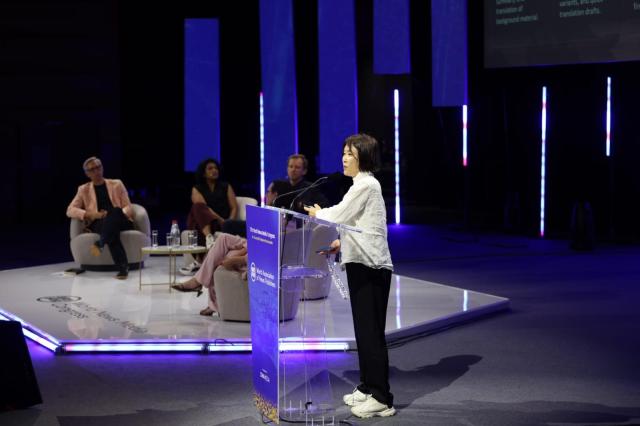
Artificial intelligence is not only changing how news is produced but also how readers experience it. The era of searching for keywords and clicking links is fading, giving way to a time when content is delivered based on predictions of what readers want, even before they ask.
On June 3, during the 77th World News Media Congress held at the Palais du Pharo in Marseille, discussions took place in a session titled "How AI Is Transforming the News Experience." The congress, which ran from June 1 to 3, attracted around 1,000 participants representing over 450 media organizations from more than 60 countries.
The session was moderated by Dmitry Shishkin, a former digital development editor at BBC World Service and now an independent media consultant. Panelists included Markus Knall, Chief Content Officer and Editor-in-Chief at Ippen Digital in Germany; Astrid Maier, Deputy Editor and Strategy Head at dpa in Germany; Sannuta Raghu, Executive Producer at Scroll.in in India; and Seo Hye-seung, Editor-in-Chief of AJP at Ajou Media Group in South Korea.
The central theme of the session was "liquid content," which refers to the concept that a single piece of reporting can change its form based on the context of the reader, reaching them in the appropriate format at the right moment. This contrasts sharply with the traditional model that waits for readers to visit the media outlet.
Shishkin's "user needs" model provided the theoretical foundation for this discussion. It starts from the premise that readers do not consume news solely for information. Instead, it categorizes their different intents into four areas: "to know," "to understand," "to feel," and "to do."
He emphasized, "Tell the story you want to tell, but frame it from the perspective that adds value for the reader." AI takes this model a step further by analyzing data to determine which readers currently seek understanding or emotional resonance, automatically generating content in the appropriate form.
The session also posed the fundamental question: What does it mean to be a news agency in the age of AI?
Traditionally, news agencies have acted as wholesalers, producing articles to supply to other media. However, as AI automates translation, curation, and distribution, the boundaries of what agencies can deliver are expanding. In this context, Seo Hye-seung's AJP model stands out.
Ajou Media Group publishes content in five languages, including Korean, English, and Chinese, as well as Japanese and Vietnamese editions, all driven by AI. Seo identifies AJP's identity not in the search era but in the AI era.
He stated, "In the search era, language was tied to regions, but in the AI era, that formula is flipped. All major language models are fundamentally built around English, and Asia is increasingly described by AI trained on Western data. We have found our role as an Asian English news agency, writing in the language that AI can best understand. This is the 'Asian substance in English.'"
Seo explained the paradox of being a latecomer designed as an AI-native. Although AJP is a newcomer in the English news agency market, its foundation built on AI from the start has offset the disadvantages of being late to the game.
He shared that the 72-year-old founder of Ajou Media Group, Kwak Young-gil, adopted the principles "AI or Die" and "Start now, perfect later" after attending AI lectures at KAIST during the pandemic.
Seo emphasized that while AI serves as an auxiliary tool, the role of journalists has become even more crucial. He said, "Our motto is clear: to become journalists that AI can learn from and keep up with. Currently, at AJP, reporters with less than two years of experience are producing in-depth features, interviews, and analytical articles of 5,000 words."
In practice, AJP selects a portion of the approximately 300 articles produced daily by Ajou Economic Daily through a system called "AI Pick" for automatic distribution in four additional languages. This automation has increased the publication volume in those four languages tenfold, and English traffic has reportedly risen by 30%.
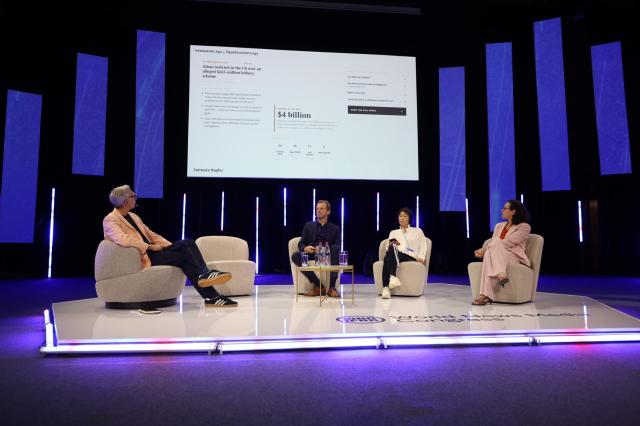
This session naturally connected with the previous day's discussion on "Discovery: How to Rethink Search in the AI Era." While the June 2 session addressed the evolution of search strategies from SEO to AEO (Answer Engine Optimization) and GEO (Generative Engine Optimization), the June 3 session looked ahead to a stage where readers experience news even before searching for it.
This shift suggests that the long-standing questions in the media industry are changing. Where publishers once asked, "What is the best journalism?" the new question is, "What is the best experience?" However, both sessions emphasized a common message: the fundamentals remain more important than technology. Algorithms and platforms may constantly change, but the direct relationship with readers endures.
The third key point was how AI is rapidly expanding the reporting scope of local publishers. Sannuta Raghu from Scroll.in in India has led experiments using AI to cover broader communities with limited resources, demonstrating the significant benefits of automation for resource-constrained local media.
AJP shares a similar discovery. A small AI video and essay contest conducted last year in collaboration with the Indian Embassy in South Korea started with a mere $220 marketing budget but garnered about one million impressions, laying the groundwork for building India-focused content.
Seo illustrated how the time freed up by AI translates into enhanced reader experiences by referencing the recent BTS concert in Gwanghwamun, which was live-streamed 24/7 for two months, transforming into a platform for the global fanbase 'ARMY' in five languages.
He stated, "We cannot wait for readers to come to us. We must seek them out and understand what they want to experience."
Ultimately, the session converged on a single conclusion: while AI is shaking up the production, distribution, and consumption of news, the reader remains at the center. Technology is merely a tool, and the goal of 'predictive journalism' is to create content that finds its audience. The panelists, including Seo, shared a vision that regardless of where readers are or what format they desire, stories will be delivered at the right moment, emphasizing that the competitive edge for media in the AI era lies in creating reasons for readers to return.
* This article has been translated by AI.

Copyright ⓒ Aju Press All rights reserved.