

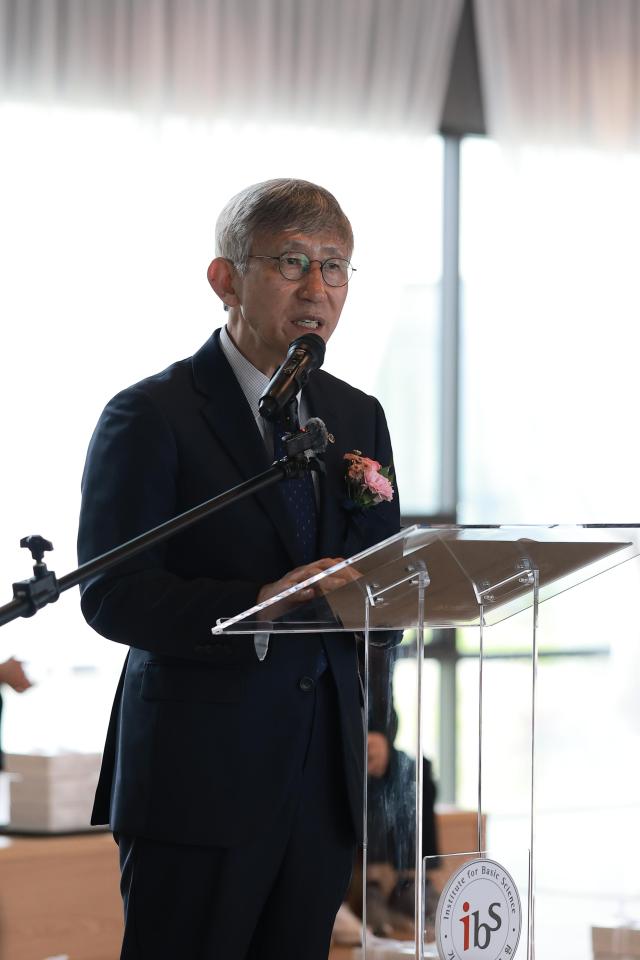
"At the forefront of knowledge, what matters most is 'who poses innovative questions and suggests new directions.' The Institute for Basic Science (IBS) will establish more than 10 'pioneer research teams' to strengthen its role as a hub for new discoveries and concepts," Jang Seok-bok, the newly appointed director of IBS, stated during his inauguration ceremony held at the IBS headquarters in Daejeon on June 4. The event was attended by key figures including Choi Young-ki, director of the Korea Virus Research Institute, Choi Yoon-sung, director of the National Institute for Mathematical Sciences, and Kwon Myun, acting director of the Heavy Ion Research Institute, along with IBS team leaders and members.
Jang, who has been a prominent researcher since being appointed as a team leader at the inception of IBS in 2012, has led the Molecular Activation Catalysis Research Team and contributed significantly to the growth and development of IBS. His term as director will last from June 2026 to June 2031.
In his inaugural address, Jang emphasized that IBS has accumulated world-class research capabilities over the past 15 years and must now focus on new discoveries and concepts as its core values, moving beyond mere excellence. He outlined a vision for IBS to evolve into a 'Discovery Hub' that explores uncharted territories and proposes new questions and research directions, rather than just accumulating results in established fields.
To achieve this, he proposed several key operational directions, including the introduction of pioneer research teams, the establishment of an open research system, strengthening the competitiveness of the headquarters and research infrastructure, presenting future-oriented research directions, and fostering a healthy organizational culture based on public trust.
Drawing from his experience in identifying and nurturing young researchers, Jang announced plans to support innovative researchers through the establishment of 'pioneer research teams' and enhance the system for talent discovery and development. He also mentioned expanding flexible collaborations with domestic and international universities, research institutes, and industries to build an open research ecosystem.
Jang highlighted the importance of strengthening research competitiveness centered around the headquarters, stating that the newly constructed second building will create an environment that attracts outstanding researchers from both domestic and international backgrounds. He expressed commitment to expanding research infrastructure and ensuring that the heavy ion accelerator becomes a prominent research facility utilized by researchers worldwide.
Additionally, he outlined plans to actively expand future research areas such as quantum science, systems biology, synthetic biology, and new materials, while proactively responding to changes in research environments driven by computing, machine learning, and artificial intelligence.
"A research culture that does not fear failure, combined with stable yet bold administrative and technical support, is essential for the emergence of an outstanding research institute," Jang stated. "I will do my utmost to ensure that IBS grows into a research institution that earns the trust and support of the public and sets a new direction for global science."
IBS was established in November 2011 to conduct world-class basic science research. The Ministry of Science and ICT expressed optimism about Jang's appointment, noting that his academic authority and extensive experience in research will contribute to IBS's advancement as a leading global research institution and the development of the domestic basic science research ecosystem.
* This article has been translated by AI.
Copyright ⓒ Aju Press All rights reserved.