


NVIDIA CEO Jensen Huang's visit to South Korea has prompted major business leaders in the country to gather for discussions.
Just a decade ago, NVIDIA was primarily known as a manufacturer of graphics cards for gaming. However, with the advent of generative artificial intelligence (AI), the company has transformed into a key provider of infrastructure for the global AI industry, closely linking with South Korean semiconductor and IT firms.
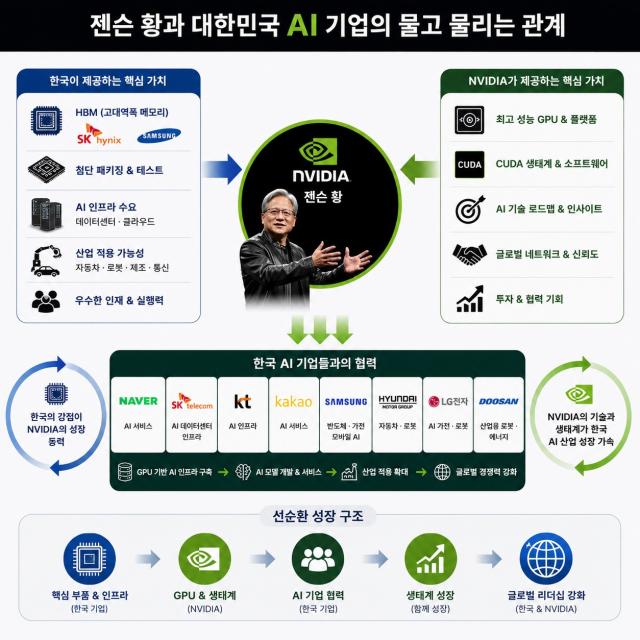
SK Hynix and Samsung Electronics are now major partners for NVIDIA, supplying high-bandwidth memory (HBM), a critical component for AI semiconductors. Domestic companies like Naver and LG are also expanding their collaboration with NVIDIA as they work on building AI data centers and implementing sovereign AI strategies.
Industry experts view Huang's visit as more than just a friendly meeting; it is seen as a step toward strengthening AI supply chain collaboration. NVIDIA requires a stable HBM supply chain, while South Korean firms are eager to leverage NVIDIA's AI infrastructure and technology to remain competitive in the global AI landscape.
Huang's long-term strategy has positioned NVIDIA at the center of the AI industry. Founded in 1993, NVIDIA initially focused on designing graphics processing units (GPUs) for PCs, which were then seen primarily as auxiliary chips for smooth gaming visuals. Huang recognized the potential of GPUs for large-scale parallel computing and identified them as a key asset for future computing.
This vision culminated in the launch of CUDA in 2006, a programming platform that allowed GPUs to be used beyond graphics processing for scientific calculations and machine learning. Initially met with skepticism, the landscape shifted dramatically in 2012 when the University of Toronto's deep learning model, AlexNet, won the ImageNet Large Scale Visual Recognition Challenge using NVIDIA GPUs. This success confirmed GPUs as essential tools for AI advancement.
Subsequently, global AI companies like Google, Meta, and OpenAI adopted GPU-based learning systems, establishing CUDA as the de facto standard for AI development. Today, millions of researchers and developers worldwide build AI solutions within the NVIDIA ecosystem.
As a result, NVIDIA is now regarded as the dominant player in the AI accelerator market for data centers. While major tech companies like Google, Meta, and Microsoft are developing their own AI chips, analysts suggest that replacing NVIDIA's comprehensive hardware, software, and developer ecosystem will be a significant challenge.
For South Korean firms, NVIDIA represents more than just a business partner; it is a critical player in the AI infrastructure landscape. Collaborations across semiconductors, cloud services, data centers, and AI services are directly linked to competitive advantage.
Recently, Huang emphasized the importance of national AI capabilities, stating, "No country can import intelligence 100%." This underscores the significance of strengthening AI supply chain partnerships with South Korean companies during his visit.
* This article has been translated by AI.

Copyright ⓒ Aju Press All rights reserved.