

"We plan to continue expanding the AIDC based in Paju in the future."
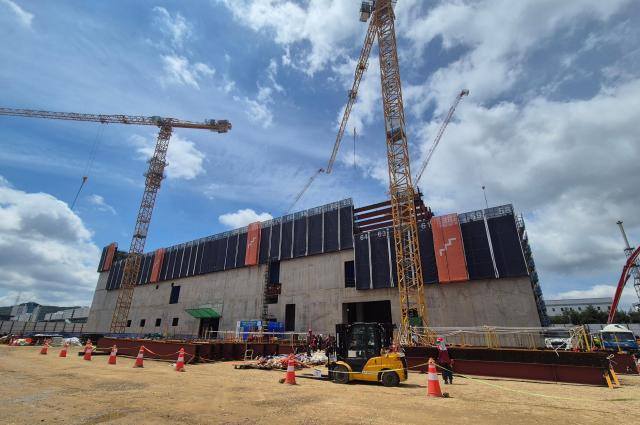
On June 5, at the construction site of LG Uplus's Paju AIDC, workers donned hard hats as they entered a site still dominated by concrete frames and steel structures. By 2027, this facility is set to transform into the largest AIDC in the Seoul area, capable of accommodating over 100,000 servers with a power capacity of 200 megawatts (MW).
During a press briefing held at the site, Ahn Hyung-kyun, head of LG Uplus's Enterprise AI Business Group, stated, "We aim for 5 trillion won in contract revenue over the next five years and an annual growth rate of 15-20%."
The motivation behind LG Uplus's large-scale AIDC construction in Paju stems from changes in the AI market. Ahn noted, "As AI demand shifts from learning-based to inference-based, we are entering an era where customers are rapidly adopting AI technology."
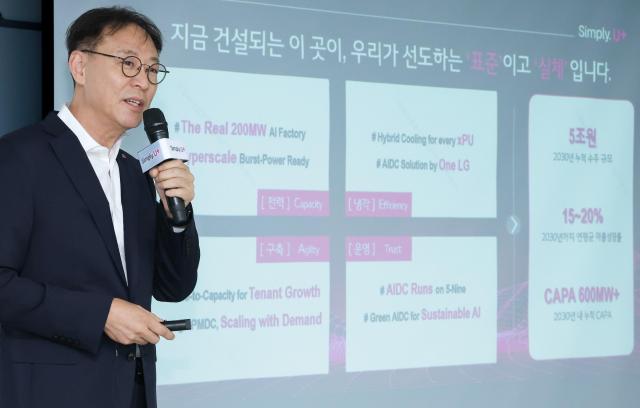
LG Uplus emphasized the need for rapid AI infrastructure supply. While graphics processing units (GPUs) can be secured within months, building a data center to accommodate them typically takes 3-4 years. Ahn assessed, "As AI services increase, there is a need for new infrastructure standards that possess real competitive advantages in power, cooling, construction, and operational capabilities."
To address this, LG Uplus will adopt a standard modular data center (PMDC) approach that enhances construction speed and scalability. This method involves pre-manufacturing key equipment and assembling it on-site, allowing for infrastructure expansion tailored to customer demand.
The Paju AIDC is being developed as the largest data center in the Seoul area, with a power supply capacity of 200 MW. According to LG Uplus, this is sufficient to accommodate approximately 70,000 NVIDIA Blackwell GPUs.
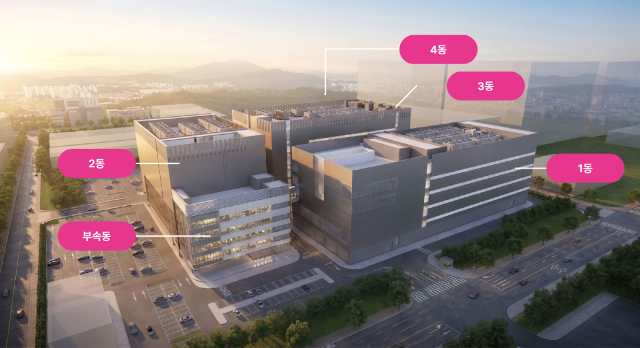
Plans for business expansion are also taking shape. Currently, one building (50 MW) has secured customers, while discussions are ongoing with potential clients for buildings two through four.
Ahn stated, "We are in talks with customers who have actual demand for buildings two through four, and we are preparing our business while providing the necessary specifications to our clients." He added, "Our goal is to eventually expand the AIDC capacity to 600 MW."
A key focus at the site was cooling technology. AI servers have higher power density and heat generation than standard servers, making cooling technology increasingly critical as next-generation GPUs emerge.
The Paju AIDC was designed with liquid cooling in mind from the outset. The building's load, piping, and waterproofing were all configured to accommodate a liquid cooling environment. It is designed to support various AI semiconductors, including GPUs and neural processing units (NPUs). Ahn remarked, "Air cooling is nearing its physical limits; the Paju AIDC is designed with a hybrid structure that supports both air and liquid cooling."
Jeong Sook-kyung, who oversees the AIDC business at LG Uplus, revealed plans to develop the Paju AIDC into a testing hub for a "Korean-style AI Data Center (K-AIDC)."
To achieve this, LG Uplus intends to build the Paju AIDC as a culmination of "One LG" technologies. This will integrate LG Electronics' liquid cooling technology and chillers, LG Energy Solution's UPS batteries, and LS Electric's power solutions to establish the core infrastructure for the AI data center.
The initiative goes beyond merely applying affiliate equipment. It will also serve as a proof-of-concept data center to validate the performance and reliability of domestic solutions in real-world environments for major tech clients.
Jeong stated, "Big tech clients have hundreds of technical requirements," adding that the Paju AIDC will play a role in verifying the performance and reliability of domestic solutions.
Ahn emphasized, "Ultimately, the key is uninterrupted reliability," asserting that the Paju AIDC will provide infrastructure that allows businesses and customers to confidently utilize AI.
* This article has been translated by AI.

Copyright ⓒ Aju Press All rights reserved.