

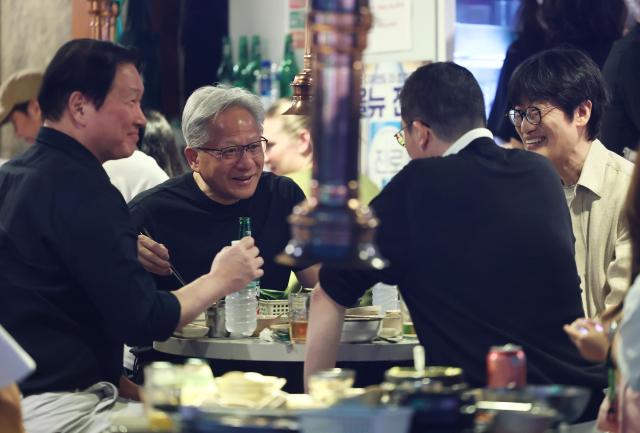
In the first weekend of June 2026, a humble pork belly restaurant in Seoul unexpectedly drew global attention. The reason? Jensen Huang, CEO of NVIDIA and a leader in the AI revolution, was seated among the bustling after-work crowd. Dressed in a black leather jacket, he was grilling pork belly and sharing drinks with officials from LG Electronics, Naver, and SK Hynix, all while smiling brightly. At first glance, he appeared to be just another office worker enjoying dinner with old friends, but he is, in fact, one of the most scrutinized figures in the global capital markets.
Interestingly, this scene was no coincidence. Huang has long demonstrated a unique management style. He has been spotted enjoying pepper buns at night markets in Taiwan, visiting hawker centers in Singapore, and dining at modest ramen shops in Japan. In Hong Kong, he frequents local favorites, and in Korea, he opts for pork belly. What drives a billionaire CEO to seek out street food and casual dining? Is it merely a matter of taste, or is there a deeper strategy and philosophy at play?
His appearance at the Seoul pork belly restaurant was far from the typical image of a global corporate leader. Smoke from grilling meat wafted through the air as busy waitstaff rushed to serve plates. Huang flipped the meat with a smile, and those at the table engaged in lively conversation. He resembled a neighborhood big brother rather than the head of the world’s leading AI company. Yet, it was this very naturalness that resonated with people. While discussions about AI and semiconductors may be complex, the act of sharing a meal of pork belly is universally relatable.
Global Dining Patterns
A closer look at Huang's dining choices reveals a consistent pattern.
First, he seeks out supply chain hubs. Taiwan, where he enjoys pepper buns, is the center of the world's largest foundry industry, while Korea, where he dines on pork belly, is a leading producer of high-bandwidth memory (HBM). Singapore serves as a hub for the data center industry, and Japan is critical for advanced materials and equipment. In other words, Huang's dining venues are not merely tourist spots but the heart of the AI industry's supply chain.
Second, he opts for casual dining over fine dining. While many global CEOs might prefer high-end hotel banquets or private dinners, Huang takes the opposite approach. He enters spaces filled with the aroma of home-cooked meals. Pork belly, noodles, and ramen are universally understood languages. While advanced AI technology may be complex, food is simple. People may not remember the structure of a data center, but they will recall grilling pork belly.
Third, he always engages in fan service. At the Computex event in Taiwan, he is surrounded by admirers like a rock star. Young developers and students line up for his autograph and wait long to take a photo with him. Such scenes are rare for a corporate CEO. However, today, Huang has become a symbol of the AI revolution.
Dining as Supply Chain Diplomacy
Many view dining as simply a meal. However, in the international business world, meals often hold more significance than meetings. Historically, important diplomatic breakthroughs have frequently occurred over dinner rather than in conference rooms.
The corporate world is no different. Huang's dining experiences can be seen as a form of supply chain diplomacy. He bridges gaps with people through food, setting aside complex technical jargon and contracts to engage in human-to-human interactions. It is in these moments that the future direction of industries is discussed.
People see pork belly, but what is truly in motion is a supply chain worth trillions. They see pepper buns, but behind them, the future of the AI industry is being shaped. While dining may appear as a friendly cultural activity, it encapsulates cold industrial strategies and global management philosophies.
Why People Adore Jensen Huang
Why do people today idolize Jensen Huang? It is not solely because he is a successful businessman. Many wealthy individuals and famous CEOs exist, yet not all become public stars.
People appreciate Huang because he comes across as relatable. He does not present himself as a special figure. He wears a black leather jacket, eats street food, and takes photos with ordinary people. Despite being the CEO of a leading global company, he maintains an approachable demeanor.
Another key reason is his ability to articulate a vision for the future. He does not stop at explaining GPUs; he illustrates the world that AI will create. He sells dreams rather than just technology, sharing visions instead of mere numbers. People are moved by stories rather than technology and are inspired by hope rather than data. Huang understands this better than anyone.
Lessons for Korean Leaders
Here lies a point for leaders in our society to reflect upon. Today, many politicians, business leaders, and public officials are becoming increasingly distant from the public. While explanations have increased, empathy has diminished; authority remains, but approachability has faded. Citizens no longer respect titles alone, nor do they trust power alone. They seek authenticity and communication skills.
Of course, leaders cannot gain popularity simply by forcing themselves to dine with the public. The key lies in attitude. It is essential to strive to connect with people, to align with the perspectives of citizens and customers, and to choose communication over authority.
This is especially important for leaders in their 40s, 50s, and 60s. As people age, they tend to rely on past successes and depend on titles and authority. However, the AI era is not one of authority but of connection. It is not a time for commands but for empathy. Leadership that fails to win the hearts of citizens, customers, employees, and citizens will not endure.
A New Textbook for Leadership in the AI Era
AI is transforming the world. Paradoxically, the value of humanity becomes even more crucial in the AI era. Technology may advance, but people still find inspiration in other people. Algorithms can calculate but cannot empathize. Artificial intelligence can provide information but cannot build trust.
Thus, leaders in the AI era must possess both technological and human qualities. They should be able to discuss the world’s best technologies while sharing laughs over pork belly, negotiate multi-billion-dollar deals while taking selfies with students, and plan for the future without forgetting the people of the present.
Today, South Korea stands at a significant crossroads. AI is not merely a technological revolution; it is a civilizational shift that alters the order of industry, economy, politics, education, culture, and daily life. The leadership required in this era is neither the authoritative leadership of the past industrial age nor the popularity-driven leadership that merely chases public acclaim. It demands insight that can breathe with the people while looking toward the future, strategic thinking that can align with the direction of the nation and businesses while connecting with individuals, and a sense of balance that understands advanced technology without losing sight of humanity.
Huang's pork belly and pepper buns may not just be about food. They could be a metaphor for the new leadership required in the AI era. The image of a CEO of a leading global company laughing and taking photos with street people, enjoying food at night markets, and engaging casually with supply chain partners illustrates that, no matter how advanced technology becomes, the true power that moves the world lies with people.
AI can mimic human intelligence but cannot replace human trust. Ultimately, it is not technology itself that determines the future but the people who use that technology and the leadership that guides them.
South Korea now faces the same question. What kind of leader do we want in the AI era? What kind of entrepreneur do we respect? What kind of society do we wish to create? Will it be a leadership that reigns over people with authority and distance, or a leadership that enters the community, breathes with the people, and designs the future together?
The outcome of the AI revolution will not be determined solely by the performance of semiconductors or the scale of data centers. The ultimate measure of national competitiveness will be how much leadership understands people, connects with them, and nurtures their potential.
The reason a piece of pork belly and a pepper bun became global topics is precisely that. As the AI era deepens, the value of humanity grows. For South Korea to remain a respected nation in the world, it must evolve into a country of leadership that embodies dignity and trust beyond being a technological powerhouse. This may be the most unexpected yet profound message left by Jensen Huang's dining experiences.
* This article has been translated by AI.
Copyright ⓒ Aju Press All rights reserved.