

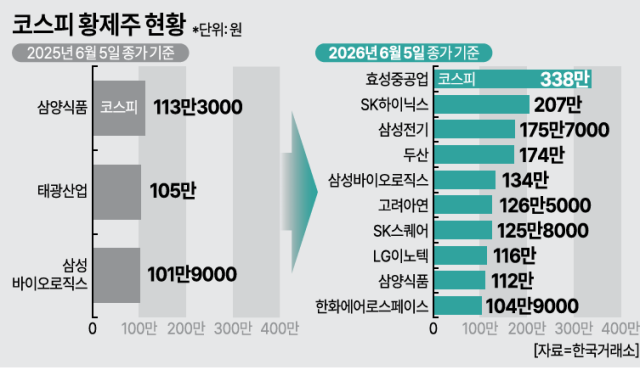
The landscape of 'emperor stocks'—shares priced over 1 million won—in South Korea has changed significantly over the past year. The number of these stocks has increased from three last year to ten this year. Many of the newly added stocks are related to artificial intelligence (AI), power infrastructure, and defense sectors.
According to the Korea Exchange, as of June 5 last year, the emperor stocks on the KOSPI market included Samyang Foods, Taekwang Industrial, and Samsung Biologics. In contrast, as of June 5 this year, the list has expanded to include Hyosung Heavy Industries, SK Hynix, Samsung Electro-Mechanics, Doosan, Samsung Biologics, Korea Zinc, SK Square, LG Innotek, Samyang Foods, and Hanwha Aerospace.
The number of emperor stocks has more than tripled in just one year. Many of the newly added stocks are leading players that have driven the domestic market recently. SK Hynix is considered a major beneficiary of the surge in demand for AI semiconductors, particularly high-bandwidth memory (HBM). Samsung Electro-Mechanics and LG Innotek have also seen their stock prices rise due to expectations for high-performance substrates and components for AI servers. SK Square has benefited from the increased value of its stake in SK Hynix.
Hyosung Heavy Industries, a player in the power infrastructure sector, has surged due to the global expansion of data centers and increased investment in power grids. Hanwha Aerospace has joined the emperor stocks list amid rising global defense demand and expectations for increased orders. Analysts suggest that the emperor stocks list, which was previously dominated by domestic consumer goods and long-term blue-chip stocks, is being reshaped around AI infrastructure and advanced industries, indicating a new growth theme in the domestic market.
However, with the recent sharp rise in AI-related stocks, concerns about increased short-term volatility have also been raised. If stock prices rise excessively, individual investors may find it difficult to access these stocks, leading to limited trading volumes. Given that the price of some stocks reaches several million won, it is challenging for individual investors to engage in fractional buying.
Lee Kyung-min, a researcher at Daishin Securities, stated, "While Broadcom's AI revenue met market expectations, future guidance fell short, raising doubts about profit forecasts for the semiconductor sector. As profit-taking pressure increases following the recent surge, stock price volatility may rise in the short term."
* This article has been translated by AI.

Copyright ⓒ Aju Press All rights reserved.