

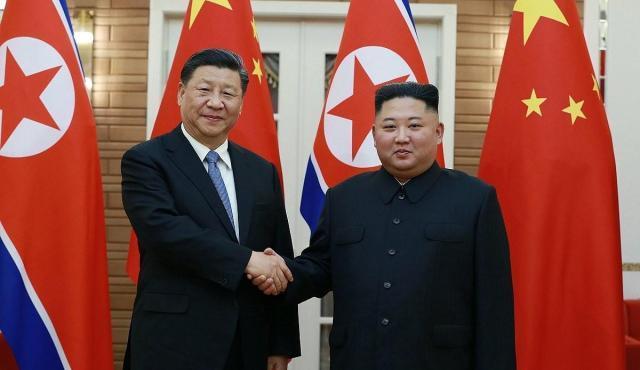
Chinese President Xi Jinping, on his first visit to Pyongyang in seven years, emphasized the importance of strategic communication and cooperation with North Korea while expressing a commitment to advancing global multipolarity.
In an op-ed published on the front page of the North Korean ruling party's newspaper, the Rodong Sinmun, Xi stated, "We must strengthen strategic communication and cooperation in line with the trends of the times, and jointly uphold the international order based on international law and the United Nations as its core."
He added, "We must oppose hegemony and power politics, and reject all ambitions and actions that threaten regional security and stability," calling for a joint effort to promote a multipolar world that is equitable and inclusive in economic globalization.
Xi's reference to 'global multipolarity' aligns with China's foreign strategy aimed at challenging U.S. hegemony, while his mention of 'revival of militarism' is interpreted as a warning against Japan's military expansion.
He urged the implementation of four global initiatives, which appear to refer to his proposals for a Global Security Initiative (GSI), Global Development Initiative (GDI), Global Civilization Initiative (GCI), and Global Governance Initiative (GGI) that he has advocated since the 2020s.
Xi emphasized that the traditional friendship between China and North Korea remains "unbreakable, regardless of how times change and international circumstances evolve."
He stated, "The highest-level strategic guidance is the greatest advantage of China-North Korea relations," asserting that the leaders' direction ensures that the 'great ship' of China-North Korea relations will bravely advance through winds and waves.
Xi also highlighted the historical significance of high-level strategic cooperation, stressing the need to firmly support the protection of national sovereignty, security, and development interests, while jointly safeguarding regional peace, international fairness, and the post-war international order.
Although Xi did not directly address inter-Korean relations, denuclearization, or issues related to the Korean Peninsula, he emphasized the importance of supporting each other in following a socialist path suited to their respective national conditions to ensure political security for both countries.
This could be interpreted as a tacit endorsement of North Korea's ongoing nuclear development and its hostile stance toward South Korea, despite strong opposition from the international community.
Xi also mentioned the potential for strengthening military cooperation between the two countries in light of the upcoming 65th anniversary of the signing of the China-North Korea Treaty of Friendship, Cooperation, and Mutual Assistance on July 11.
He stated, "On the occasion of the treaty's 65th anniversary, we will enhance communication and exchanges across various sectors and levels between our parties, governments, and militaries, injecting strong momentum into the development of China-North Korea relations by effectively implementing our important common understandings."
Xi referred to China's 15th Five-Year Plan and North Korea's recently concluded 9th Party Congress, expressing a desire to combine the development strategies of both countries, mobilize cooperation potential in various fields, and share opportunities for mutual development to benefit both peoples.
Professor Lim Eul-chul from Kyungnam University’s Institute for Far Eastern Studies analyzed that, "In the past, military closeness was often downplayed in favor of party and government exchanges due to considerations of relations with the U.S. and international scrutiny. This time, however, the emphasis on 'military exchanges' as a core diplomatic issue marks a significant shift and distinction."
In an op-ed published on the front page of the North Korean ruling party's newspaper, the Rodong Sinmun, Xi stated, "We must strengthen strategic communication and cooperation in line with the trends of the times, and jointly uphold the international order based on international law and the United Nations as its core."
He added, "We must oppose hegemony and power politics, and reject all ambitions and actions that threaten regional security and stability," calling for a joint effort to promote a multipolar world that is equitable and inclusive in economic globalization.
Xi's reference to 'global multipolarity' aligns with China's foreign strategy aimed at challenging U.S. hegemony, while his mention of 'revival of militarism' is interpreted as a warning against Japan's military expansion.
He urged the implementation of four global initiatives, which appear to refer to his proposals for a Global Security Initiative (GSI), Global Development Initiative (GDI), Global Civilization Initiative (GCI), and Global Governance Initiative (GGI) that he has advocated since the 2020s.
Xi emphasized that the traditional friendship between China and North Korea remains "unbreakable, regardless of how times change and international circumstances evolve."
He stated, "The highest-level strategic guidance is the greatest advantage of China-North Korea relations," asserting that the leaders' direction ensures that the 'great ship' of China-North Korea relations will bravely advance through winds and waves.
Xi also highlighted the historical significance of high-level strategic cooperation, stressing the need to firmly support the protection of national sovereignty, security, and development interests, while jointly safeguarding regional peace, international fairness, and the post-war international order.
Although Xi did not directly address inter-Korean relations, denuclearization, or issues related to the Korean Peninsula, he emphasized the importance of supporting each other in following a socialist path suited to their respective national conditions to ensure political security for both countries.
This could be interpreted as a tacit endorsement of North Korea's ongoing nuclear development and its hostile stance toward South Korea, despite strong opposition from the international community.
Xi also mentioned the potential for strengthening military cooperation between the two countries in light of the upcoming 65th anniversary of the signing of the China-North Korea Treaty of Friendship, Cooperation, and Mutual Assistance on July 11.
He stated, "On the occasion of the treaty's 65th anniversary, we will enhance communication and exchanges across various sectors and levels between our parties, governments, and militaries, injecting strong momentum into the development of China-North Korea relations by effectively implementing our important common understandings."
Xi referred to China's 15th Five-Year Plan and North Korea's recently concluded 9th Party Congress, expressing a desire to combine the development strategies of both countries, mobilize cooperation potential in various fields, and share opportunities for mutual development to benefit both peoples.
Professor Lim Eul-chul from Kyungnam University’s Institute for Far Eastern Studies analyzed that, "In the past, military closeness was often downplayed in favor of party and government exchanges due to considerations of relations with the U.S. and international scrutiny. This time, however, the emphasis on 'military exchanges' as a core diplomatic issue marks a significant shift and distinction."
* This article has been translated by AI.

Copyright ⓒ Aju Press All rights reserved.