

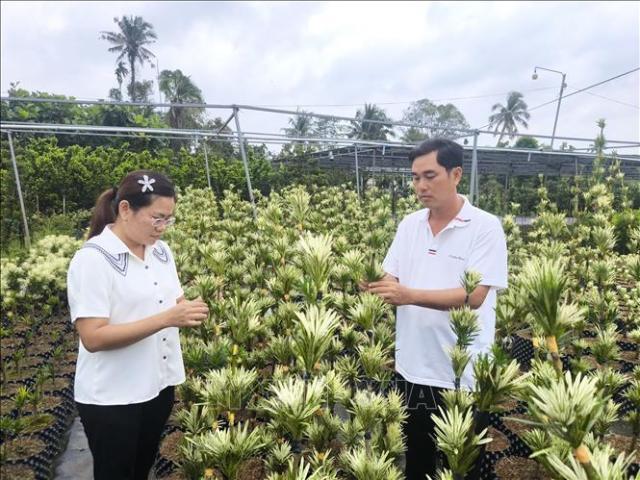
According to reports from Vietnamese media outlets like Tuoi Tre, a farmer with 40 years of experience recalled how the return of young farmers changed his perspective. "I grew up working in the fields with my parents and continued to live off the land left by my grandparents. Terms like digital transformation, e-commerce, traceability, and sustainable development seemed distant and unfamiliar to me." His mindset shifted not due to catchy slogans but through tangible changes.
"The answers we couldn't find in the soil, the youth brought back"
Traditionally, Vietnamese farmers focused solely on production. While they were accustomed to planting, nurturing, and harvesting, the sales and consumer engagement aspects were foreign to them. Most agricultural products were sold to middlemen at fluctuating market prices, meaning that even in years of abundant harvests, income remained stagnant if prices fell.
The return of young farmers is beginning to change this structure. Through local digital transformation training programs, they taught farmers how to record production logs using smartphones. They also showed them how to create social media accounts to communicate directly with consumers and conduct live sales broadcasts. Farmers learned effective photography techniques for their products and how to document the production process through videos to reach a wider audience.
One young farmer noted, "At first, many were hesitant, saying it was difficult to learn technology at their age, but as the youth patiently assisted them, they gradually became more comfortable." As a result, products that were once sold only locally began reaching other provinces, cities, and major export partners, significantly increasing farmers' incomes.
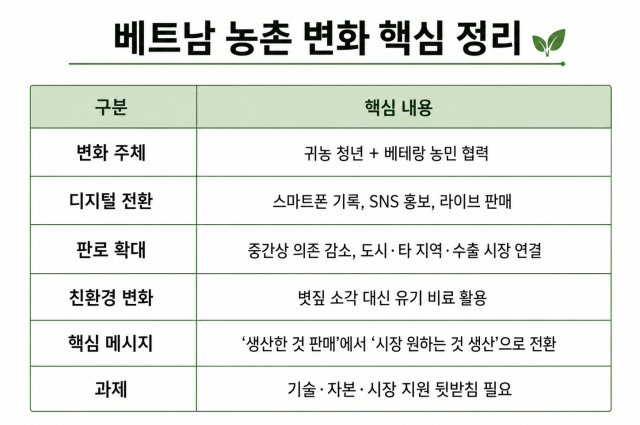
The youth have not only expanded market access but also shifted the perspective on agricultural products. They emphasize the 'story' behind the products, advocating for the importance of conveying the organic cultivation process, local culture, and the producer's philosophy. This focus on transparent origin information and traceability enhances trust and becomes a key factor in price competitiveness.
Environmental changes have also emerged. Burning rice straw after harvest has long been a common practice in rural Vietnam, seen as a quick way to clear fields. Young farmers have educated their communities about the potential for rice straw to contribute to air pollution and greenhouse gas emissions, teaching them how to create organic fertilizers from agricultural byproducts like rice straw and fallen leaves. What was once waste has now become a resource. As the use of chemical fertilizers decreases and organic fertilizers and eco-friendly products increase, production costs have been reduced, contributing to soil and water resource protection.
A farmer with 40 years of experience stated, "What the youth bring back to their hometown is not just technology or large projects, but the belief that farmers can handle technology effectively." He added, "If we invest properly, Vietnamese agricultural products can achieve higher value." He emphasized that true sustainable value is created when the knowledge and skills of the youth combine with the production experience and love for the land held by farmers.
There are even cases of young people who studied abroad returning to lead the digital transformation of agriculture. Dang Zuong Minh Hoang, a graduate of the prestigious Grenoble Institute of Technology in France, returned to his hometown in Dong Nai province, leaving behind a stable life overseas. He introduced solar power, IoT-based automatic irrigation, drone pest control, and a QR code traceability system to his family farm.
Hoang established electronic farming logs for each crop, allowing consumers to verify the production, management, harvesting, and transportation processes. His organic pepper and avocados meet U.S. and European market standards and have entered international distribution networks. Hoang asserted, "If we learn technology properly and apply it meticulously, Vietnamese farmers can compete effectively in the global market."
Seminar in Vinh Long Province: "The era of selling what we produce is over"
Recently, a large seminar focused on transforming agricultural mindsets was held in Vinh Long province. The Vinh Long Farmers' Association hosted the seminar on June 3 at the Long Ho Yong An Orchard, gathering over 300 representatives from local businesses and farmers' cooperatives, along with officials from relevant departments.
The seminar discussed the development of specialized agricultural personnel linked to cooperatives, the promotion of agricultural tourism, the establishment of agricultural value chains, and the future directions for agricultural development in Vinh Long province.
In this context, former Vice Chairman of the National Assembly Le Minh Hoan emphasized that farmers must be the main agents in the agricultural transformation process. He pointed out that agriculture needs to move away from a simple production focus, stating, "We should not just produce what we have, but rather what the market needs."
Hoan urged a shift in thinking from producing what farmers possess to producing what the market desires, highlighting quality control, traceability, brand building, and enhancing the added value of agricultural products through cooperative connections as key tasks. He also suggested creating a multi-value agricultural model that combines production with tourism, experience, education, and services to generate additional income and enhance competitiveness.

Netizens: "Youth is Hope"... Calls for Support
In response, netizens have expressed positive reactions. One user noted, "Sustainable development requires not only the efforts of the youth but also capital, technology, and market support." Another commented, "When the energy of youth combines with science and technology, along with field experience, tremendous value can be created."
Others remarked, "It's inspiring to see young people returning to contribute to their hometowns," and "Technology is essential for cost reduction and quality improvement." There are also analyses suggesting that modern agriculture cannot rely solely on traditional experience, emphasizing the necessity of data and automation technology.
Meanwhile, Vietnam's rural areas are entering a new phase of agriculture where the skills of youth meet the experience of farmers. In an era where the boundaries between urban and rural are blurring, the future of agriculture depends on intergenerational collaboration and a shift in mindset, a message gaining traction locally.
* This article has been translated by AI.

Copyright ⓒ Aju Press All rights reserved.