

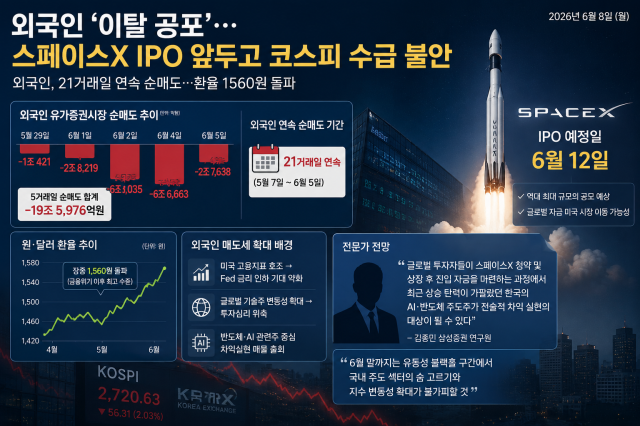
On June 8, the Korean stock market experienced a sharp decline, driven by foreign investors who have been selling off their holdings. This month alone, foreign investors have sold approximately 20 trillion won. While analysts suggest this is not a case of a "sell Korea" trend but rather a necessary adjustment following a rapid rise in the market, it has nonetheless heightened fears among investors. Concerns are growing that supply and demand instability surrounding the KOSPI will increase as the SpaceX initial public offering (IPO) approaches on June 12.
According to the Korea Exchange, foreign investors recorded net selling for five consecutive trading days from May 29 to June 5, amounting to a total of 19.6 trillion won. On June 8, they sold an additional 3.748 trillion won worth of stocks.
This foreign selling trend is not seen as a short-term phenomenon. Since the KOSPI stabilized around the 7,000 mark on May 7, foreign investors have been net sellers for 21 consecutive trading days. The recent rise in the won-dollar exchange rate, which surpassed 1,560 won during trading, has reached its highest level since the financial crisis, leading market observers to view the increased foreign selling as a contributing factor to the won's depreciation.
The decline in foreign investor sentiment is attributed to the strong U.S. employment data, which has diminished expectations for interest rate cuts by the Federal Reserve, alongside increased volatility in global tech stocks. Analysts note that profit-taking activities, particularly in semiconductor and AI-related stocks that had driven the recent KOSPI gains, have contributed to the heightened foreign selling.
The upcoming SpaceX IPO on June 12 is considered a major variable for short-term supply and demand. With the largest-ever public offering on the horizon, there are concerns about potential capital reallocations by global investors, which could further impact foreign demand in the domestic market.
Kim Jong-min, a researcher at Samsung Securities, stated, "Given that this is the largest mega IPO in history, it could act as a disruptive factor for supply and demand in the domestic market in the short term. Global investors may target Korean AI and semiconductor stocks for tactical profit-taking as they prepare funds for the SpaceX subscription and post-listing investments." He added, "Until the end of June, we can expect a liquidity black hole period, leading to a necessary pause for the leading sectors in Korea and increased volatility in the index."
* This article has been translated by AI.
Copyright ⓒ Aju Press All rights reserved.