

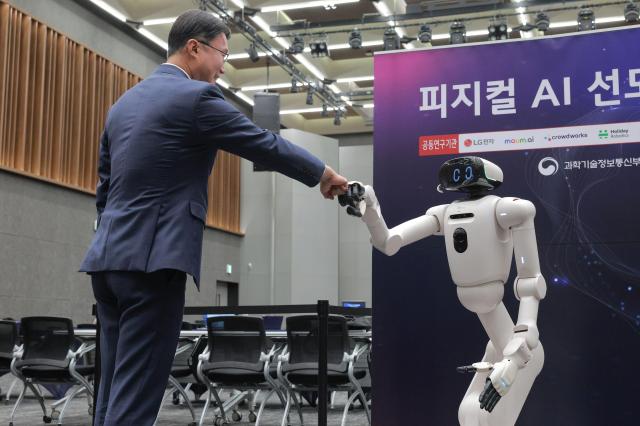
A white robot, about the height of a person, extended its fist and formed a heart shape with its hands. As it moved its head from side to side toward the audience, attendees captured the moment on their phones. This was LG's robot, Chloe, showcased to demonstrate its ability to recognize its surroundings and interact with people.
The launch event for the Physical AI Development Project took place on June 9 at LG Science Park in Magok, Seoul. The event featured next-generation technologies poised to lead South Korea's physical AI industry.
Following Chloe's demonstration, the semi-humanoid robot AI Worker, developed by Roboteers, made its appearance. This time, the focus was on its operational capabilities. Wearing a VR headset, an operator moved their hands, and the AI Worker mimicked those movements with its robotic arm from several meters away. The robot picked up an object from a table, moved it to another location, and set it down, demonstrating its dexterity with fingers that adjusted grip strength to handle the object.
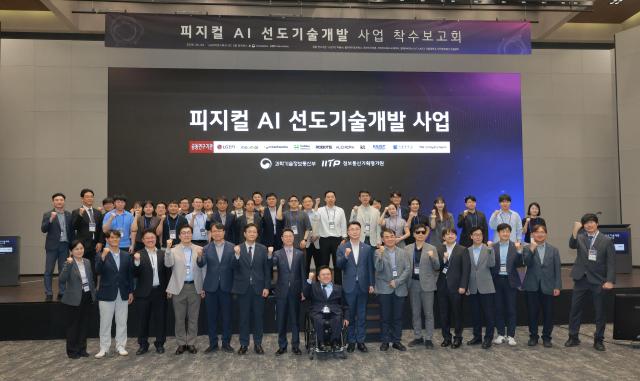
The event was organized by the Ministry of Science and ICT and the Institute of Information and Communications Technology Planning and Evaluation (IITP) to officially launch the Physical AI Development Project and share the direction of related technology development.
Physical AI is a key mission of the national innovation project "K-Moonshot," announced by the government earlier this year. While generative AI focuses on creating text and images, Physical AI is seen as the next-generation technology that enables AI to perceive, judge, and act in real physical environments, potentially transforming the manufacturing, logistics, mobility, and robotics industries.
The Ministry plans to reduce reliance on foreign physical AI simulation platforms and secure independent world model technology through this project. World models help AI learn the physical laws and environmental changes of the real world in a virtual space, serving as a crucial foundation for implementing next-generation physical AI foundation models.
Ryu Je-myung, Deputy Minister of Science and ICT, stated, "Korea is at a pivotal moment where it can lead the Physical AI era, possessing both manufacturing competitiveness and AI capabilities. We believe this is a golden opportunity, and the government is focusing its policy efforts on establishing strategies and fostering ecosystems related to this field."
He added, "In the future, general models will evolve beyond simple task execution to become agents that can independently assess situations and achieve goals. To achieve this, securing synthetic data and world model technology that can replace and supplement real-world data is essential."
The project will be led by LG Electronics, with participation from ten organizations, including Mind AI, Holiday Robotics, Roboteers, CrowdWorks, Alchera, KT, Korea Advanced Institute of Science and Technology (KAIST), Seoul National University, and the Korea Information and Communication Technology Association.
The Ministry plans to invest a total of 34 billion won over two years to achieve world-class performance in a short period. The goal is to enhance the simulation performance of world models and the transfer performance to robotic foundation models, aiming to improve the success rate of actual robot final actions by 20 percentage points compared to scenarios without world model application.
To achieve this, a demonstration pipeline will be established that connects "world model learning → robotic foundation model linkage → demonstration and performance evaluation → case analysis and re-learning" within the shortest timeframe, with four rounds of repeated verification over two years. In the final stage, the project aims to generate commercially viable outcomes through demonstrations in manufacturing and logistics settings.
* This article has been translated by AI.
Copyright ⓒ Aju Press All rights reserved.