

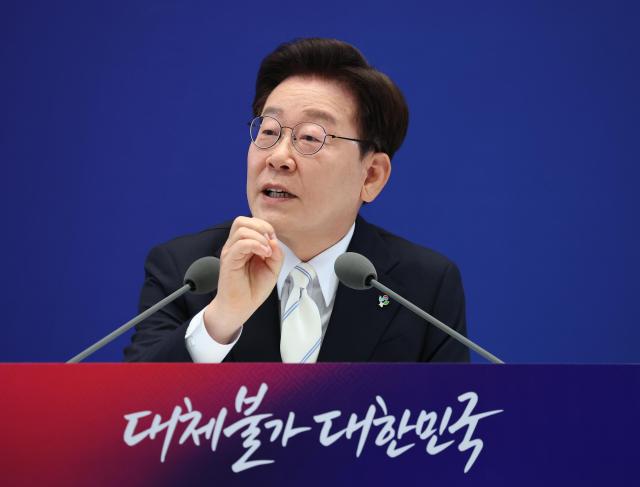
President Lee Jae-myung discussed the growth of the artificial intelligence (AI) industry, wealth distribution, regional development, U.S.-South Korea security negotiations, and North Korea's nuclear issue in an interview with The Economist.
In the interview conducted at the Blue House, President Lee stated that South Korea can move beyond the chaos following former President Yoon Suk Yeol's declaration of martial law and impeachment.
The Economist noted that President Lee has maintained a high approval rating of around 60% a year into his term, bolstered by political stability, a stock market rally, and pragmatic diplomacy.
However, the publication highlighted that addressing the wealth distribution issue stemming from the AI investment boom will be a significant challenge for President Lee during his remaining term. While South Korean semiconductor companies like Samsung Electronics and SK Hynix benefit from increased AI demand, how to distribute the newly created wealth could become a political issue.
In response, President Lee emphasized the need for a new mechanism to distribute some of the excess profits to the general public. The Economist reported that he is considering measures such as basic income payments.
Regional development was also identified as a key issue. The Economist reported that President Lee is encouraging semiconductor companies to establish supply chains in relatively underdeveloped areas. His plan to relocate some administrative functions from the Blue House to an administrative hub south of Seoul is part of this regional development strategy.
In the realm of diplomacy and security, the U.S.-South Korea relationship was a focal point. The Economist assessed that while relations with former President Donald Trump could have been disastrous, President Lee's administration has managed to stabilize ties by committing to increase defense spending to 3.5% of GDP, up from 2.7% last year.
Regarding defense, President Lee stated, "We must directly address our own defense issues." He also mentioned that during U.S.-South Korea tariff negotiations, South Korea secured tariff reductions in exchange for a $350 billion investment commitment to the U.S. The Economist analyzed that President Lee included security goals in this negotiation package, such as acquiring nuclear-powered submarines and capabilities for uranium enrichment and reprocessing spent nuclear fuel for nuclear power generation.
However, President Lee drew a line regarding concerns over nuclear proliferation, explaining that enrichment capabilities would only be used for the low levels required for nuclear power operations. He stated that possessing nuclear weapons is neither desirable nor realistic for South Korea.
On the North Korean issue, President Lee expressed a pessimistic outlook, stating that the likelihood of North Korea abandoning its nuclear weapons has decreased following the Iran war. The Economist reported that North Korea has recently labeled South Korea as an "enemy" and has strengthened ties with Russia, showing little interest in inter-Korean dialogue.
Nevertheless, President Lee remains hopeful about the possibility of breakthroughs through U.S.-North Korea dialogue, noting that former President Trump's "unique personality" could be very helpful in the current situation.
The article also addressed President Lee's personal legal challenges. The Economist pointed out that he took office while facing five trials related to his time as a market and provincial governor, and while these trials were paused during his presidency, they are likely to resurface after he leaves office.
President Lee claims that the charges against him are politically motivated. The Economist highlighted that more than half of South Korea's presidents since democratization have faced impeachment or imprisonment, raising uncertainties about President Lee's future.
In response, President Lee acknowledged that he could also become a victim of this cycle of sacrifice, stating that the likelihood is "quite high." The Economist concluded that President Lee's legacy will depend on whether he can institutionalize political stability and achieve diplomatic and economic successes, thereby breaking the so-called "curse of the Blue House."
* This article has been translated by AI.
Copyright ⓒ Aju Press All rights reserved.