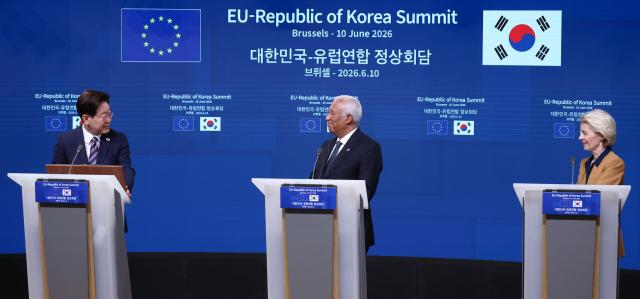
SEOUL, June 11 (AJP) -South Korea and the European Union on Wednesday condemned what they called "Russia-DPRK illegal military cooperation" and unveiled a new strategic partnership on economic security and competitiveness against a backdrop of mounting geopolitical risks straining the global security and economic order amid protracted wars in Ukraine and the Middle East.
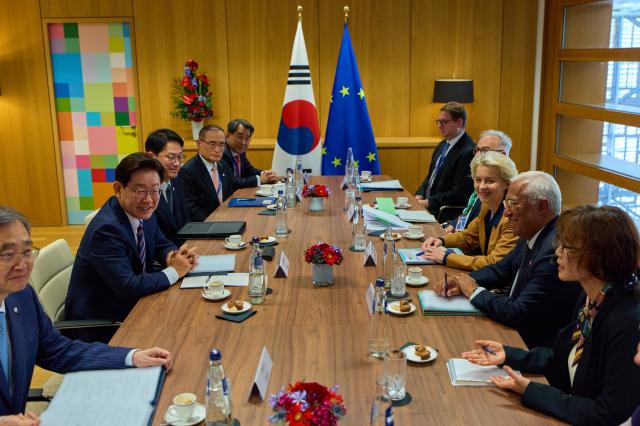
The 11th EU-Republic of Korea Summit brought together President Lee Jae Myung, Ursula von der Leyen and António Costa in Brussels, where the leaders adopted a sweeping joint statement covering security and defense, economic security, digital trade, artificial intelligence, energy cooperation and climate policy.
The summit reflected growing strategic convergence between Seoul and Brussels as Russia's war in Ukraine, North Korea's military support for Moscow, instability in the Middle East and intensifying U.S.-China competition reshape global supply chains, security arrangements and trade flows.
"Korea is one of Europe's closest partners in the Indo-Pacific region and on the global stage," von der Leyen said after the summit. "In today's uncertain world, stable and trusted partnerships like ours are more precious than ever."
The leaders reaffirmed their commitment to "effective multilateralism" and "a stable and predictable rules-based free and fair economic order," underscoring the increasingly strategic nature of EU-Korea relations.
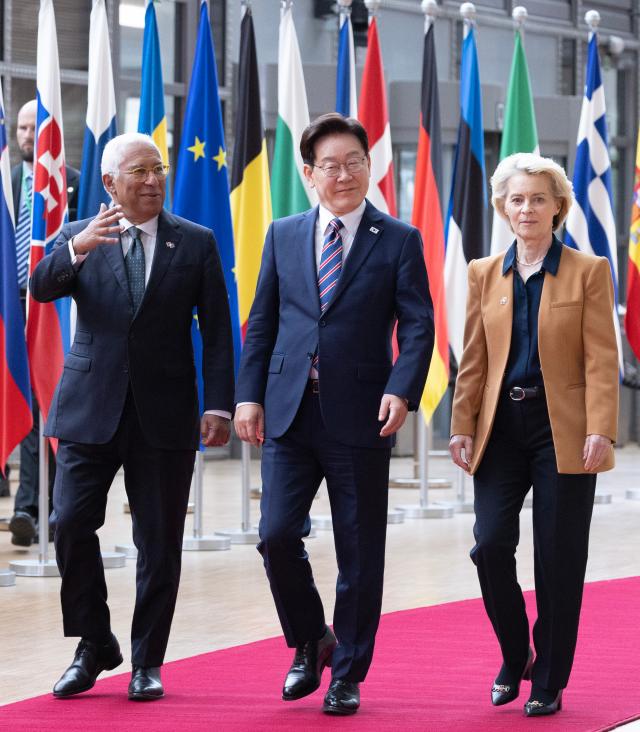
The strongest language in the joint statement was directed at military cooperation between Moscow and Pyongyang.
"We condemn support by third parties, in particular the DPRK, which enable Russia to sustain its war of aggression against Ukraine. We strongly condemn Russia-DPRK illegal military cooperation," the trio said in a joint conference.
The two sides urged Russia and North Korea to "immediately cease all such activities" and comply with the U.N. Charter and all relevant Security Council resolutions.
The statement came amid growing international concern over North Korea's military support for Russia's war effort and the potential transfer of military technologies between the two countries.
The EU and South Korea also reaffirmed support for Ukraine's sovereignty, independence and territorial integrity.
"We stress the importance of a full cease-fire," the statement said, while reiterating support for a "just and lasting peace" and continued assistance for Ukraine's recovery and reconstruction.
"We are committed to support Ukraine's recovery and reconstruction and remain resolved to support Ukraine," the leaders added, emphasizing the importance of sanctions enforcement.
Security and defense cooperation expands
The summit highlighted a rapidly evolving security relationship between Seoul and Brussels.
The two sides agreed to strengthen cooperation on maritime security, cyber threats, hybrid threats and foreign information manipulation and interference.
They also pledged to deepen collaboration in securing sea lanes, protecting critical undersea infrastructure, combating piracy and countering shadow fleets used to evade sanctions.
The statement highlighted South Korea's participation in the EU naval mission Operation Atalanta and discussed ways to enhance cooperation on maritime security and freedom of navigation.
The leaders further agreed to work toward negotiations on a Security of Information Agreement that would facilitate exchanges of classified information and pave the way for stronger defense cooperation.
"We look forward to developing further exchanges on defence initiatives, including exchanging information on defence industry related matters," the statement said.
Economic security emerged as a central pillar of the summit. The leaders announced the launch of an EU-Republic of Korea Competitiveness Partnership covering trade, investment, supply chains, digital technologies, advanced industries, energy and innovation.
"We will launch the EU-Republic of Korea Competitiveness Partnership to enhance competitiveness and economic resilience in a structured manner," the statement said.
The two sides also endorsed the creation of an EU-Korea High-Level Economic Dialogue to deepen cooperation "in particular on economic security, trade and industrial policy."
The initiative reflects growing efforts by both sides to diversify supply chains and reduce vulnerabilities exposed by geopolitical tensions and export restrictions on critical materials and technologies.
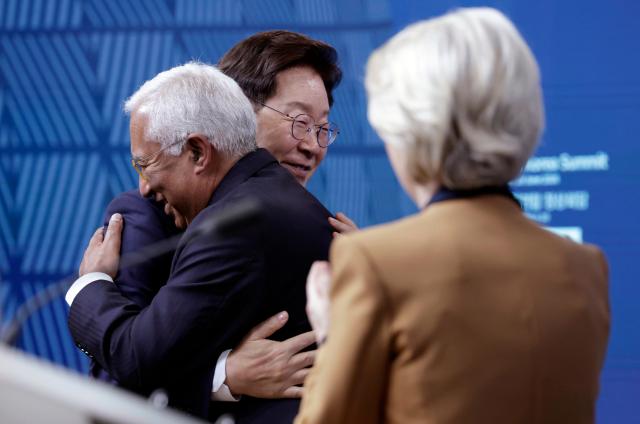
"We underscore the importance of further deepening our bilateral cooperation in areas of strategic importance for our economies, notably trade, investment, supply chains, digital, advanced technologies, energy, and innovation," the leaders said.
The focus on supply chains is particularly significant given South Korea's leadership in semiconductors, batteries and advanced manufacturing and Europe's efforts to strengthen strategic autonomy in critical technologies.
Trade between South Korea and the EU has doubled since 2015, reaching roughly 124 billion euros in goods trade in 2025, according to European Commission data cited during the summit.
One of the summit's most tangible outcomes was the signing of the EU-Korea Digital Trade Agreement, signed by South Korean Trade Minister Yeo Han-koo and EU Trade Commissioner Maroš Šefčovič in the presence of the three leaders.
The pact is expected to facilitate cross-border data flows, prohibit unnecessary data-localization requirements and improve legal certainty for businesses operating in both markets.
South Korea's Industry Ministry described it as Seoul's first digital trade agreement with one of its five largest trading partners and only its second bilateral digital trade pact after Singapore.
Artificial intelligence and emerging technologies also made top agenda. "We acknowledge the importance of AI uptake for our economies and societies as well as boosting AI innovation and competitiveness and will pursue concrete collaborative actions to that end," the statement said.
The two sides agreed to conclude a Cooperation Arrangement on AI while strengthening cooperation on AI governance, safety and responsible use.
The statement also highlighted the importance of the Digital Partnership and Horizon Europe research framework in boosting competitiveness, innovation and economic security in emerging technologies.
The summit addressed several issues affecting Korean exporters as Brussels expands industrial and environmental regulations.
"We commit to continue close consultations on our respective legislation and policies, in particular on industrial policies, as well as circular economy and carbon border measures relevant for energy-intensive industries," the statement said.
The two sides also agreed to continue joint efforts to tackle global steel overcapacity through the Global Forum on Steel Excess Capacity.
"The EU and the ROK moreover agree to continue their joint efforts to tackle global steel overcapacity," the leaders said.
North Korea, Taiwan and the Middle East
The statement reiterated a firm position on North Korea's nuclear and missile programs.
"We express grave concern over the DPRK's nuclear and ballistic missile programs," the leaders said, adding "The DPRK will never be accepted as a nuclear-weapon State under the NPT or have any other special status in that regard."
The EU also backed Seoul's efforts to pursue inter-Korean dialogue through "proactive de-escalation and confidence-building measures" aimed at peaceful coexistence and denuclearization.
On Indo-Pacific security, the leaders reiterated support for "freedom of navigation and overflight, including in the South China Sea," stressed "the importance of preserving peace and stability across the Taiwan Strait" and opposed "unilateral attempts to change the status quo in the Indo-Pacific."
Regarding the Middle East, the statement called for de-escalation and diplomacy while emphasizing "freedom of navigation and safe transit passage in the Strait of Hormuz," a vital artery for global energy supplies.
"We are committed to enhance our collaborative efforts in addressing the challenges and fostering opportunities associated with the energy transition through the EU-ROK Green Partnership," the statement said.
They also reaffirmed commitments to implementing emissions-reduction targets, achieving net-zero goals and accelerating deployment of low-carbon technologies.
On the sidelines of the summit, South Korea secured $165 million in new European investment commitments.
German advanced-materials company ORAFOL announced plans to expand facilities in Korea, while Dutch technology firm Prodrive Technologies said it would establish its first Korean entity to support semiconductor and advanced-manufacturing equipment businesses.
The announcements were made during an investment roundtable hosted by South Korea's Ministry of Trade, Industry and Energy and KOTRA in Brussels.
The Brussels summit forms the opening leg of Lee's 10-day European tour, his first visit to Europe since taking office.
Before departing Seoul, Lee described the trip as an effort to "expand the horizon of cooperation amid complex global challenges" and strengthen the foundations of South Korea's economy and diplomacy.
Following meetings with EU leaders, Lee is scheduled to hold talks with Belgian Prime Minister Bart De Wever and meet Philippe before traveling to Italy for a state visit at the invitation of President Sergio Mattarella.
The Rome visit includes separate summits with Mattarella and Prime Minister Giorgia Meloni, meetings with leaders of both houses of parliament and a wreath-laying ceremony at the Tomb of the Unknown Soldier.
Lee will then travel to the Vatican to attend a special Mass for peace and solidarity and meet with Pope Leo XIV to discuss peace on the Korean Peninsula and global reconciliation.
The tour will conclude in Evian, France, where Lee will attend the June 16-17 G7 summit as an invited partner for the second consecutive year, joining discussions on global economic imbalances, artificial intelligence and international security as Seoul seeks to expand its role as a global middle power.
Copyright ⓒ Aju Press All rights reserved.