

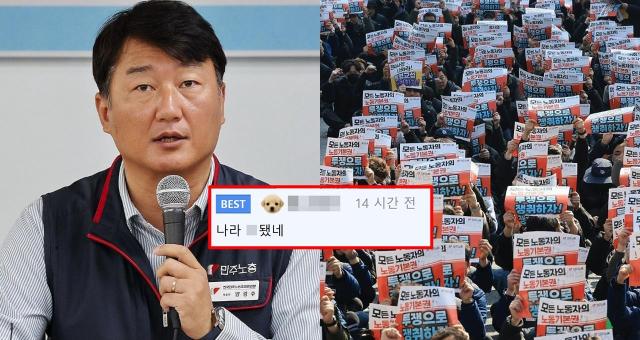
The Korean Confederation of Trade Unions (KCTU) has called for large corporations to share their excess profits with subcontracted workers and local communities, following a controversy over performance bonuses at Samsung Electronics. This statement has sparked significant backlash online.
At a press conference on June 10 in Seoul, KCTU Chairman Yang Kyung-soo stated, "The enormous profits generated by the semiconductor boom and the growth of the artificial intelligence industry are concentrated in a few large corporations and individuals. We need to discuss ways to share these excess profits not only with regular employees of large companies but also with subcontracted workers and society as a whole."
Yang defined "excess profits" as additional earnings that occur when a company significantly exceeds its expected revenue.
He referenced the recent negotiations over performance bonuses within the Samsung Electronics union, noting, "While the Samsung union negotiated to use 15% of the company's profits for performance bonuses, there needs to be a discussion about the remaining 85% that is retained under the guise of reinvestment."
Yang emphasized the need to create a structure where benefits extend beyond just large corporations and regular workers to include subcontracted workers and local communities.
His remarks echoed those of Minister of Employment and Labor Kim Young-hoon, who on May 27 expressed a desire to explore how to socially redistribute excess profits from large corporations, particularly in light of the ongoing strike at Samsung Electronics. He proposed discussions on a so-called "Korean-style social solidarity wage" to ensure that both primary and subcontracted companies can grow together by sharing profits.
Yang further argued that negotiations should involve both primary and subcontracted unions to guarantee a fair share for subcontracted workers.
He criticized the current structure where decisions about profit distribution are made at shareholder meetings, stating, "This structure excludes workers, allowing only management and shareholders to decide. Profit distribution should be a core issue in labor negotiations."
Yang also expressed dissatisfaction with the recently enacted "yellow envelope law," which is intended to expand the scope for subcontracted workers to negotiate directly with primary companies.
He remarked, "Although the law has been implemented, actual negotiations with primary companies are hardly taking place. The government is also not actively engaging as a model employer."
According to KCTU, since the law's implementation, 527 workplaces nationwide have requested negotiations with 485 primary companies. However, only one location, Incheon Medical Center, has seen actual negotiations occur. KCTU has announced plans for a general strike on July 15 to demand expanded negotiations with primary companies.
The news has prompted a wave of critical responses online.
Internet users have reacted with comments such as, "Why should KCTU distribute Samsung's profits?" and "Samsung is not KCTU's company." Others have suggested, "KCTU should distribute its own salaries to society first," and questioned why companies should be forced to share profits earned through investment.
Some users expressed concerns, stating, "While the U.S. offers subsidies to attract semiconductor companies, it seems Korea is only focused on how to redistribute profits," and warned that such policies could drive businesses away from Korea.
Others argued, "We should be focused on attracting semiconductor companies rather than demanding they give up profits," and emphasized that fostering businesses is essential for job creation, criticizing the proposals as detrimental to the investment environment.
Meanwhile, the ongoing semiconductor boom has led to escalating tensions surrounding performance bonuses at SK Hynix, sparking broader debates across the industry. There are growing demands for performance bonuses to extend beyond subcontracted workers to include those in support roles, further intensifying social conflict.
Recently, subcontracted workers have held protests, claiming they have received no compensation despite working alongside others during record-high earnings at primary companies. Workers from SK Hynix's partner firms have also joined in collective actions demanding performance bonuses.
This trend is spreading beyond individual companies to the entire industry. In shipbuilding and construction, indirect workers, such as those in catering services, are now demanding performance bonuses from primary companies, leading to calls for compensation structures that include support staff not directly involved in production.
This situation is influenced by the recently enacted "yellow envelope law," which allows subcontracted workers to demand direct negotiations with primary companies. Some unions are already seeking profit-sharing agreements with primary firms.
In response to these developments, many online commentators have voiced their opinions, suggesting that while Koreans publicly advocate against communism, they exhibit tendencies that align closely with it.
Others have remarked, "Our nation seems to fit communism better, but the U.S. has forced democracy upon us. Observing how society operates, communism seems more appropriate," and criticized the current laws as overly controlling while expressing support for them. They noted, "The yellow envelope law reflects a trend toward communism, and the public sentiment leans toward it," and expressed concerns about the nation's direction, stating, "It feels like the country is deteriorating."
This controversy extends beyond mere disputes over performance bonuses, raising questions about the extent of accountability between primary and subcontracted companies. Since the implementation of the yellow envelope law, discussions about "who is the employer and how far their responsibilities extend" have begun to emerge in the workplace, raising concerns about similar conflicts arising across major industries, including semiconductors, shipbuilding, and construction.
* This article has been translated by AI.
Copyright ⓒ Aju Press All rights reserved.