

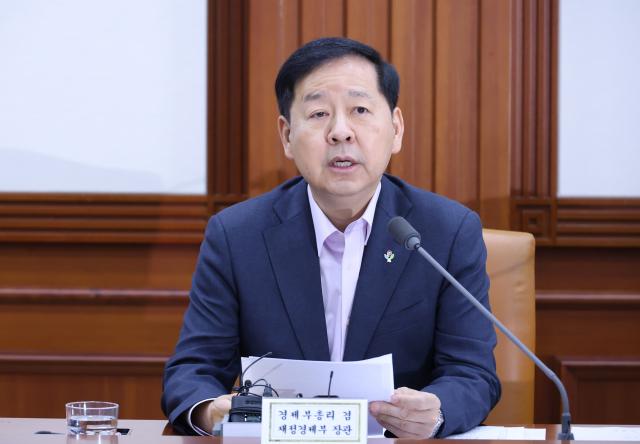
Deputy Prime Minister and Minister of Economy and Finance Koo Yun-cheol announced the official launch of the 'Super Innovation Economy Project' aimed at fostering future industries such as next-generation power semiconductors, small modular reactors (SMRs), and on-sensor artificial intelligence (AI). The initiative seeks to generate visible results quickly and develop the next generations of semiconductors.
Koo made the remarks on June 12 during a meeting of the emergency economic headquarters and the Economic Relations Ministers' meeting at the Government Complex in Seoul. He stated, "Alongside stabilizing people's livelihoods, we will actively pursue structural reforms and the Super Innovation Economy Project to uncover future growth drivers."
The government is accelerating the Super Innovation Economy Project to secure world-class technological capabilities and capture global markets. In the field of next-generation power semiconductors, a commercialization technology roadmap will be established this month, and large-scale research and development (R&D) projects linked to demand companies will be initiated.
For small modular reactors (SMRs), the government plans to expedite early commercialization based on the standard design approval applied for in February and the 'SMR Special Act' set to take effect in September. The government aims to develop related technologies and refine regulations to secure a competitive edge in the global market.
Support for technology development and field demonstrations in the areas of on-sensor AI, actuators for humanoid robots, and secondary batteries will also be strengthened. The government targets to achieve significant results in these fields starting next year.
During the meeting, Koo emphasized the need to swiftly implement measures for price and employment stability while also pursuing structural reforms and discovering future growth drivers. He stated, "Starting next week, I will personally visit five regions to identify localized growth drivers and provide systematic support."
Koo also highlighted that improving youth employment will be a top priority for policy initiatives. To this end, he plans to expedite the implementation of key tasks from the youth New Deal announced in April and actively identify additional supplementary measures. He noted that through collaboration with relevant ministries, employment trends by class and industry will be closely analyzed, and immediate improvements will be made where swift action is needed, alongside enhanced communication in the field.
Furthermore, Koo assessed that the prolonged conflict in the Middle East is contributing to inflation and supply chain pressures, along with ongoing volatility in financial markets. He noted that the employment situation showed a downturn in May, indicating increased uncertainty in labor conditions. In response, the government will focus its policy efforts on stabilizing prices and employment while reviewing related measures weekly through the Economic Relations Ministers' meeting.
* This article has been translated by AI.
Copyright ⓒ Aju Press All rights reserved.