


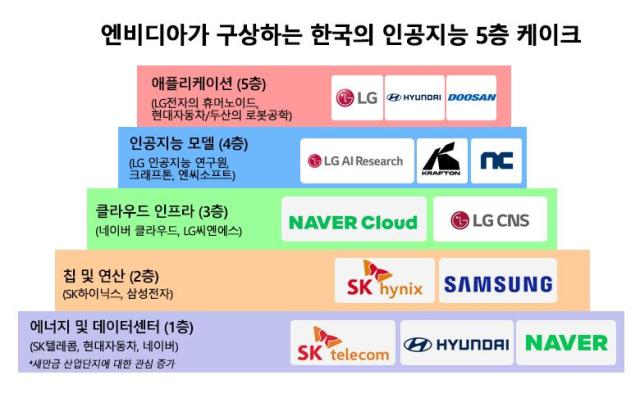
NVIDIA views AI not as a single product but as a complex structure. The foundation consists of energy, followed by semiconductors, infrastructure that supports and drives the AI models, and finally, the application stage where economic value is generated.
Huang believes that the demand across all application stages ultimately reaches the power plants. He asserts that the competition for supremacy in the AI era will hinge on the competitiveness of all five layers.
Countries that possess all these layers are rare. China has vertically integrated energy, infrastructure, and applications, while the United States leads in advanced semiconductors and models.
In contrast, Huang assesses that South Korea has the potential to fill all five layers. His enthusiasm throughout the tightly packed schedule supports this view.
As he concluded his visit on June 10, Huang stated, "Now is your time. You must seize this opportunity." He added, "South Korea is in a very special moment, in a unique position."
Building the Foundation with Energy and Infrastructure for AI
Huang's agenda began at the bottom layer, focusing on energy and the physical infrastructure above it. However, the core emphasis was on 'cloud' services that provide computational power.
SK Telecom plans to build a gigawatt-level AI cloud based on NVIDIA's DSX platform. The first AI factory is set to launch in 2027, providing sovereign and physical AI services domestically.
Naver is also embarking on a similar phased expansion, starting with 55 megawatts in the first half of 2027, scaling to 100 megawatts that same year, and reaching 200 megawatts by 2028, ultimately aiming for gigawatt capacity.
LG has joined the competition through LG Uplus, which will establish a large-scale AI data center based on NVIDIA DSX to accommodate the latest GPUs and support future AI cloud and GPU services. Its affiliate, LG Energy Solution, is developing an 800V direct current power system to power this initiative.
These facilities are not traditional data centers but are referred to by NVIDIA as 'AI factories,' transforming power and data into tokens, the fundamental outputs of modern intelligence.
This construction trend extends to the west coast. Huang expressed NVIDIA's willingness to participate in the AI data center project that Hyundai Motor Group is pursuing in Saemangeum.
This marks a concrete manifestation of the infrastructure layer, with land, power, and cooling being realized in concrete, forming the physical foundation for the cloud services that SK Telecom, Naver, and LG will sell.
Semiconductors: South Korea's Strongest Asset
NVIDIA and SK Hynix have established a long-term technological partnership to jointly develop memory across four NVIDIA platforms encompassing AI infrastructure, personal AI, and physical AI. This memory is designed to align with NVIDIA's computational roadmap rather than simply purchasing off-the-shelf products.
After meeting with SK Group executives, Huang told reporters, "SK is our largest memory partner," and added, "We are expanding this collaboration into several new markets."
Samsung Electronics marked the other end of his schedule.
On the evening of June 9, Huang concluded his visit with a private meeting with Jeon Young-hyun, Vice Chairman of Samsung Electronics' Device Solutions Division. The two sides reportedly discussed broad cooperation encompassing next-generation high-bandwidth memory (HBM), advanced packaging, and foundry manufacturing.
After the meeting, Huang returned to a recurring theme throughout his visit.
He stated, "The next wave of AI is physical AI, where AI interacts with the physical world." He praised South Korea as a very unique country due to its social and cultural cohesion, noting, "Today, South Korea is a global leader in heavy industry and manufacturing."
He added, "South Korea is also world-class in electronics, and interestingly, it ranks among the top in software and AI as well." He emphasized, "Countries excelling in manufacturing and heavy industry tend to be weak in software, and those strong in software often lag in heavy industry, but South Korea excels in all areas. It is a unique situation."
AI Models: Homegrown Innovations
The next layer, AI models, is often perceived as an area where South Korea relies on imports. However, this visit painted a different picture.
NVIDIA and LG AI Research are collaborating to enhance EXAONE, one of South Korea's representative sovereign AI models. LG is training this model using NVIDIA's Blackwell GPU and NeMo framework, showcasing a homegrown model refined on Korean infrastructure.
EXAONE is not alone. Naver possesses HyperCLOVA X, deeply rooted in the Korean language, while NC, highlighted by Huang for its technological prowess in gaming, has developed its own VARCO model series. Although many of the accelerators powering these major Korean AI models are foreign, there is a gradual shift toward domestic solutions.
Applications: A Passion for Physical AI
Above all these layers lies the application stage, which Huang sees as the realm where true economic value is generated and where his enthusiasm was most palpable.
Huang stated, "South Korea excels in manufacturing, mechatronics, and AI, and the fusion of these strengths will make robotics and physical AI a major growth driver for the country."
NVIDIA's concept of physical AI, particularly in robotics, led to the broadest collaborations during this visit. LG Electronics is considering applying NVIDIA's Isaac GR00T inference model to future home robots, while LG CNS is integrating NVIDIA technology into industrial automation and logistics systems.
Doosan emerged as an unexpected beneficiary of this visit. The industrial group supplies advanced electronic materials used in AI accelerators and has established a reciprocal relationship by adopting NVIDIA's platform to develop and train its own robotic systems. Huang highlighted this relationship by throwing the first pitch for the Doosan Bears at Jamsil Baseball Stadium.
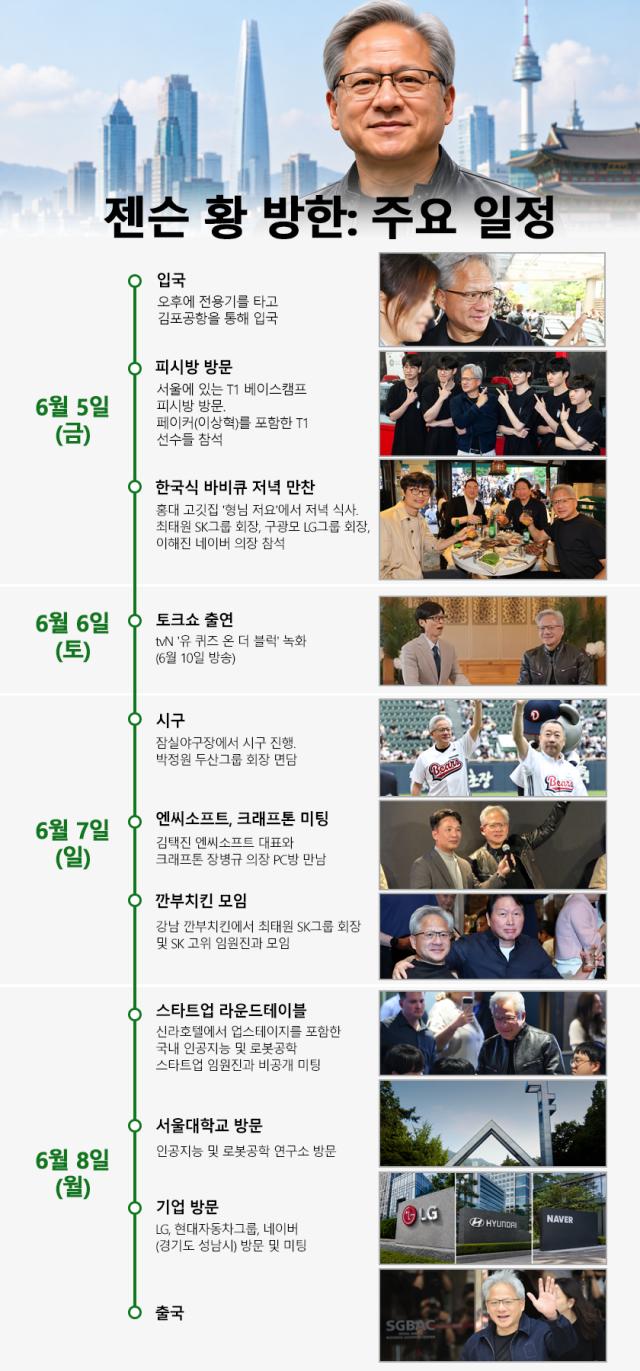
This tour itself reflected the breadth of the ecosystem NVIDIA perceives in South Korea.
The itinerary began with a gathering over samgyeopsal and soju in Hongdae, attended by Chey Tae-won, Chairman of SK Group, Koo Kwang-mo, Chairman of LG Group, and Lee Hae-jin, founder of Naver. It continued with discussions on autonomous driving with Chung Eui-sun, Chairman of Hyundai Motor Group, memory negotiations at SK Hynix, and concluded with a meeting with Samsung Electronics' semiconductor division at the Shilla Hotel.
As Huang prepared to leave Seoul, the 'five-layer cake' had evolved beyond a mere presentation slide.
Energy was represented by South Korea's nuclear capabilities and the construction of AI factories, while semiconductors were embodied by SK Hynix and Samsung Electronics. Infrastructure was provided by SK Telecom, Naver, and LG, while models were represented by sovereign AIs like EXAONE and HyperCLOVA X. Applications were evident in various sectors, from autonomous vehicles to factory robots.
Huang remarked, "South Korea is collaborating with NVIDIA across all layers of the AI ecosystem, from energy to semiconductors, infrastructure, robotics, and applications."
His message to a country long identified solely as a semiconductor powerhouse was broader. South Korea's strength lies not in any single layer of the AI stack but in its rare ability to build nearly every layer independently.
* This article has been translated by AI.
Copyright ⓒ Aju Press All rights reserved.