

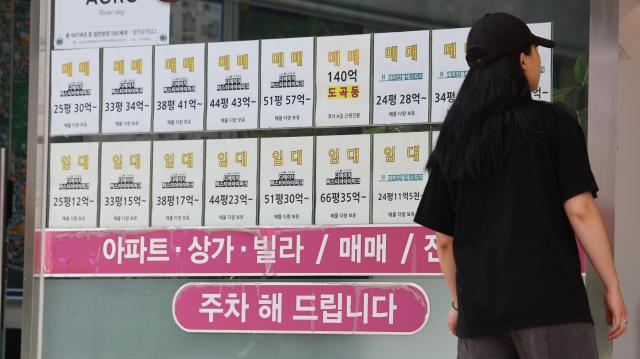
The government has pledged to tackle household debt, yet borrowing continues to surge. The Financial Services Commission has set a target to limit household loan growth to 1.5% this year and aims to reduce the household debt-to-GDP ratio to 80% by 2030. Additionally, the proportion of policy loans will be gradually decreased from the current 30% to 20%. However, the increase in household loans in May reveals how fragile these targets are. Bank lending to households rose by 6.9 trillion won in just one month. While the government claims it will tighten policies, the market is once again turning to debt for home and asset purchases.
The issue is not solely due to weak lending regulations. South Korea's household debt is deeply intertwined with the real estate market. As long as there is an expectation that home prices will rise, demand for loans will always resurface. Banks view mortgage loans, backed by solid collateral, as an easy source of profit, while policy loans, under the guise of ensuring housing stability for low-income families, inadvertently bolster home-buying capacity. Jeonse loans serve as both a protective measure for tenants and a funding source that drives up rental prices and enables gap investments. With households, banks, and government policies moving in the same direction, even slight tightening of total loan amounts fails to effectively restrict real estate financing.
Therefore, what is needed is not merely a repetition of total loan regulations. The government must first refine policy loans. Programs like the Didirim, Buteumok, and Bogumjari loans should serve as safety nets for low-income households without becoming subsidies that prop up home prices. Support criteria should be more rigorously evaluated based on income, assets, housing prices, and regional overheating levels, while preventing funds from flowing into high-priced homes or investment demand. If the justification of protecting low-income families results in supporting rising real estate prices, the direction of policy must be redesigned.
Banks must also be held accountable. The structure that allows funds to flow into real estate-backed loans while claiming to promote productive finance cannot be tolerated. Banks with high mortgage growth rates should face greater regulatory burdens, and evaluations and soundness regulations must be adjusted to direct funds toward corporate loans, innovative finance, and regional finance. While banks accumulate profits through easy collateral loans, households are burdened with lifelong debt, and the economy's funds remain tied to apartment prices. This cannot be considered normal finance.
Exemptions for jeonse loans and the Debt Service Ratio (DSR) cannot remain sacred. While maintaining protections for genuine demand, the guarantee limits and income assessments should be strengthened, and pathways that allow business loans or credit loans to be rerouted for home purchases must be blocked. If households continue to evade loan regulations by acquiring debt under different names to buy homes, managing household debt will inevitably fail each time.
Breaking the cycle of real estate financing does not mean punishing those who wish to buy homes. It aims to ensure that future household income, bank funds, and government policy financing are no longer solely tied to expectations of rising home prices. Financial policy alone is insufficient. Normalizing ownership burdens, curbing speculative demand, and focusing on genuine supply must go hand in hand. Measures for household debt are both financial and real estate policies. If the government cannot sever this cycle, household debt will rise again each time it tightens lending.
The issue is not solely due to weak lending regulations. South Korea's household debt is deeply intertwined with the real estate market. As long as there is an expectation that home prices will rise, demand for loans will always resurface. Banks view mortgage loans, backed by solid collateral, as an easy source of profit, while policy loans, under the guise of ensuring housing stability for low-income families, inadvertently bolster home-buying capacity. Jeonse loans serve as both a protective measure for tenants and a funding source that drives up rental prices and enables gap investments. With households, banks, and government policies moving in the same direction, even slight tightening of total loan amounts fails to effectively restrict real estate financing.
Therefore, what is needed is not merely a repetition of total loan regulations. The government must first refine policy loans. Programs like the Didirim, Buteumok, and Bogumjari loans should serve as safety nets for low-income households without becoming subsidies that prop up home prices. Support criteria should be more rigorously evaluated based on income, assets, housing prices, and regional overheating levels, while preventing funds from flowing into high-priced homes or investment demand. If the justification of protecting low-income families results in supporting rising real estate prices, the direction of policy must be redesigned.
Banks must also be held accountable. The structure that allows funds to flow into real estate-backed loans while claiming to promote productive finance cannot be tolerated. Banks with high mortgage growth rates should face greater regulatory burdens, and evaluations and soundness regulations must be adjusted to direct funds toward corporate loans, innovative finance, and regional finance. While banks accumulate profits through easy collateral loans, households are burdened with lifelong debt, and the economy's funds remain tied to apartment prices. This cannot be considered normal finance.
Exemptions for jeonse loans and the Debt Service Ratio (DSR) cannot remain sacred. While maintaining protections for genuine demand, the guarantee limits and income assessments should be strengthened, and pathways that allow business loans or credit loans to be rerouted for home purchases must be blocked. If households continue to evade loan regulations by acquiring debt under different names to buy homes, managing household debt will inevitably fail each time.
Breaking the cycle of real estate financing does not mean punishing those who wish to buy homes. It aims to ensure that future household income, bank funds, and government policy financing are no longer solely tied to expectations of rising home prices. Financial policy alone is insufficient. Normalizing ownership burdens, curbing speculative demand, and focusing on genuine supply must go hand in hand. Measures for household debt are both financial and real estate policies. If the government cannot sever this cycle, household debt will rise again each time it tightens lending.
* This article has been translated by AI.
Copyright ⓒ Aju Press All rights reserved.