

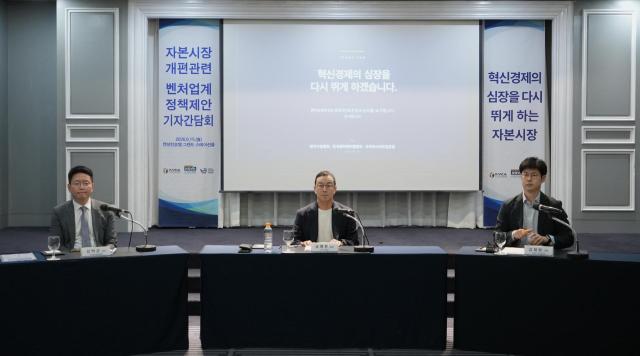
On June 15, the Venture Business Association, the Korea Venture Capital Association, and the Korea Startup Forum held a joint press conference in Yeouido, Seoul, under the theme “Reviving the Heart of the Innovative Economy through Capital Markets.”
During the conference, the industry expressed serious concerns about the recent push by financial authorities to tighten delisting criteria and presented five key policy proposals regarding capital market reform. The proposals include: a postponement and review of the KOSDAQ segmentation, exceptions to the ban on dual listings, a delay in implementing delisting criteria, the establishment of a permanent policy consultative body, and improvements to the technology-based special listing system.
Song Byeong-jun, Chairman of the Venture Business Association, pointed out the ongoing “deepening polarization” and “hierarchization” within the KOSDAQ market. He cited the government's plan to split the KOSDAQ into “premium” and “standard” segments as a prime example.
Song stated, “The venture and startup sector fears that companies classified in the standard segment will be effectively branded as ‘subpar companies.’”
He added, “The ‘KOSDAQ 3000 era’ proposed by the government last year still feels cold on the ground even a year later. Instead of building higher walls of regulation, we need to normalize the KOSDAQ market so that everyone can grow.”

Regarding the financial authorities' push to strengthen delisting criteria, the industry called for a more specific postponement and review of the standards. While they agree with the intention to eliminate underperforming companies to restore market confidence, they argue that the planned delisting criteria set for January 1, 2027, which targets companies with a market capitalization below 30 billion won, should be fully postponed and reassessed.
As of late April 2026, 79.5% of the 1,603 companies listed on KOSDAQ have venture backgrounds, accounting for 81.1% of the total market capitalization. Notably, the proportion of venture companies among those listed through the technology-based special listing system is nearly 89.8%.
In this context, applying immediate delisting measures based solely on quantitative indicators like market capitalization, stock price, and capital erosion could unjustly target promising companies with future potential. Companies already close to the threshold for delisting have been branded as “delisting risk companies,” leading to further stock price declines and a vicious cycle of funding shortages.
Kim Jae-won, Chairman of the Korea Startup Forum, stated, “If the focus is solely on delisting and regulation, it will stifle innovative startups that desperately need funding. We must clearly distinguish between the split listings of large corporations and the subsidiary listings of startups.”
* This article has been translated by AI.
Copyright ⓒ Aju Press All rights reserved.