

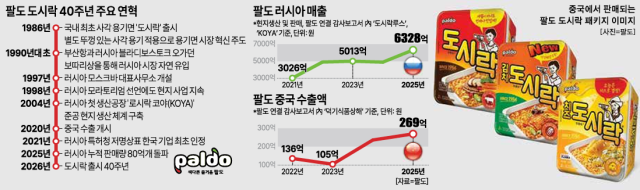
This year marks the 40th anniversary of the launch of Paldo's square container noodles, which is gaining traction in international markets. After establishing itself as a staple in Russia, sales have recently surged in China, positioning Paldo as a leading K-food brand globally.
According to industry reports on June 16, Paldo's exports to China reached 9.7 million units in the first quarter of this year, a dramatic increase from 700,000 units during the same period last year—nearly a 14-fold rise. The upward trend continued, with over 4.5 million units exported to China in April alone. Paldo currently exports four varieties to China: lunch box, kimchi lunch box, spicy lunch box, and cheese lunch box.
Industry analysts attribute the success of the lunch box to its localization strategy. The unique thin noodles and mild yet spicy beef broth stand out in a Chinese noodle market often characterized by greasy and intense flavors. The easing of restrictions on Korean products has also fueled interest in K-food in China. Notably, local influencers have featured the lunch box in their food content, generating organic buzz among younger consumers.
To meet the growing overseas demand, Paldo is accelerating the establishment of its global production infrastructure. In Russia, a third factory has been added in the Nizhny Novgorod region, complementing the existing Ramenskoe and Ryazan facilities. In Vietnam, Paldo plans to complete a second factory in Tay Ninh Province by 2024, which, combined with the first factory, will enable an annual production capacity of up to 700 million noodle units.
The expansion into global markets is translating into positive financial expectations. According to Paldo's consolidated audit report, overseas subsidiaries and export sales in 2025 are projected to reach 632.8 billion won in Russia (based on Lunch Box Rus and KOYA), 139.8 billion won in Vietnam (Paldo Vina), and 26.9 billion won in China (Deokgi Food Shanghai). While it is challenging to isolate sales from the lunch box brand alone, it is estimated that the total global annual revenue driven by the lunch box brand approaches 800 billion won, considering that most of the revenue in Russia comes from lunch boxes and that exports to China are primarily lunch box-focused.
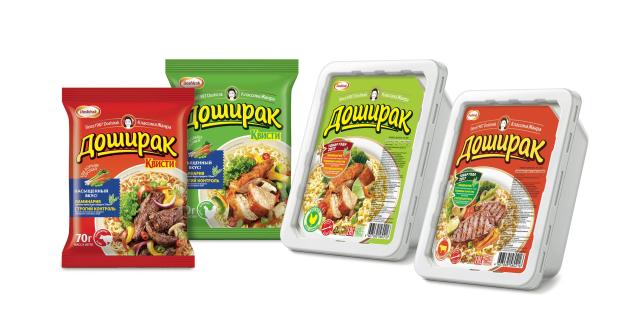
Paldo plans to accelerate its global business expansion, focusing on Russia and China as its two main pillars. The lunch box is currently sold in about 30 countries, including Russia, Vietnam, and China. In Russia, it holds approximately 60% of the cup noodle market share, with cumulative sales reaching 8 billion units last year—ten times the 800 million units sold domestically. Recently, Paldo has also expanded its market to Singapore, Hong Kong, and Mongolia, while increasing its distribution network in North and South America.
A Paldo representative stated, "The lunch box is receiving a positive response not only in Russia but also in the Eurasian market, including China. We will enhance our global brand competitiveness through product development tailored to local tastes and strengthening production capabilities."
* This article has been translated by AI.
Copyright ⓒ Aju Press All rights reserved.