

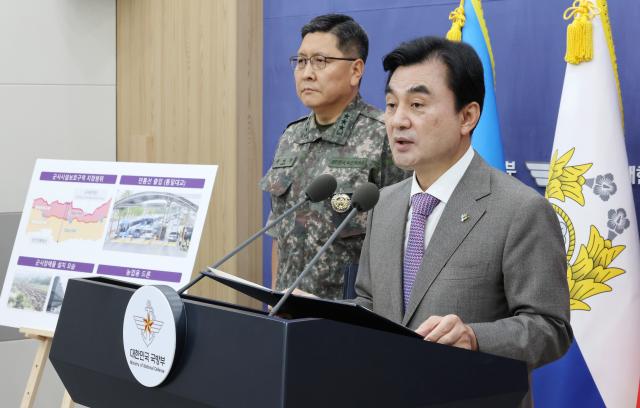
Military authorities are adjusting the Civilian Control Line (CCL) and optimizing restricted protection zones to minimize inconveniences for residents in border areas.
The Defense Ministry plans to reduce the CCL from an average of 8 kilometers to 6 kilometers from the Military Demarcation Line (MDL) after carefully reviewing geographical conditions and operational plans for each region. This adjustment is expected to convert a control zone covering an area 90 times the size of Yeouido (approximately 270 square kilometers) into a restricted protection zone, while efforts are underway to dismantle a restricted protection zone estimated to be 150 times the size of Yeouido (approximately 450 square kilometers) through a redefinition of the criteria.
On June 17, Defense Minister An Gyu-baek stated at the Defense Ministry in Yongsan that the government is actively implementing the key national policy of "regulatory relaxation in the defense sector for civil-military coexistence."
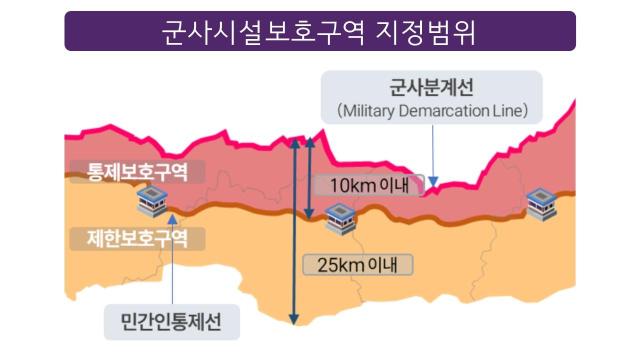
Starting next year, adjustments to the CCL will be implemented across the entire border area. The CCL serves as a boundary to restrict civilian access in areas adjacent to the MDL, where high levels of military activity are required, and is designated within a 10-kilometer range south of the MDL. Currently, the CCL is set at an average distance of 8 kilometers south of the MDL.
The Defense Ministry believes it can adjust the CCL to an average of about 6 kilometers from the MDL, which is expected to reduce a control zone covering an area 90 times the size of Yeouido to a restricted protection zone.
The ministry plans to gradually implement the CCL adjustments starting next year, supplementing control measures such as relocating CCL posts and installing fences and closed-circuit television (CCTV).
Additionally, efforts are underway to dismantle a restricted protection zone estimated to be 150 times the size of Yeouido through a redefinition of its criteria.
The restricted protection zone encompasses areas within 25 kilometers south of the MDL, specifically south of the CCL, with approximately 2,900 square kilometers currently designated. Development in these areas is restricted, requiring prior consultation with the military for any new construction.
Currently, even areas of lesser military operational importance are uniformly designated as restricted protection zones. The Defense Ministry plans to optimize the scope of these zones by reviewing the necessary protective distances for military bases and facilities, taking into account actual operational factors.
Beginning in the second half of this year, the ministry will sequentially lift restrictions in these zones through operational reviews and geographical surveys.
The total area of protection zones to be dismantled or eased through the CCL adjustment and redefinition of restricted protection zone criteria is equivalent to 240 times the size of Yeouido. However, the Defense Ministry noted that this figure is based on map assessments and may vary during actual geographical surveys and operational reviews.
The ministry will also work to remove unnecessary military obstacles that cause traffic congestion and detract from the surrounding landscape in border areas.
Next year, the Defense Ministry plans to prioritize the removal of 23 military obstacles in areas such as Yangju and Paju, where their military utility has diminished, as requested by local governments. A comprehensive survey will be conducted in the second half of this year to establish an annual improvement plan.
Additionally, to improve delays in access to the CCL, the ministry will implement a management system utilizing a mobile app and simplified authentication starting next year.
Furthermore, the ministry will significantly simplify the approval and licensing procedures for agricultural drones in border areas and provide local governments with regular updates on military surplus land twice a year.
Defense Minister An Gyu-baek stated, "The military facility regulations of the past were suitable for the environment at that time, but today's reality demands new approaches. To respond to the changing security environment and ensure that the military can focus on its core combat missions, improving military facility regulations is an essential choice."
Rep. Han Gi-ho of the People Power Party expressed relief that the persistent efforts to persuade authorities on behalf of residents in border areas, who have endured significant infringements on property rights and daily inconveniences for national security, are finally bearing fruit. He added, "We will ensure that the adjustments to the CCL lead to tangible regional development that residents can feel, and we will take thorough measures for subsequent actions."
* This article has been translated by AI.
Copyright ⓒ Aju Press All rights reserved.