

SEOUL, June 17 (AJP) - Enabling robots to adapt to new tasks without relying on heavy human programming is a critical hurdle in advancing industrial automation. To address this, researchers have developed a framework where large language models can directly generate and debug low-level robot control commands, Sookmyung Women's University said Wednesday.
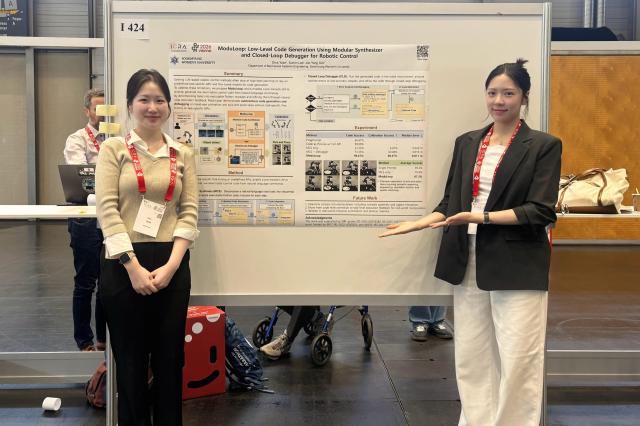
The research team, led by Professor Sim Joo-yong from Sookmyung Women's University's Department of Mechanical Systems Engineering, presented the system at the 2026 IEEE International Conference on Robotics and Automation (ICRA) held in Vienna in early June. The framework, named ModuLoop, allows artificial intelligence to automatically synthesize the exact codes needed to operate robotic arms. Previous applications of large language models in robotics were mostly limited to high-level planning that still relied heavily on pre-defined application programming interfaces.
Currently, deploying robots in factories or workplaces requires human engineers to manually write complex, low-level code for every specific movement and task. This traditional programming method is time-consuming and makes it difficult to quickly adapt robots to new production lines or unexpected changes. The ModuLoop framework introduces a different approach by allowing AI to translate natural language instructions directly into executable control codes. By automating the programming process, this system could enable manufacturing facilities to rapidly reassign robots to new tasks without the need for expert programmers, lowering the barrier to flexible workplace automation.
ModuLoop operates through two primary components: a modular code synthesizer and a closed-loop debugger. The synthesizer creates the initial control code, and the debugger continuously improves the system by analyzing execution errors and automatically modifying the code. The researchers tested the system on practical tasks, including hand-eye calibration to precisely align a robot arm with a camera, and pick-and-place operations to move objects to desired locations.
During testing, the framework demonstrated higher task accuracy and code generation success rates compared to existing methods, achieving rapid stability through its automated feedback loop. Because the system does not require task-specific prior training, it offers a technical foundation that can adapt to various environments and be broadly applied to intelligent manufacturing systems. The findings were published in the international journal IEEE Robotics and Automation Letters, with master's students Yoon Ji-na and Lee Su-min serving as joint first authors and Sim as the corresponding author.
"We confirmed that a structure where the system automatically generates and modifies code based on natural language enables more flexible and scalable robot control," Yoon Gina, a student at the university's Department of Mechanical Systems Engineering, said, adding: "Moving forward, we plan to expand the research so it can be applied to more complex manipulation tasks and actual industrial environments."
(Reference Information)
Journal/Source: IEEE Robotics and Automation Letters (IF 5.3, JCR top 25 percent)
Title: ModuLoop: Low-Level Code Generation Using Modular Synthesizer and Closed-Loop Debugger for Robotic Control
Link/DOI: https://ieeexplore.ieee.org/document/11207505/

Copyright ⓒ Aju Press All rights reserved.
