

Seoul's apartment sales prices turned upward in April, particularly in the mid-priced complexes of the Northeast and Southwest regions. Jeonse prices have increased by more than 10% over the past year, while the rental market is nearing a 50% share of monthly leases.
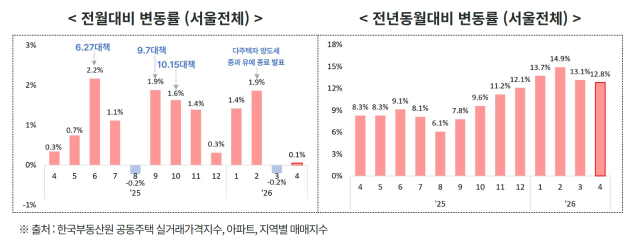
According to the Seoul City government, the apartment sales price index for April rose by 0.08% compared to the previous month, marking a shift to an upward trend. Year-over-year, the index increased by 12.86%.
Data from the Korea Real Estate Agency shows that the sales price index for Seoul apartments rose slightly from 196.2 in March to 196.3 in April. The average transaction price increased by 12.6%, from 14.563 million won per square meter to 16.394 million won. For apartments with a standard area of 84 square meters, the average transaction price rose from 1.223 billion won to 1.377 billion won, an increase of approximately 154 million won.
Regionally, the Northeast led the price increase with a 0.61% rise compared to the previous month, the highest among Seoul's five living zones. This was followed by the Southwest (0.21%) and Northwest (0.10%). In contrast, the Southeast (-1.27%) and Central (-2.41%) regions experienced declines.
From the beginning of the year, the Northeast region also recorded the highest cumulative increase, rising 4.6% from December of last year to April of this year. The Southwest saw a 4.4% increase, while the Northwest rose by 3.0%. Analysts attribute this trend to a focus on mid-priced apartments, which are less affected by loan regulations.
The strength of the jeonse market is even more pronounced. The jeonse price index for Seoul apartments rose by 1.14% from the previous month and 10.53% year-over-year. Regionally, the Central area saw the largest increase at 3.32%, followed by the Southeast (1.76%) and Southwest (1.53%).
Jeonse prices increased across most size categories, with the exception of very small apartments (40 square meters or less). Large apartments (over 135 square meters) saw the highest increase at 1.50% compared to the previous month.
Transaction volumes have decreased somewhat. As of May 15, the number of apartment sales transactions in Seoul was 7,282, a 15.2% drop from the previous month. However, as the reporting deadline has not yet passed, the final transaction volume may rise.
Transactions for apartments priced below 1.5 billion won continue to dominate, accounting for 76.4% of sales in May, an increase of 0.4 percentage points from the previous month. In terms of individual districts, Nowon had the highest transaction volume at 760, followed by Guro and Gangseo. In these areas, the proportion of transactions below 1.5 billion won exceeded 90%. Seoul City officials noted that the market is being driven by demand for mid-priced apartments.
The rental market continues to show a trend toward monthly leases. In May, the number of jeonse transactions was 7,741, while monthly lease transactions totaled 7,429. The share of jeonse transactions was 51.0%, with monthly leases making up 49.0%, effectively maintaining a near 50-50 split. Since December of last year, one in every two rental contracts has been a monthly lease.
Among jeonse contracts, the proportion of renewal contracts rose to 53.6%, up from 43.0% in the same month last year. However, the use of the right to request contract renewal dropped to 50.2%, down from 57.5% year-over-year.
Additionally, data analyzed by Real Estate 114, commissioned by this publication, indicates that the proportion of apartments priced over 1.5 billion won in Seoul increased from 32.83% on October 3 of last year to 39.70% on June 12, a rise of 6.87 percentage points. During the same period, the share of apartments priced below 1.5 billion won decreased from 67.17% to 60.30%.
* This article has been translated by AI.
Copyright ⓒ Aju Press All rights reserved.