

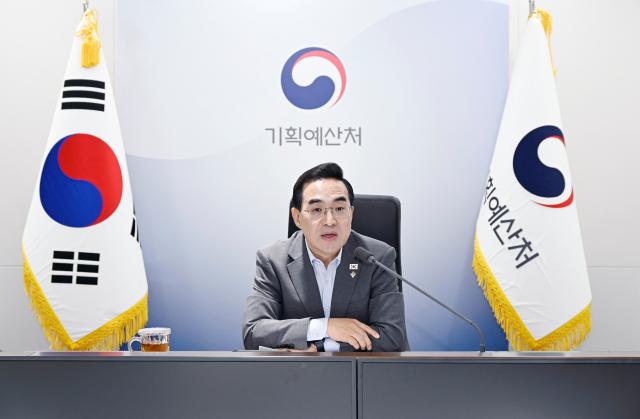
On June 22, Park Hong-keun, Minister of the Ministry of Strategy and Finance, held a meeting with financial experts to gather insights on fiscal direction and key investment priorities.
Attendees included Kim Se-jik, President of the Korea Development Institute (KDI); Kwon Nam-hoon, President of the Korea Institute for Industrial Economics and Trade; Woo Seok-jin, Professor at Myongji University; Lee Woo-jin, Professor at Korea University; Ko Sun, Professor at Chung-Ang University; Son Byeong-ho, Adjunct Professor at Yonsei University; and Lee Sang-min, Senior Research Fellow at the National Institute of Public Finance.
Minister Park noted, "While the South Korean economy continues to show positive trends, uncertainties regarding the semiconductor market, future tax revenue flows, and potential fluctuations in prices and interest rates are at an all-time high."
He sought expert opinions on effective ways to utilize the unprecedented excess tax revenue, the role of finance in addressing five major structural challenges, and the need for fiscal innovation to ensure sustainability.
Participants predicted that substantial excess tax revenue would continue through next year and emphasized the need to invest this revenue for future growth potential. They particularly highlighted the importance of investing in research and development (R&D) in artificial intelligence (AI) and semiconductor infrastructure to respond to the ongoing AI transformation.
Additionally, there were calls to consider saving and management methods, such as establishing funds, to prepare for potential economic changes and to utilize the increased tax revenue for future investments.
Regarding the five structural challenges—industrial transformation, population decline, polarization, regional extinction, and climate change—experts stressed the importance of ensuring that economic growth does not exacerbate K-shaped growth issues. They also urged the government to actively work to prevent job losses resulting from the AI transformation. Discussions also included addressing income and asset inequality and making proactive investments in energy infrastructure.
Finally, experts emphasized the need to restructure low-performing projects to reinvest in core areas. They argued that fiscal structural innovation should not only focus on discretionary spending but also boldly reform the rigid increase structure of mandatory expenditures.
Minister Park responded, "I will actively incorporate the suggestions provided today into next year's budget proposal and the medium-term fiscal management plan."
* This article has been translated by AI.
Copyright ⓒ Aju Press All rights reserved.