

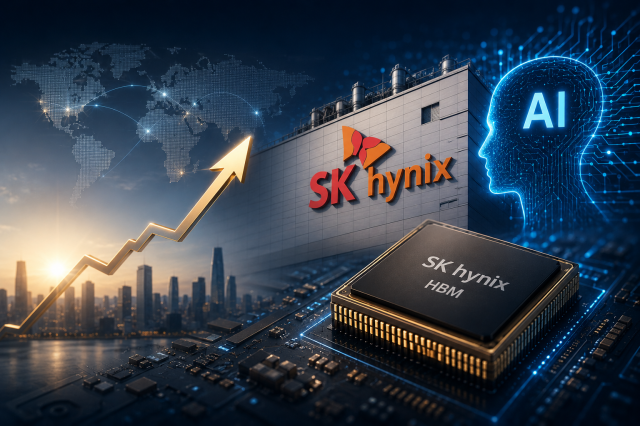
SK Hynix continues its impressive growth, becoming the second-largest publicly traded company in South Korea to surpass a market capitalization of 200 trillion won, following Samsung Electronics. The gap between the two industry leaders has significantly narrowed. With plans to list American Depositary Receipts (ADRs) in July, the potential for global investors to access SK Hynix could lead to discussions about a possible market cap reversal. The achievement of 200 trillion won in market cap carries substantial implications for both the capital market and the industry. It symbolizes where investment is flowing in the AI era and highlights which companies are receiving the highest valuations. As we witness, the AI revolution is fundamentally reshaping existing industrial orders, marking a structural change. In particular, semiconductors have emerged as a core asset in the AI age. The performance of AI ultimately depends on how quickly it can process vast amounts of data, with high-bandwidth memory (HBM) at its core. SK Hynix has secured a unique competitive edge in this market, positioning itself at the center of the global AI supply chain. This illustrates that semiconductors are no longer just components of specific industries but strategic assets that influence national competitiveness and security. Just as countries that secured oil once dominated economic power, we have now entered an era where nations capable of producing and supplying advanced semiconductors lead the future. The technological rivalry between the U.S. and China is fundamentally a contest for dominance in the semiconductor sector. In this context, it is encouraging to see South Korean companies leading the global market.
However, we must not simply celebrate the figure of 200 trillion won. Surpassing this milestone presents new challenges. Above all, South Korea must establish an ecosystem that can sustain its leadership in AI-era semiconductors. The semiconductor industry cannot grow solely through the efforts of one company. It requires a multitude of firms and personnel to be interconnected across materials, components, equipment, design, packaging, and software. If current success remains concentrated within a single company, maintaining a competitive advantage will be difficult.
Securing talent is also urgent. Countries around the world are investing heavily to attract semiconductor talent. Expanding semiconductor engineering education, enhancing research and development investments, and implementing policies to attract skilled foreign workers must follow. Regulatory innovation and the expansion of industrial infrastructure, including power and water supply, are also tasks that can no longer be postponed.
There is an increasing need to consider how to spread the benefits of the semiconductor boom throughout the entire industry. The astronomical profits of Samsung Electronics and SK Hynix and the issue of profit distribution are causing significant ripples across South Korean society. Questions about how to allocate excess tax revenue are being raised. Historically, South Korea's economy has faced criticism for failing to ensure that the growth of large corporations translates into the growth of their partners and small businesses. The AI semiconductor supercycle must not only improve the performance of a few companies. We need to enhance the technological competitiveness of partner firms and expand opportunities for small and medium-sized enterprises and startups to thrive. Only then can the achievements of a semiconductor powerhouse contribute to the growth of the national economy.
SK Hynix's entry into the 200 trillion won era is undoubtedly a milestone in the history of South Korean industry. However, the true significance lies not in the number itself but in the potential it demonstrates to lead the world in a core strategic industry of the AI era. What is now needed is to ensure that this success does not end as a one-time boom. By linking corporate success to national competitiveness and spreading the growth of large companies to the development of the entire industrial ecosystem, South Korea can truly become a winner in the AI era.
* This article has been translated by AI.
Copyright ⓒ Aju Press All rights reserved.