SEOUL, June 23 (AJP) - As the explosive growth of artificial intelligence services drives up power consumption and creates heavy data traffic jams in global computing facilities, finding ways to process more information with less electricity has become a pressing global challenge. To tackle this infrastructure problem, a team of South Korean researchers has developed a new optical modulator, a key communication component that converts electrical signals into light waves to transmit data efficiently, the Korea Advanced Institute of Science and Technology said Tuesday.
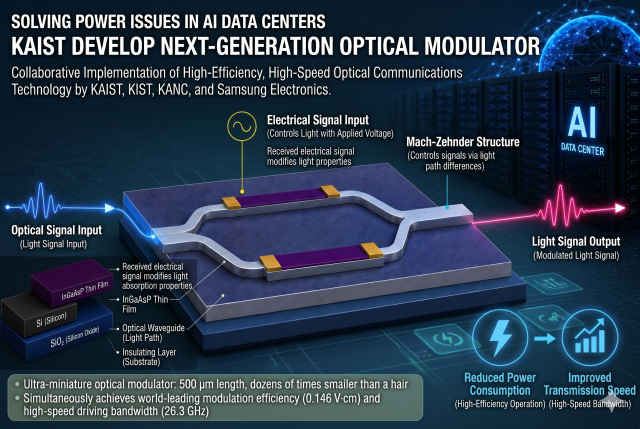
Conventional computing facilities rely on standard silicon optical modulators, which generate high heat and are vulnerable to temperature shifts. The optical modules suffer from a physical limitation where boosting energy efficiency inevitably slows down data transmission speeds. The newly engineered device bypasses these existing barriers by bonding a highly sensitive compound semiconductor material onto a traditional silicon base, allowing the hardware to simultaneously achieve high transmission speeds and low power consumption in a much smaller physical footprint.
The press release detailing the technological development was issued from Daejeon, South Korea, on June 23, 2026. The announcement outlines a collaborative research initiative involving academic researchers, major national scientific centers, and the semiconductor packaging division of Samsung Electronics.
The research team was led by the Korea Advanced Institute of Science and Technology (KAIST) School of Electrical and Electronic Engineering's Professor Kim Sang-hyun. The joint project incorporated the technological expertise of researcher Han Jae-hoon from the Korea Institute of Science and Technology (KIST), researcher Kim Jong-min from the Korea Advanced Nano Fab Center (KANC), and engineers from Samsung Electronics. Together, they successfully fabricated an ultra-small modulator measuring just 500 micrometers in length, making the component dozens of times smaller than the thickness of a human hair.
To build the device, the team layered an indium gallium arsenide phosphide thin film, which reacts strongly to light and electricity, over a standard silicon path while maintaining a stable structural design that resists temperature changes. The researchers combined two specific physical manipulation techniques to prevent electrical charges from accumulating inside the component, an issue that typically causes operational slowdowns. This structural approach allowed the hardware to demonstrate a high energy efficiency rating of 0.146 volt-centimeters alongside a rapid processing bandwidth of 26.3 gigahertz.
Inside modern data centers, countless computing servers and semiconductor chips continuously exchange massive quantities of information in real time. Because optical modulators dictate both the speed and the electrical drain of these exchanges, improving their performance directly impacts the overall capability of the facility. The compact, low-power nature of the new component makes it well-suited for future co-packaged optics, an advanced manufacturing design that integrates optical communication parts and computer chips directly inside a single shared package to save space and power.
"We have been developing various optical device technologies, such as silicon photonics and micro-light-emitting diodes, to solve the power consumption and data transmission bottlenecks of data centers, which are the core infrastructure of the AI era," Professor Kim said, adding: "This achievement simultaneously improves the efficiency and speed of optical modulators, and we expect it to be used in next-generation artificial intelligence data centers and ultra-high-speed optical communication systems."
The collaborative study was led by KAIST doctoral candidate Kang Dong-gil as the first author. The research findings were formally presented to the international semiconductor community at the VLSI Symposium on Technology and Circuits on June 17, 2026.
(Reference Information)
Journal/Source: VLSI Symposium on Technology and Circuits
Title: Depletion-Mode III-V/Si SISCAP Mach-Zehnder Modulator Breaking the Efficiency-Bandwidth Trade-Off for Co-Packaged Optics
Link/DOI: https://vlsi26.mapyourshow.com/8_0/sessions/session-details.cfm?scheduleid=202

Copyright ⓒ Aju Press All rights reserved.