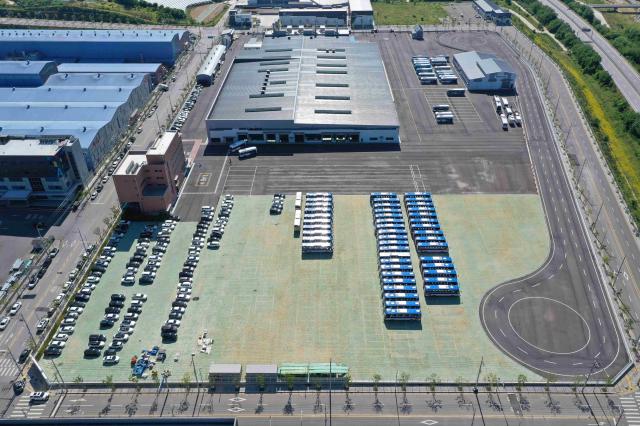
The project, announced Thursday by Woojin, draws support from a national research and development scheme run by the Ministry of Trade, Industry and Resources, the Korea Institute for Advancement of Technology and the Gyeongbuk Regional Institute of Industrial Advancement, aimed at nurturing regional innovation clusters.
Formally titled the development of a 420 km-class low-floor electric bus applying high-safety core components for the transport-vulnerable, the effort runs through 2030 and centers on three pillars: an AI-based battery pack, an 800-volt silicon-carbide power module and a wide-area low-floor platform.
Woojin said it would adopt a homegrown universal design with sharply improved wheelchair access, paired with a high-safety system fitted with cybersecurity technology, to close gaps in transport welfare.
Localizing core parts is another central goal.
South Korea's green public transport has long leaned heavily on imports from China and elsewhere, and the company aims to achieve technological self-reliance across the future-vehicle supply chain by bringing batteries and power modules in-house.
"This national R&D project carries the significance of guaranteeing mobility rights for the transport-vulnerable and building a model of regional shared growth," a company official said, adding that Woojin would seek to lead technological innovation in the eco-friendly commercial vehicle field and present a successful regional standard.

Copyright ⓒ Aju Press All rights reserved.