

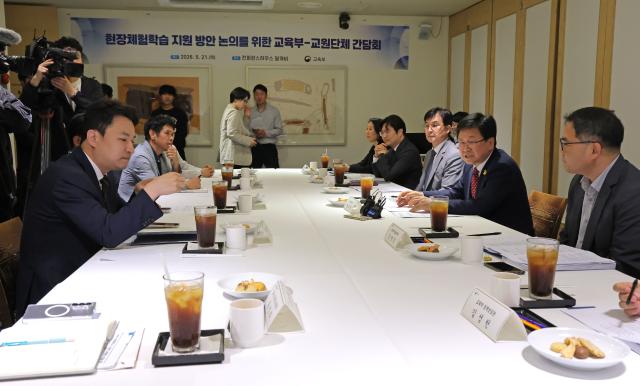
In response to the declining school-age population and changes in future educational environments, the government has outlined its teacher supply direction for primary and secondary education over the next four years. However, teacher organizations have criticized the plan, stating it remains tied to a simplistic economic rationale based solely on student numbers, and they are calling for a fundamental overhaul of the staffing calculation system.
On June 25, the Ministry of Education announced its long-term teacher supply plan for 2027-2030, focusing on regional balanced growth and supporting the development of future talent. This plan aims to respond swiftly to the inevitable decline in student numbers while ensuring the recruitment of teachers to effectively implement key educational initiatives of the Lee Jae-myung administration, including the high school credit system, basic academic skills assurance, and artificial intelligence (AI) education.
On June 25, the Ministry of Education announced its long-term teacher supply plan for 2027-2030, focusing on regional balanced growth and supporting the development of future talent. This plan aims to respond swiftly to the inevitable decline in student numbers while ensuring the recruitment of teachers to effectively implement key educational initiatives of the Lee Jae-myung administration, including the high school credit system, basic academic skills assurance, and artificial intelligence (AI) education.
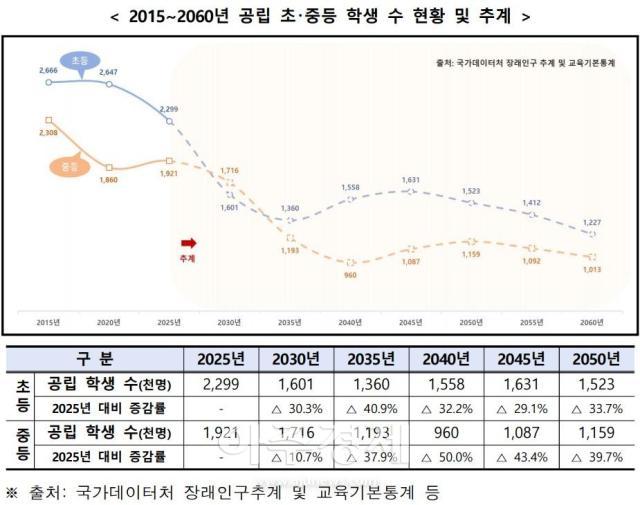
According to the 2023 National Data Agency's future population projections and basic educational statistics, the number of public primary and secondary school students is expected to decrease from 4.22 million in 2025 to approximately 3.32 million by 2030, a decline of about 900,000 (21%). Specifically, elementary school enrollment is projected to drop by around 30% (700,000 students) compared to 2025, while secondary school enrollment is expected to decrease by about 11% (200,000 students).
In light of this, the Ministry of Education plans to distribute the impact of the decline over the years based on long-term statistics while actively supporting teacher placements to ensure national balanced development and meet future educational demands. Specifically, it will allocate an appropriate number of teachers to small schools in declining population areas to safeguard students' right to learn and address overcrowded classes in newly developed cities. Additionally, it aims to support the implementation of the high school credit system, place specialized teachers for basic academic skills, and ensure the deployment of information technology teachers to adapt to the AI and digital era.
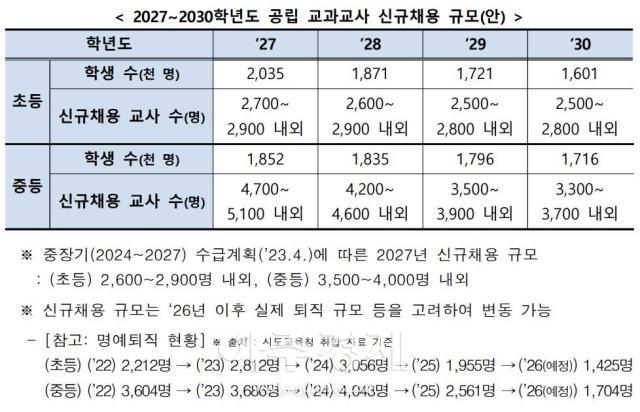
As a result of these comprehensive policy considerations, the expected number of new public subject teacher hires for the 2027 academic year is projected to be around 2,700-2,900 for elementary schools and 4,700-5,100 for secondary schools. This represents an increase in secondary teacher hiring compared to the initial long-term supply plan, which indicated a hiring range of 2,600-2,900 for elementary and 3,500-4,000 for secondary. The final figures will be confirmed in September, reflecting retirements and leaves from each regional education office.
In light of this, the Ministry of Education plans to distribute the impact of the decline over the years based on long-term statistics while actively supporting teacher placements to ensure national balanced development and meet future educational demands. Specifically, it will allocate an appropriate number of teachers to small schools in declining population areas to safeguard students' right to learn and address overcrowded classes in newly developed cities. Additionally, it aims to support the implementation of the high school credit system, place specialized teachers for basic academic skills, and ensure the deployment of information technology teachers to adapt to the AI and digital era.
As a result of these comprehensive policy considerations, the expected number of new public subject teacher hires for the 2027 academic year is projected to be around 2,700-2,900 for elementary schools and 4,700-5,100 for secondary schools. This represents an increase in secondary teacher hiring compared to the initial long-term supply plan, which indicated a hiring range of 2,600-2,900 for elementary and 3,500-4,000 for secondary. The final figures will be confirmed in September, reflecting retirements and leaves from each regional education office.
However, the announcement has drawn criticism from three major teacher organizations: the Korean Federation of Teachers' Associations (KFTA), the Korean Teachers and Education Workers Union (KTU), and the Teachers' Union Federation. While they acknowledge the government's attempt to reflect new educational demands, they argue that the fundamental criteria for staffing remain tied to the economic logic of declining student numbers, failing to account for the overwhelming workload faced by educators in schools.
The KTU stated, "The increase in students facing emotional and behavioral crises and multicultural students indicates that educational demands are changing more rapidly than student numbers. Instead of reducing teachers based on the declining school-age population, we should seize the opportunity to lower class sizes and enhance the quality of education."
They emphasized that issues of overcrowded classes in metropolitan areas and small schools in rural areas are distinct and should not be addressed with a one-size-fits-all approach based on student numbers. A shift towards a teacher supply policy centered on class sizes and educational demands is necessary.
The KFTA also criticized the current teacher supply plan, stating it remains subservient to the simplistic economic rationale of declining student numbers. They pointed out that schools are currently facing rampant violations of teacher rights, threats of child abuse reporting, and an increase in at-risk students, making it impossible to teach effectively. They urged that to realize student-centered education, the focus should not be on the total number of students but rather on maintaining a maximum class size of 20 students to alleviate overcrowding and expand the number of regular teachers.
Additionally, they called for transparency in the allocation ratios of teacher positions across regions and for discussions on extending teacher retirement age to align with the timing of civil servant pension eligibility to be included in the supply model.
The Teachers' Union Federation went further, stating, "It is a policy contradiction to claim to strengthen student-centered education while simultaneously reducing the number of teachers needed to implement it," and urged a paradigm shift not only within the Ministry of Education but also involving the Ministry of the Interior and Safety and the Ministry of Economy and Finance.
They highlighted that according to OECD statistics, South Korean teachers' weekly working hours have steadily increased, with administrative tasks taking up more than 70% of the OECD average. They lamented that even as student numbers decline, the responsibilities teachers face, such as addressing school violence, managing parental complaints, and overseeing student conduct, have grown exponentially.
They concluded by asserting that teacher staffing is not merely about numbers but represents the last line of defense for the future of public education in South Korea, calling for new supply standards that comprehensively reflect the number of subjects each teacher is responsible for and their workload.
The KTU stated, "The increase in students facing emotional and behavioral crises and multicultural students indicates that educational demands are changing more rapidly than student numbers. Instead of reducing teachers based on the declining school-age population, we should seize the opportunity to lower class sizes and enhance the quality of education."
They emphasized that issues of overcrowded classes in metropolitan areas and small schools in rural areas are distinct and should not be addressed with a one-size-fits-all approach based on student numbers. A shift towards a teacher supply policy centered on class sizes and educational demands is necessary.
The KFTA also criticized the current teacher supply plan, stating it remains subservient to the simplistic economic rationale of declining student numbers. They pointed out that schools are currently facing rampant violations of teacher rights, threats of child abuse reporting, and an increase in at-risk students, making it impossible to teach effectively. They urged that to realize student-centered education, the focus should not be on the total number of students but rather on maintaining a maximum class size of 20 students to alleviate overcrowding and expand the number of regular teachers.
Additionally, they called for transparency in the allocation ratios of teacher positions across regions and for discussions on extending teacher retirement age to align with the timing of civil servant pension eligibility to be included in the supply model.
The Teachers' Union Federation went further, stating, "It is a policy contradiction to claim to strengthen student-centered education while simultaneously reducing the number of teachers needed to implement it," and urged a paradigm shift not only within the Ministry of Education but also involving the Ministry of the Interior and Safety and the Ministry of Economy and Finance.
They highlighted that according to OECD statistics, South Korean teachers' weekly working hours have steadily increased, with administrative tasks taking up more than 70% of the OECD average. They lamented that even as student numbers decline, the responsibilities teachers face, such as addressing school violence, managing parental complaints, and overseeing student conduct, have grown exponentially.
They concluded by asserting that teacher staffing is not merely about numbers but represents the last line of defense for the future of public education in South Korea, calling for new supply standards that comprehensively reflect the number of subjects each teacher is responsible for and their workload.
* This article has been translated by AI.
Copyright ⓒ Aju Press All rights reserved.