

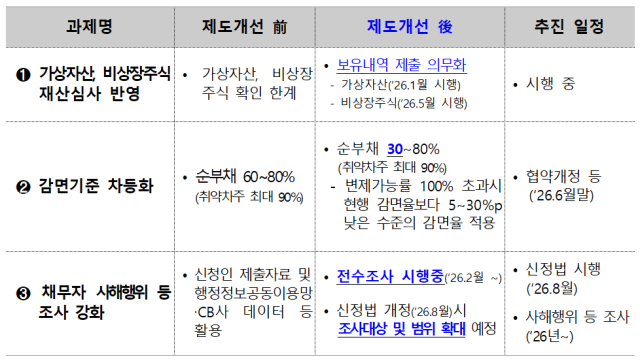
As applications for the New Start Fund surpass 200,000, financial authorities are revising asset assessments and debt relief criteria. The review will now include previously hard-to-verify investments such as virtual assets and unlisted stocks. The aim is to concentrate benefits on small business owners and self-employed individuals who require support but have higher repayment capabilities.
According to the Korea Asset Management Corporation and the Credit Recovery Commission, as of the end of May, the total number of applicants for the New Start Fund reached 201,176, with a cumulative debt amount of 31.7553 trillion won. This marks an increase of 4,856 applicants and 738.8 billion won in debt compared to the previous month.
Among those who have entered into debt adjustment agreements, 136,702 individuals have a total principal debt of 12.3297 trillion won. Of these, 68,951 have entered into purchase-type debt adjustments, with a principal debt of 6.3454 trillion won and an average principal reduction rate of approximately 73%. Meanwhile, 67,751 individuals have confirmed mediation-type debt adjustments, totaling 5.9843 trillion won, with an average interest rate reduction of about 5.4 percentage points.
On the same day, the Financial Services Commission held a meeting with the Korea Asset Management Corporation to review operational status and discuss improvements to the New Start Fund support system. This follows the discovery of cases where some debtors possessed significant investment assets or received high relief rates relative to their repayment capabilities.
As a result, since January, the New Start Fund has been verifying membership with five major Korean virtual asset exchanges and requiring account holders to submit balance certificates for asset assessments. Starting in May, applicants have also been asked to provide details of unlisted stock holdings through the Home Tax system.
The criteria for debt relief will also be differentiated. Currently, for non-collateralized bad debts, principal reductions of 60% to 80% are possible, with vulnerable borrowers eligible for up to 90%. However, in the future, debtors with repayment capabilities exceeding 100% will see the minimum relief rate drop from 60% to 30%. The higher the repayment ability, the more the relief rate will be reduced by 5% to 30 percentage points compared to current levels.
Investigations into fraudulent activities will also be strengthened. Since February, the Korea Asset Management Corporation has been operating a dedicated asset investigation team. If it is confirmed that a debtor has intentionally reduced their assets by gifting or selling property before applying, the corporation plans to terminate agreements or pursue debt recovery. The Financial Services Commission and the Korea Asset Management Corporation explained that these adjustments are intended not to reduce support but to prevent unnecessary waste of resources and focus benefits on those in genuine need.
* This article has been translated by AI.
Copyright ⓒ Aju Press All rights reserved.