

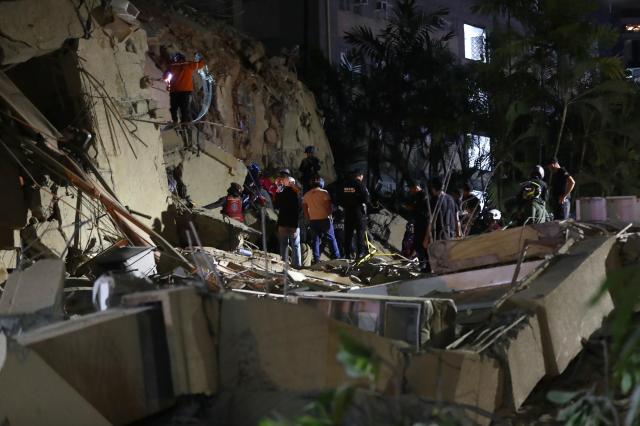
According to the U.S. Geological Survey (USGS), a magnitude 7.2 earthquake struck approximately 168 kilometers west of Caracas, near the Caribbean coastal town of Morón, shortly after 6 p.m. local time on June 24. About 40 seconds later, a stronger magnitude 7.5 quake followed 16 kilometers southwest of Morón. The USGS noted that this 7.5 quake is the strongest recorded in Venezuela since a 7.7 magnitude earthquake in 1900, marking it as the second most powerful earthquake in the country's history.
In a public address early on June 25, Delsy Rodríguez, the acting president of Venezuela, confirmed that at least 32 people had died and over 700 were injured across several states due to the earthquakes, declaring a national emergency. However, this figure does not include casualties from La Guaira state, which suffered the most damage, suggesting that the death toll may increase. Rodríguez declared La Guaira a 'disaster area,' located about 30 kilometers north of Caracas.
Simón Bolívar International Airport near Caracas was also damaged and closed, which may delay rescue operations. The Caracas metro and natural gas services have been suspended, and the Venezuelan Ministry of Education announced that classes would be halted for several days, with some school buildings being used as shelters and distribution centers for relief supplies.
Venezuelan Interior Minister Diosdado Cabello urged residents not to obstruct emergency vehicles and ambulances as search and rescue efforts continue in various regions where buildings have collapsed.
The USGS assessed that the earthquake could lead to significant loss of life and extensive property damage, with initial estimates suggesting that fatalities could reach 10,000, and in the worst-case scenario, up to 100,000.
In response to the disaster, international support has begun to flow in. President Donald Trump stated on Truth Social that the U.S. is ready and willing to assist Venezuela, and Secretary of State Marco Rubio announced that search and rescue teams, medical resources, and humanitarian aid would be dispatched immediately under Trump's direction. The U.S. State Department has already activated a disaster response team and task force to aid Venezuela.
Neighboring Latin American countries have also offered assistance, with El Salvador ready to send a rescue team of 300 personnel, and the Dominican Republic planning to deploy specialized military units for search and rescue operations. Ecuador and Chile have expressed their willingness to provide humanitarian aid, while Brazil, Bolivia, and Mexico have conveyed messages of solidarity and condolences.
Fortunately, Venezuela's key oil infrastructure appears to have avoided significant damage. As the country with the largest proven oil reserves, reports indicate that major oil facilities are located in areas that have not been severely affected. However, concerns remain that prolonged power outages could disrupt oil production.
Meanwhile, around the same time as the earthquakes in Venezuela, California and Aomori Prefecture in Japan experienced earthquakes measuring 5.6 and 6.9, respectively. However, seismologist Lucy Jones from California Institute of Technology stated that these quakes appear to be unrelated to the events in Venezuela.
* This article has been translated by AI.
Copyright ⓒ Aju Press All rights reserved.