

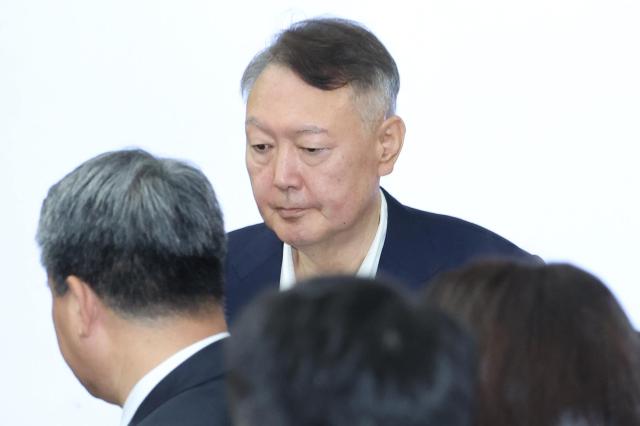
The appeal hearing for former President Yoon Suk Yeol and former Defense Minister Kim Yong-hyun on charges of leading a rebellion resumed after a month, with both the special prosecutor's team and the defense presenting their arguments.
On June 25, the Seoul High Court's Criminal Division 12-1, presided over by judges Lee Seung-cheol, Jo Jin-goo, and Kim Min-ah, held the appeal hearing, attended by key defendants including Yoon, Kim, former Army Intelligence Command Chief Noh Sang-won, and former Military Police Chief Kim Yong-gun.
During the hearing, the special prosecutor's team presented their reasons for the appeal, while the defense team read their summary of the appeal.
The special prosecutor's team criticized the lower court's ruling, requesting the court to impose the same death penalty on Yoon as was sought in the first trial, while seeking life imprisonment for Kim and 30 years for Noh. In the initial ruling, Yoon received a life sentence, while Kim and Noh were sentenced to 30 years and 18 years, respectively.
The special prosecutor's team stated, "The first trial court made an error by excessively dismissing key evidence, such as Noh Sang-won's memo, which clearly outlines the timing of the martial law preparations and the purpose of the coup attempt."
They specifically pointed out the lower court's conclusion that the declaration of martial law, lacking legal requirements, could not be directly equated with the crime of rebellion.
The special prosecutor's team emphasized, "This is a misinterpretation of existing Supreme Court precedents and a flawed application of legal principles. The essence of using the military to undermine the National Assembly for the purpose of consolidating presidential power and establishing a long-term dictatorship is a clear coup and rebellion."
After the special prosecutor's presentation, Yoon and Kim's defense team requested an opportunity to rebut, arguing that the appeal included points not mentioned in the appeal brief.
The court then allowed the defense to present their summary of the appeal. Yoon's defense team, using PowerPoint materials, reiterated their argument that the martial law was justified, similar to their stance in the first trial.
A defense attorney stated, "To suppress national resistance and opposition from state agencies during a prolonged martial law, it would require meticulous planning and overwhelming force, such as deploying tanks and armored vehicles, imposing school closures nationwide, and creating an atmosphere of fear to prevent lawmakers from gathering in the National Assembly. However, the defendant never planned or considered large troop deployments or political agendas."
They also presented evidence that the military and police personnel deployed during the martial law were minimal, with troop deployment lasting only about an hour, and that live ammunition was strictly prohibited, resulting in no casualties.
The defense further argued that the case stemmed from the indiscriminate abuse of impeachment rights by the opposition party, the rapid introduction of special prosecutor laws, and budgetary excesses that paralyzed the executive branch, asserting that the president acted within constitutional authority to inform the public of the crisis.
Another defense attorney claimed that witness testimonies accepted as evidence in the first trial were contaminated, specifically alleging that former Police Chief Jo Ji-ho's statements were part of a planned effort to evade legal consequences.
The defense contended that Jo's testimony about instructing to detain lawmakers attempting to breach the National Assembly was false, arguing that the president had never received reports regarding the blockade or breach attempts.
They also claimed that the testimony from former Defense Security Command Chief Lee Jin-woo, which formed the basis of the special prosecutor's indictment, was tainted by malicious and false testimony from a subordinate who was not a direct participant in the conversations.
The defense team pointed out procedural violations during the investigation, arguing for the reversal of the lower court's decision. They asserted that, according to constitutional provisions, a sitting president cannot be criminally prosecuted, and thus the investigation by the prosecution and the Corruption Investigation Office for High-ranking Officials into allegations of abuse of presidential authority constituted a violation of the president's immunity and was illegal.
The court scheduled the next hearing for July 2 before concluding the session.
* This article has been translated by AI.
Copyright ⓒ Aju Press All rights reserved.