

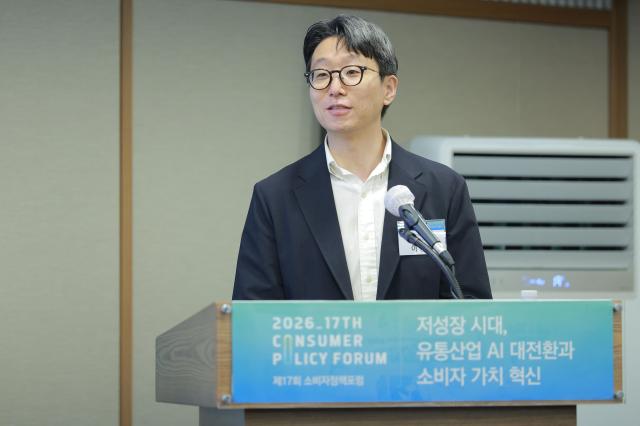
"The retail market is shifting to a structure where AI agents explore, compare, and purchase on behalf of consumers," said Lee Seung-jun, head of the AX Promotion Team at Shinsegae I&C.
During the 17th Consumer Policy Forum held on June 25, Lee outlined the changes in the retail industry and consumer policy direction in the era of agentic commerce.
In his keynote speech titled "Corporate and Consumer Policy Directions in the Era of Agentic Commerce," Lee diagnosed that the advancement of generative AI is fundamentally changing how consumers make purchases and the competitive landscape of the retail industry.
He explained that since the emergence of generative AI, the development and utilization of technology have become commonplace, completely transforming everyday planning and design processes. "AI is changing not just technology but the very decision-making processes of consumers," he emphasized, adding that AI commerce will become a new normal in the future.
Lee specifically warned about the changing shopping structure. He stated, "If AI agents take the lead in purchasing, retailers and e-commerce could be reduced to mere execution infrastructures. While the transition to the internet and mobile created revenue gaps in the past, failure to adopt AI could threaten the very survival of companies." He predicted that future competition in the retail sector will center more on what AI recommends rather than where customers choose to shop.
In response to these changes in the retail environment, companies are adopting various strategies. Efforts are underway to convert existing human-centered data into formats recognizable by AI. Additionally, there is a clear trend of linking products to global AI platform algorithms and integrating AI into existing systems to reduce costs.
Lee also shared specific examples of applying AI technology in practice. The self-checkout solution, which refines Shinsegae I&C's unmanned store technology, uses AI to analyze CCTV footage to detect "missed scans" where barcodes are not scanned intentionally or accidentally. Furthermore, a next-generation checkout technology recognizes items placed in a basket using computer vision technology, allowing for automatic payment without scanning each product's barcode. This technology is already being utilized in corporate settings. AI is also learning from weather and sales data to suggest optimal discount rates for perishable goods, reducing waste that previously relied on experience or intuition.
However, Lee pointed out that technological advancement alone is not sufficient. Given AI's deep involvement in the consumer purchasing process, he stressed the need for trust-based policies and infrastructure to mitigate social costs.
"In the era of agentic commerce, transparency of platform algorithms, reliability of supplier data, and consumer control over delegation will be key challenges," he stated. He urged platforms to clearly disclose their recommendation criteria and advertising status, while suppliers must ensure the accuracy and timeliness of the data used for AI learning.
In conclusion, he emphasized, "Companies that build strong consumer trust alongside technological innovation will seize the future market leadership."
* This article has been translated by AI.
Copyright ⓒ Aju Press All rights reserved.