

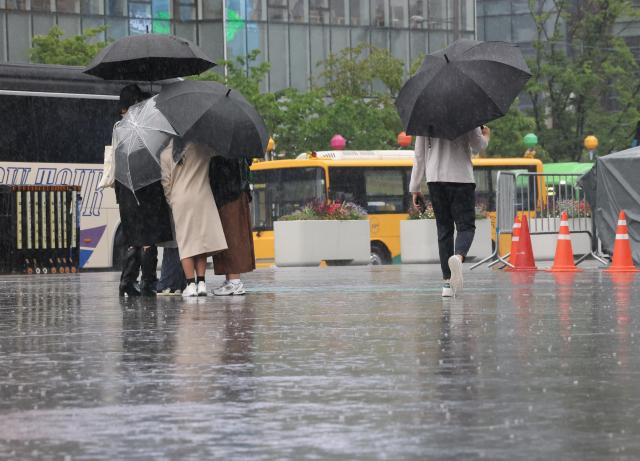
On Friday, June 26, the weather is expected to be mostly cloudy nationwide, with persistent showers primarily affecting the central and southern inland regions. As temperatures rise during the day, the atmosphere will become increasingly unstable, leading to the possibility of heavy rain accompanied by thunder, lightning, and hail in some areas.
According to the Korea Meteorological Administration, heavy showers of around 30 mm per hour are anticipated until the morning of June 26, particularly in Gangwon Province, northern Chungbuk, and northern Gyeongbuk. Strong rain of about 20 mm per hour is also expected in parts of Chungnam, Jeonbuk, and Gyeongsang provinces. Areas experiencing showers may see gusty winds and frequent thunderstorms, with a risk of hail in the central region and Gyeongbuk, necessitating caution against property damage and safety incidents.
The expected rainfall amounts are as follows: 50-60 mm in eastern Gyeonggi, Chungbuk, and northern Gyeongbuk; 10-80 mm in the inland and mountainous areas of Gangwon; 10-50 mm along the eastern coast of Gangwon; and 5-40 mm in Daejeon, Sejong, Chungnam, Jeonbuk, and parts of Daegu and Gyeongbuk (excluding northern areas). Showers are forecasted to continue into the afternoon, bringing an additional 5-20 mm of rain to the southern inland and mountainous regions of Gangwon, northern Chungbuk, and the Yeongnam inland area. Ulleungdo and Dokdo are expected to receive 5-40 mm, while Jeju Island is predicted to see less than 5 mm of precipitation.
Tomorrow morning's low temperatures are expected to range from 15 to 20 degrees Celsius, with daytime highs reaching between 23 and 30 degrees Celsius. In the western regions, the heat will persist, with temperatures in Seoul and Gwangju expected to reach 29 degrees Celsius, and Suwon and Cheongju also hitting 29 degrees. In contrast, coastal areas like Gangneung and Pohang will be cooler, with temperatures of 23 and 25 degrees, respectively, falling below the seasonal average.
Meanwhile, improved atmospheric dispersion is expected to maintain fine dust levels at 'good' across all regions, resulting in clean air conditions.
* This article has been translated by AI.
Copyright ⓒ Aju Press All rights reserved.