

Korean shamanism has not disappeared. For many years, it was not a state religion, lacked systematic scriptures, and was often dismissed as superstition under modernization. However, Korean shamanism has persistently survived. It remains in the mountain shrines, village guardian deities, the rhythms of shamanic rituals, and the cultural practices of ancestral rites during the Lunar New Year and Chuseok. Although its name and forms have changed, shamanism continues to live on as an ancient spiritual language that connects nature and humanity, ancestors and descendants, life and death deep within the hearts of Koreans.
The first reason for the survival of Korean shamanism is that it is a religion of life rather than doctrine. People are born, fall ill, love, part ways, and die. This process encompasses joy and sorrow, success and injustice. Korean shamanism embraces the tears, fears, hopes, and grievances of people in these life experiences. When a child is born, prayers are offered to the Samshin (the goddess of childbirth); when illness strikes, rituals are performed; and when misfortune befalls a family, ancestors are invoked. Shamanism served as a comfort in daily life before abstract philosophies emerged.
Secondly, Korean shamanism does not separate nature from humanity. Mountains are not just mountains but the abodes of mountain spirits; water is not merely water but the realm of the dragon king; and stars are not mere decorations in the sky but the order of the Seven Stars. Koreans have not viewed nature solely as something to conquer. Instead, nature is seen as a being to coexist with, a foundation of life that must be revered and respected. Thus, Korean shamanism embodies ecological spirituality, which is particularly relevant in today's discussions on climate crisis and ecological civilization.
Thirdly, Korean shamanism is a communal religion. Rituals are not solitary acts; they are gatherings where villagers come together, share food, sing, dance, and collectively alleviate community anxieties. Village rituals, such as the Gut and Dangsanje, as well as the Byeolsin Gut and the Fishing Festival, are not merely magical practices but social ceremonies that rebind the community. In contemporary terms, these rituals combine healing, celebration, counseling, and community restoration. Therefore, the Gut is a space filled with both tears and laughter, death and the life force that seeks to continue.
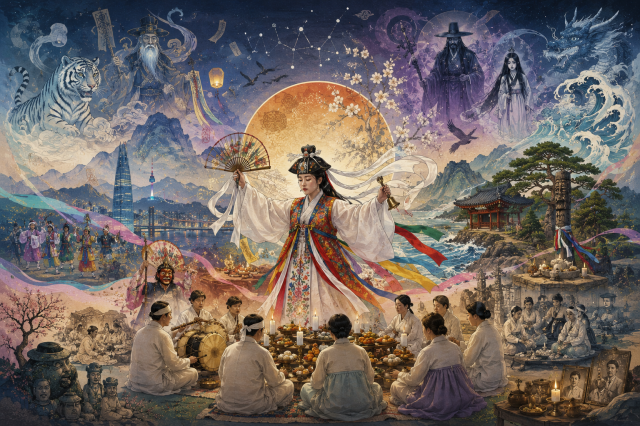
When compared to global shamanism, the uniqueness of Korean shamanism becomes even clearer. Shamanism in Siberia, Mongolia, and Central Asia is deeply connected to the sky, spirits, and nomadic life. Native American shamanism resonates with the earth, animals, and tribal spirituality. Southeast Asian shamanism intertwines with jungles, ancestral spirits, and village guardian beliefs. All these forms of shamanism represent ancient civilizational attempts to communicate with the unseen world. However, Korean shamanism is strongly intertwined with the unique Korean concepts of Han (grievance) and Haewon (healing), ancestral remembrance, mountain worship, and community rituals.
At the core of Korean shamanism is the resolution of Han. It does not bury unjust deaths, unresolved sorrow, or unspoken pain. Korean rituals evoke this Han, expressing it through song, tears, and dance. This is Haewon. The presence of both tears and laughter in Korean culture, and the ability to eat, work, and dream again amidst tragedy, are closely related to this spirit of Haewon. Korean shamanism is not merely a ritual for the dead but a life-affirming practice that helps the living continue.
In comparison with Shinto, similarities and differences emerge. Shinto worships kami (gods) found in nature, believing that divinity resides in mountains, rivers, rocks, trees, wind, and rain. In this regard, both Shinto and Korean shamanism hold nature sacred. However, while Shinto establishes community order through institutionalized spaces like shrines and festivals, Korean shamanism more directly embraces human grief and life’s struggles through Gut and village beliefs. Where Shinto expresses the sacredness of nature through pure and restrained rituals, Korean shamanism does so through tears, rhythms, dance, song, food, and Haewon.
In other words, while Shinto emphasizes the order of the divine in nature, Korean shamanism highlights spirituality that addresses the pains of nature, ancestors, and humanity. If Shinto's aesthetics focus on purification and moderation, Korean shamanism's aesthetics center on Haewon and life. While Shinto is a religion that transcends boundaries to enter the divine realm, Korean shamanism is a practice where the living and the dead, humans and spirits, past and present converge in one space. This distinction creates the deep individuality of spirituality in both countries.
Korean shamanism has also interacted with Buddhism, Confucianism, and Taoism. Mountain spirits and the Seven Stars have entered temples, ancestral worship has merged with Confucian rituals, and Taoist immortal beliefs have expanded the world of Korean shamanism. A defining characteristic of Korean religious history is its fusion rather than exclusion. When foreign religions entered, they did not completely displace indigenous beliefs but were embraced in a uniquely Korean manner. Thus, Korean Buddhism has incorporated mountain shrines and the Seven Stars, while Korean Confucianism has become a living religion through ancestral rites and filial piety, and Korean shamanism has served as a root connecting all these elements.
In modern society, the significance of Korean shamanism is being reinterpreted. While science and technology have provided immense convenience, they have not completely resolved human loneliness, feelings of loss, fear of death, or the emptiness of life. Even in the age of AI, people still need comfort. Algorithms may calculate everything, but they cannot live out human tears, grievances, memories, and longings. Thus, the essence of shamanism remains relevant today. It is not a technology for predicting the future but an ancient healing method where individuals express their wounds and communities listen together.
The resurgence of Korean shamanism within K-culture is no coincidence. K-pop, dramas, films, animations, games, and webtoons are reinterpreting traditional Korean symbols. The emotions of tigers, grim reapers, ghosts, talismans, mountain spirits, rituals, and the concepts of Han and Haewon are transforming into narratives that can be understood globally. This is not merely a revival of shamanism; it is a process of reawakening the ancient imagination and spirituality of Koreans in the language of the digital age. Just as past rituals gathered villagers, today’s K-content invites the world into a single narrative.
As we conclude this trilogy on Korean shamanism, we look toward a broader path of Asian spirituality. Hinduism speaks of the vast order of the universe and the divinity within humanity. Buddhism confronts the causes of suffering and opens the path of compassion and liberation. Zoroastrianism emphasizes moral choices amid the struggle between good and evil. Taoism teaches that humans should not go against the flow of nature. Confucianism establishes human relationships and community ethics, while Shinto showcases the divinity inherent in nature. Korean shamanism, in turn, reveals a spirituality that connects heaven and earth, nature and humanity, ancestors and descendants, the living and the dead.
Asian spirituality cannot be reduced to a single doctrine. It represents a perspective on the universe, an attitude toward humanity, and a way of life that cherishes nature and community. India has contemplated the cosmos, China has established the Tao and propriety, Persia has questioned the moral order of good and evil, Japan has recognized the sacredness of nature, and Korea has expressed the pains of life through the Gut. While different, they all fundamentally ask how humans should live, how to coexist with nature, and how to rise again in the face of death and suffering.
Korean shamanism answers these questions by affirming that humans are not alone. Mountains, rivers, stars, winds, ancestors, descendants, villages, and communities are all present. Sorrow should not be hidden but expressed; death should not be forgotten but remembered; and life is fulfilled not in isolation but in connection. This is why Korean shamanism has survived through thousands of years to the present day.
Shamanism is one of the oldest forms of spirituality among Koreans. It is not a relic of pre-civilization but a foundational sense of life. It embodies a heart that fears and loves nature, remembers ancestors, shares community pain, and seeks to resolve grievances to continue living. Thus, Korean shamanism is not a thing of the past but a present reality, not superstition but culture, and not an outdated remnant but a profound aspect of the Korean spiritual history.
In the series on Asian spirituality, Korean shamanism occupies a very special place. While Hinduism reveals the depth of the universe, Buddhism the depth of the mind, Zoroastrianism the depth of morality, Taoism the depth of nature, Confucianism the depth of human relationships, and Shinto the depth of nature's divinity, Korean shamanism shows the depth of embracing life's pains. This is the uniqueness of Korean shamanism: a spirituality that weeps with humanity, opens paths when people are lost, and helps communities rise again when they fall.
Ultimately, the path of Korean shamanism is a reflection on how the Korean people have understood nature, humanity, and community. This path resembles Shinto yet remains distinct, connecting with global shamanism while being uniquely Korean. The reverence for mountains and skies, the remembrance of ancestors, the resolution of Han, and the revitalization of community are all aspects of this ancient spirituality that continues to breathe within today’s Korean culture.
Asian spirituality is not a dead tradition. It is ancient wisdom that today’s civilization must relearn. As technology accelerates, humanity needs deeper roots. As AI advances, people require more human-like comfort and community. It is at this intersection that Korean shamanism speaks to us again: Do not forget nature. Do not forget ancestors. Do not forget community. And above all, do not turn away from human sorrow.
This is the oldest yet most contemporary message that Korean shamanism leaves with us.
* This article has been translated by AI.
Copyright ⓒ Aju Press All rights reserved.