

President Lee Jae-myung and the Democratic Party are advocating for the establishment of a semiconductor cluster in the Honam region. They argue that investing in Honam's semiconductor industry should be viewed not merely as regional support but as a future investment crucial for national balanced development and the restructuring of the artificial intelligence (AI) industry.
According to industry sources on June 28, President Lee praised the potential investments by Samsung Electronics and SK Hynix in Honam, describing it as an "unprecedented large-scale regional investment." He explained that this reflects the commitment of public officials to achieve the administrative goal of balanced national development, framing the semiconductor initiative in Honam as part of a broader industrial strategy rather than a political event.
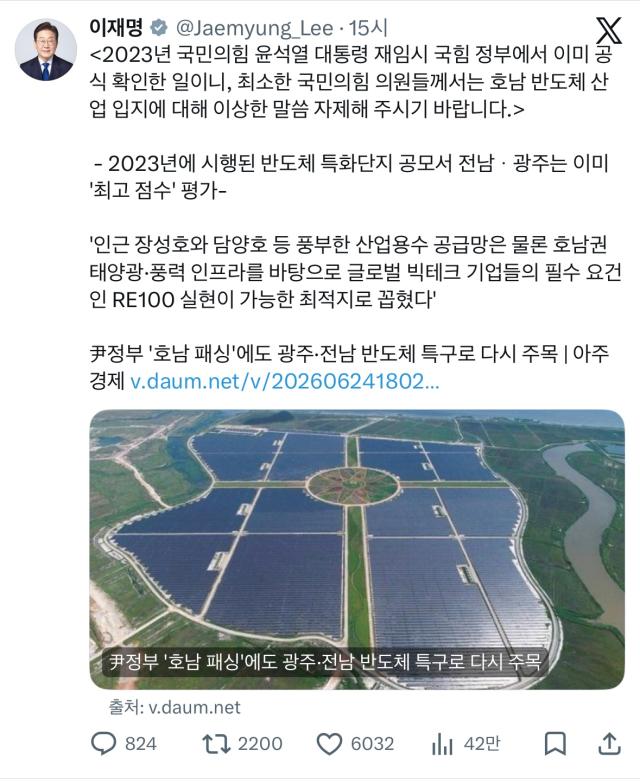
President Lee also highlighted the advantages of the Honam region for semiconductor production. He emphasized the importance of water and energy, particularly renewable sources like solar and wind power, in the semiconductor industry. While the Seoul metropolitan area is already saturated, the southwestern coast offers significant renewable energy potential, low earthquake risk, and favorable conditions for securing large plots of land. He also shared an article from Aju Business Daily, noting that the competitiveness of Honam's semiconductor industry was confirmed during the previous government's Ministry of Trade, Industry and Energy selection process.
The presidential office is aligned with this initiative. Kim Yong-beom, head of the presidential policy office, recently stated at a Kwanhun Club forum that discussions are nearing completion on establishing a second semiconductor cluster in Honam and Chungnam. He clarified that the ongoing construction of the Yongin cluster will not be relocated, emphasizing the need to initiate the new cluster before it is too late.
Within the Democratic Party, there is a consensus that semiconductor investment in Honam is a key strategy for balanced development. Unlike past efforts that focused on relocating public institutions, this initiative aims to directly link semiconductor and AI industries with regional growth strategies. There are calls to ensure that the benefits of the semiconductor boom do not remain confined to the metropolitan asset market but instead contribute to local job creation and the foundation for future industries.
There are also analyses suggesting that Jeonbuk and Honam could become centers for AI. The AI industry requires data centers, power, semiconductor backend processing, and validation infrastructure. The Jeonbuk and southwestern coastal areas possess significant renewable energy potential, ample land, and relatively low location costs. If combined with the industrial infrastructure of Saemangeum and the talent development systems of universities and research institutions in Gwangju and Jeonnam, these areas could become hubs for AI data centers, semiconductor packaging, and physical AI validation.
However, there are concerns that the investment plans led by politicians must align with corporate logic. Semiconductor factories require stable, long-term access to power and water, a supportive ecosystem of partners, and a reliable workforce. The role of politicians should be to create conditions that enable companies to invest rather than dictate specific regional choices.
A political insider remarked, "Investing in Honam's semiconductor industry is not just about regional consideration; it is about where to establish the industrial foundation for the AI era. Considering power, water, renewable energy, and land, Honam is a sufficiently competitive candidate."
* This article has been translated by AI.
Copyright ⓒ Aju Press All rights reserved.