

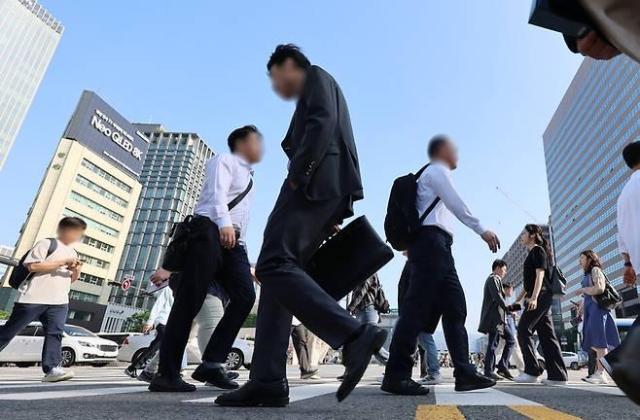
As South Korea's middle-aged population, a key driver of the economy, faces significant gaps in social security policies, experts are calling for a comprehensive redesign of support systems for those aged 50 to 60.
According to a report from the Korea Labor Institute on June 28, a concerning trend has emerged where job quality declines as individuals enter middle age. The wage decrease rate for workers in their 50s is 40.8%, while for those in their 60s, it is 44.6%, surpassing the overall average decline of 36.4%. This means that more than four in ten middle-aged workers experience reduced wages after changing jobs.
The current employment and welfare policies in South Korea largely overlook the 50 to 60 age group. While young people are supported as newcomers to the workforce and older adults are considered vulnerable, middle-aged individuals are often perceived as capable of sustaining themselves through economic activity, leaving them in a welfare blind spot.
According to the National Data Agency's "2024 Life Cycle Administrative Statistics," the population of middle-aged individuals aged 40 to 64 reached 20.03 million in 2024, accounting for 40.3% of the total population. Despite this significant demographic, tailored welfare policies for this group have been slow to develop.
Existing welfare measures primarily focus on income support through unemployment benefits and national pensions, providing only temporary financial assistance post-retirement or managing future pension payouts.
A major concern is the declining average retirement age, which is now reported at 49.4 years, according to the National Data Agency's supplementary survey on the elderly labor force. This figure indicates that many do not reach the legal retirement age of 60, resulting in over a decade of income gaps before they can access national pensions.
Support for middle-aged individuals after they leave their primary jobs, including reemployment assistance, vocational training, and social network rebuilding, is currently insufficient. Existing employment services are predominantly focused on youth-oriented regular education and leisure activities for older adults.
There is a growing call to recognize middle-aged individuals as a distinct policy target and to understand their needs. Experts argue that policies should encompass not only economic support but also employment and caregiving sectors.
Recently, discussions have emerged in political and labor circles about extending the legal retirement age to 65. However, concerns have been raised that such an extension may primarily benefit large corporations and the public sector, potentially exacerbating the dual structure of the labor market.
Given that most middle-aged workers are employed in small businesses, self-employment, or non-regular jobs, some analysts suggest that implementing a "continued employment" model may be more practical than merely extending retirement age. Additionally, there are calls for the establishment of vocational retraining and career transition programs.
Countries like Germany and Japan, which have entered super-aged societies, have successfully achieved employment stability for middle-aged workers through labor market reforms. Germany's Hartz reforms supported vocational retraining and career transitions for older workers, while Japan has enacted the Elderly Employment Stabilization Law, mandating companies to make efforts to retain employees until the age of 70, providing options beyond simple retirement age extensions.
As South Korea faces both population decline and aging, the economic role of middle-aged individuals is expected to become increasingly vital. However, due to the current policy gaps, many are experiencing wage reductions after job changes, prompting calls for a revamp of systems like the Middle-Aged Tomorrow Employment Center.
Kim Kang-ho, a researcher at the Korea Employment Information Service, noted, "Middle-aged workers are experiencing higher rates of wage decreases after job changes, indicating that half of all employed individuals are moving into precarious and unstable labor markets during job transitions." He added, "While there is a Middle-Aged Tomorrow Employment Center in operation, it faces limitations due to insufficient funding and personnel. With rising living costs, the fixed budget for operational expenses is causing difficulties, highlighting the need for increased government support."
* This article has been translated by AI.
Copyright ⓒ Aju Press All rights reserved.