

In late 2025, a man in his mid-50s, identified only as Kim, left his job after more than 20 years. Although he officially accepted a voluntary retirement package, the reality he faced was harsh. There were few full-time job openings for someone in his age group on reemployment websites. Despite his extensive experience, his age became a barrier. With college tuition for his second child still to pay and monthly medical expenses for his elderly mother, he finds himself categorized as an 'older worker' in the labor market, even though he does not consider himself a senior.
Middle-aged individuals in South Korea are increasingly caught in a blind spot between the labor market and welfare systems. While companies push them out as 'aging workers,' they are still viewed as a vital part of the workforce in terms of economic activity. They do not receive the same priority for employment support as younger job seekers, nor do they qualify for basic pension and care policies aimed at seniors. This has led to the emergence of a 'sandwiched generation' that bears the dual burden of supporting both aging parents and children while neglecting their own retirement planning.
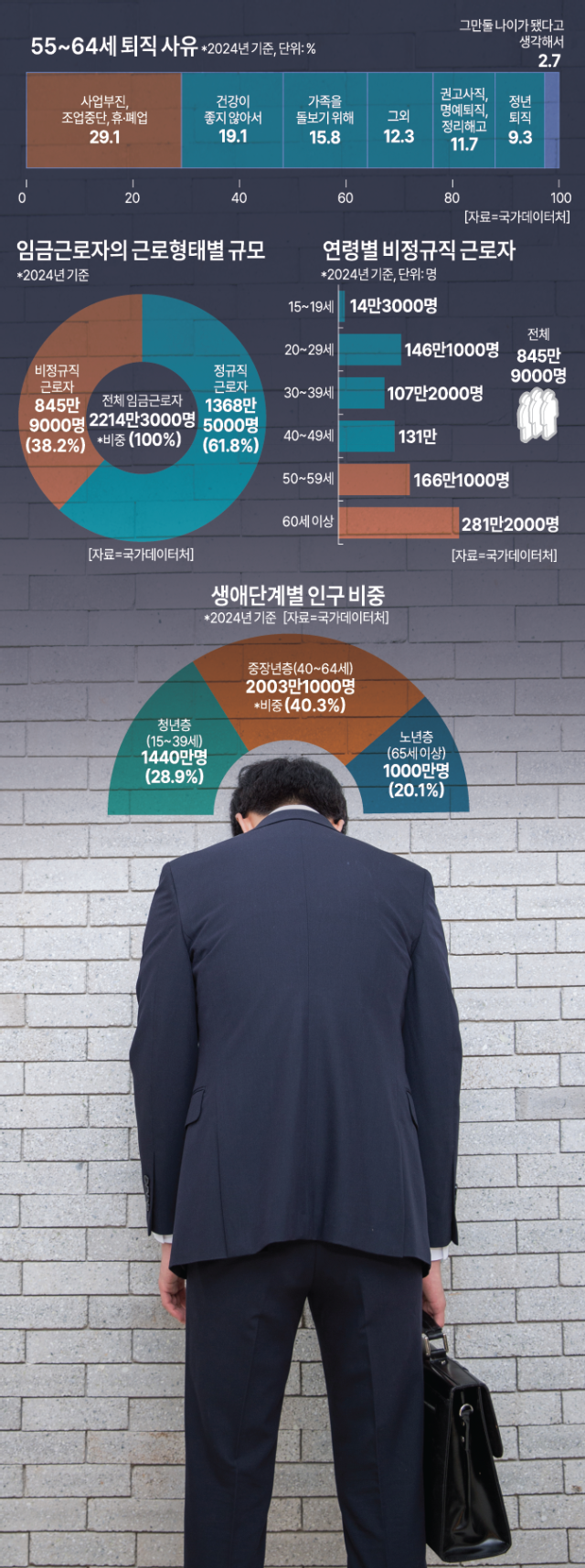
Discussions in the political arena about extending the retirement age to 65 are ongoing, but the reality of retirement is occurring much earlier. According to a study by the Korea Institute for Health and Social Affairs, the average retirement age for primary jobs among those aged 55 to 64 was 49.4 years as of 2024. This figure is significantly lower than the legal retirement age of 60 and the proposed extension to 65.
Moreover, many retire involuntarily rather than reaching retirement age voluntarily. The report indicates that 29.1% of those aged 55 to 64 left their primary jobs due to restructuring or business closures, highlighting that many are forced out due to corporate circumstances and economic fluctuations rather than planned retirements.
For middle-aged workers who lose their primary jobs, transitioning to stable second jobs is not common. As of 2024, non-regular workers made up 38.2% of all wage workers, with the largest group being those aged 60 and older, totaling 2.81 million. Additionally, there were 1.66 million non-regular workers aged 50 to 59, indicating that many middle-aged individuals are reentering the workforce in low-wage and unstable positions.
Income also declines significantly with age. The median real monthly wage for wage workers in 2024 dropped from 2.62 million won for those aged 50 to 54 to 2.45 million won for those aged 55 to 59, and further to 2.10 million won for those aged 60 to 64. This represents a decrease of about 20%, or 525,000 won, when comparing those in their early 50s to those in their early 60s.
Research focusing on individuals aged 55 and older shows that the percentage of employed individuals aged 55 to 64 who experienced job changes after retirement increased from 44.7% in 2018 to 49.4% in 2022. In 2022, 15.8% of those who changed jobs had previously held simple positions, but this figure rose to 33.3% in their new roles. This trend indicates a concerning pattern where experienced middle-aged workers are unable to leverage their skills and end up in lower-skilled jobs after retirement.
Middle-aged individuals remain on the periphery of policy considerations. An analysis by the Korea Institute for Health and Social Affairs found that only three government social security programs specifically target middle-aged individuals: the Middle-Aged Career Support Program, the Middle-Aged Technology Startup Center Support Program, and the Veterans' Job Transition Support Fund.
However, the challenges facing middle-aged workers extend beyond job security. An increase in individuals aged 50 to 64 living alone due to divorce, bereavement, or family breakdown can lead to social isolation alongside employment insecurity. The report indicates that 26.2% of employed individuals living alone are aged 50 to 64, a higher percentage than those in their 20s and 30s.
Kim is currently exploring opportunities in early morning delivery and facility management jobs. He stated, “It’s not that I don’t want to work, but the problem is that there are no positions available that utilize the skills I’ve developed over the years.” With a willingness to work and valuable experience, he finds himself in an environment lacking suitable job opportunities and policies to support the 'sandwiched generation.'
* This article has been translated by AI.
Copyright ⓒ Aju Press All rights reserved.