

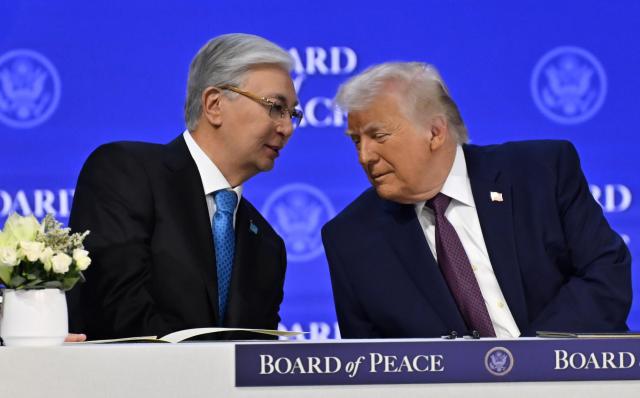
Kazakhstan, traditionally seen as a pro-Russian nation, is actively strengthening its relationship with the United States, according to a report by The New York Times on June 28. Analysts suggest that President Donald Trump's preference for transactional relationships may be appealing to Central Asian countries, which often face criticism over human rights and democracy issues.
Kassym-Jomart Tokayev, the President of Kazakhstan, has emphasized a "multivector" foreign policy, a concept introduced by the country's first president, Nursultan Nazarbayev, after the collapse of the Soviet Union. This policy aims to establish equal and mutually beneficial relationships across the East and West, as well as between Asia and Europe. Tokayev has continued Nazarbayev's legacy, with the capital, Astana, showcasing investments from Russia, China, and the United Arab Emirates in its skyline.
Politically, Kazakhstan is regarded as pro-Russian, sharing the longest border with Russia at 4,744 miles (7,644 kilometers) and a 1,107-mile (1,783-kilometer) border with China. Kazakhstan participates in the Collective Security Treaty Organization (CSTO) and the Eurasian Economic Union (EAEU), both initiatives aimed at countering NATO and the European Union, respectively.
However, Kazakhstan has been aggressively pursuing stronger ties with the Trump administration, engaging in numerous high-level meetings and exchanges with U.S. businesses. The country has signed 29 contracts with American companies, totaling over $17 billion, including agreements with Amazon for satellite services and with Nvidia for an artificial intelligence data hub. Additionally, Tokayev participated in the Abraham Accords, which normalized relations between Israel and several Middle Eastern countries, and joined Trump's peace committee addressing governance in Gaza. During a visit to the U.S. last year, Tokayev famously referred to Trump as a "great leader sent by heaven" to revive their shared values and traditions.
Unlike previous administrations that prioritized human rights and democracy in foreign relations, the Trump administration's "America First" approach has been welcomed by Central Asian nations like Kazakhstan. The New York Times noted that the dissolution of U.S. Agency for International Development (USAID) projects focused on human rights in Kazakhstan during Trump's second term has removed obstacles to diplomatic engagement.
Nevertheless, Kazakhstan maintains its relationship with Russia. Last month, Russian President Vladimir Putin visited Kazakhstan for an EAEU summit, bringing gifts and discussing a $16.4 billion nuclear power project, with 85% of the financing provided by Russia. Putin and Tokayev planted an oak tree together, symbolizing their "eternal friendship." Additionally, Reuters reported that Russia requested gasoline from Kazakhstan due to reduced refinery operations following attacks in Ukraine. Kazakhstan, a member of OPEC+, is a significant oil producer.
Nurlan Zhakupov, head of Kazakhstan's sovereign wealth fund Samruk-Kazyna, told The New York Times, "If we determine that collaborating with any company from the U.S., EU, China, Russia, South Korea, Germany, or the UAE is beneficial, we will evaluate the relative outcomes and choose the best alternative."
* This article has been translated by AI.
Copyright ⓒ Aju Press All rights reserved.