

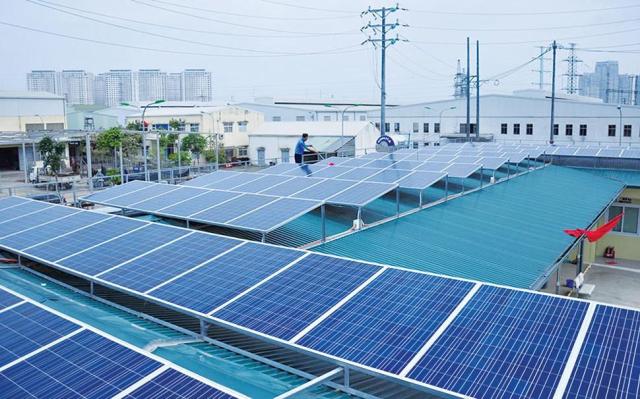
In Vietnam, the pathway for households to sell excess electricity generated from rooftop solar systems has expanded, raising interest in the installation of residential solar panels. The sales limit has been increased from 20% to 50%, and the purchase price applicable this year is projected to be 844.8 VND (approximately 49 cents) per kWh. Online users have expressed intentions to install solar systems, while also inquiring about the registration process, reasons for sales limits, and the feasibility of recovering maintenance costs.
According to recent reports from Vietnamese government sources, the government has announced Decree 243, which amends Decrees 57 and 58 related to renewable energy development, effective from June 26. The new regulations allow for the sale of up to 50% of excess power generated by self-consumed rooftop solar systems, based on agreements between buyers and sellers.
The key aspect of this amendment is the increase in the sales limit for excess power from rooftop solar systems from 20% to a maximum of 50%. Households that install solar systems for self-consumption can now sell half of the surplus electricity back to the grid. However, the government has left room for exceptions until the end of 2030, depending on regional grid conditions. If the local grid can safely accommodate additional power, buyers and sellers may agree to trade excess power beyond the 50% limit.
In areas that are still not connected to the national grid, such as mountainous, border, and island regions, different criteria will apply. In these areas, excess power generated from self-consumed rooftop solar can be bought and sold without price restrictions. The total amount of electricity supplied to the grid will be settled according to the meter readings.
Notably, if these regions are later connected to the national grid, the general trading ratios will apply. Before grid connection, there will be no restrictions to supplement local power supply, but after connection, the structure will align with national standards. The scope of eligible sellers has also expanded. The decree includes households using private residences, public buildings, low-voltage grid-connected systems, and systems that comply with power development plans. The purchasing entity is designated as the Vietnam Electricity Corporation (EVN).
The government’s decision to ease sales limits is rooted in the need to supplement local power supply and reduce the burden of grid investments. By allowing rooftop solar to be consumed on-site and only selling the surplus to the grid, the government aims to address rising electricity demand while alleviating pressure on transmission and distribution networks.
Currently, there are approximately 103,000 rooftop solar systems installed across Vietnam, with a total capacity exceeding 9,500 MW. According to the revised Power Development Plan VIII, 50% of office buildings and residential homes are expected to utilize self-consumed rooftop solar by 2030.
The pricing structure for purchasing excess power has also changed. Under the new regulations, the purchase price for excess solar power will be determined based on the average market price from the previous year, rather than a long-term fixed feed-in tariff (FIT) as before.
The National Power System and Market Operation Company (NSMO) published a document on January 16, revealing that the average market price for electricity in 2025 is 844.8 VND/kWh. Therefore, the purchase price for excess power sold to the grid from self-consumed rooftop solar this year could be around 844.8 VND/kWh.
This pricing system differs from the previous method, which applied a fixed FIT price for 20 years. Going forward, the purchase price for excess power will be updated annually based on the results of the previous year’s market operations.
Online users have reacted positively to the decree, suggesting that the installation of residential rooftop solar systems could increase. One user noted, “The main purpose of installing solar panels is to provide electricity for the family. The income from selling excess power will only cover some repair and maintenance costs, and operating solar power as a business will likely lead to immediate losses.” Another user remarked, “The government has introduced a decree that the public will welcome, and many households will likely install solar systems.”
Questions regarding the sales limit and purchase price have also surfaced. One user asked, “How do I register to sell excess power?” while another expressed interest in selling 50% of their surplus during the day when electricity usage is low and using the remaining power in the evening. A user who installed a 16.8 kW solar panel and a 12 kW inverter commented, “Even on very sunny days, the actual surplus power is not much, especially from noon to 3 PM when air conditioning usage is high, leading to a shortage of grid power. I wonder why there are restrictions on the amount of power sold and what the grid’s purchase price is.”
There are also opinions suggesting that rooftop solar should be viewed as distributed backup power. One user stated, “Rooftop solar can rapidly increase as a massive backup power source. If everyone sells, there may be a surplus, but if no one sells, there will inevitably be a shortage. In case of a blackout, this also reduces dependence on the national grid. While dozens of power plants may face issues, millions of small power plants can lower the risk of blackouts.”
* This article has been translated by AI.
Copyright ⓒ Aju Press All rights reserved.