

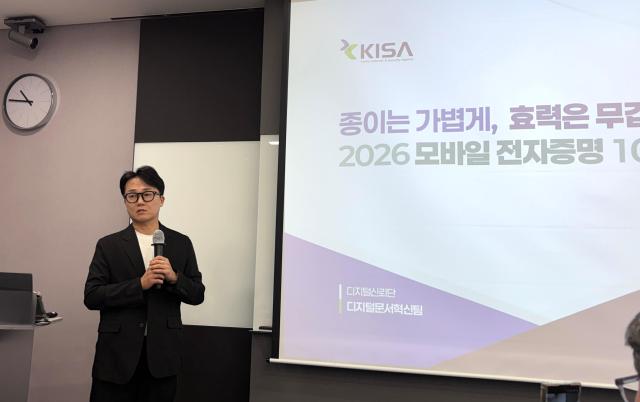
The Korea Internet & Security Agency (KISA) is expanding its legal notification system, traditionally reliant on paper mail and certified letters, to a mobile-based electronic certification service. This initiative aims to reduce the inconveniences associated with paper notifications in areas closely related to citizens' lives, such as real estate, finance, insurance, leasing, healthcare, and everyday disputes, while establishing a reliable foundation for electronic documents needed for future dispute resolution.
According to KISA, the agency is selecting and launching 10 major mobile electronic certification projects through the public participation budget system, with ongoing efforts this year. This initiative marks the first phase of practical application and commercialization of mobile electronic certification in both public and private sectors, with performance indicators set for each project to assess service outcomes. KISA plans to achieve commercialization results for each project by the end of the year.
Through this initiative, KISA aims to transform mobile electronic document services, which have primarily focused on notifications and guidance, into a mobile electronic certification system with legal proof capabilities. While mobile electronic notifications mainly involve documents requiring information delivery, such as tax notices and fines, mobile electronic certification will focus on the transmission, viewing, and storage history of documents that may lead to disputes, such as contracts, important financial notifications, leasing rights, and notifications of everyday disputes.
The expansion of mobile electronic certification is backed by the success of existing mobile electronic notification services. KISA reports that the number of mobile electronic notification services grew from 78 in 2019 to 481 in 2025, with an annual distribution volume reaching 220 million cases by 2025. Public notifications, including health examination results, national tax delinquency notices, national pension enrollment records, and prior notifications of traffic violation fines, are now being sent through mobile electronic notifications.
The 10 major projects are divided between public and private sectors. In the public sector, projects include electronic document notifications for land compensation by the Korea Real Estate Agency, integrated online and offline certified letters by the Korea Post, notifications of impending loss of benefits by IBK Industrial Bank, and guidance for small and venture businesses by the Technology Guarantee Fund. In the private sector, initiatives include electronic certification of legal documents by LawTalk, protection of rental rights by B-Tech Plus, consent for infertility treatments by Medisol, important insurance documents by Wider Lab, electronic certification for everyday disputes by Topido, and non-face-to-face transaction protection services by ARComs.
Notably, the participation of the Korea Post in this initiative is significant. Traditionally responsible for paper-based certified letters and mail notifications, the Korea Post is now pursuing an integrated online and offline delivery system that combines mobile electronic certification with physical mail. This development increases the likelihood that the existing paper-based legal notification system will evolve alongside digital methods. However, mobile electronic certification will not replace postal certified letters; rather, it will serve as a distinct trust service that verifies the transmission and storage history of documents in a digital environment based on the Electronic Document Act.
In the private sector, the LawTalk case exemplifies the initiative. The service uses AI to draft legal documents based on user input, which are then reviewed by a lawyer and sent via mobile electronic certification. This process allows for the entire drafting, reviewing, and sending of legal documents to be handled within a mobile platform while maintaining a record of transmission and document storage.
In the healthcare sector, Medisol is attempting to transition the consent process for infertility treatments to mobile electronic certification. The requirement for couples to visit the hospital together to complete consent forms has been a significant burden. Medisol aims to alleviate this by enabling mobile processing, while also maintaining a record of medical explanations and patient consent history for future dispute resolution.
KISA believes that as mobile electronic certification becomes more widespread, electronic document services will evolve beyond simple notifications and guidance to include legal proof capabilities. This will reduce the inconveniences of paper notifications in areas such as finance, insurance, real estate, healthcare, leasing, everyday disputes, and non-face-to-face transactions, while also establishing a foundation for addressing disputes based on transmission, viewing, and storage history.
Jeon Jin-hyung, head of KISA's Digital Document Innovation Team, stated, "Mobile electronic certification is essential not only for convenience but also for its legal effectiveness and reliability. We will confirm practical use cases through the 10 major projects this year."
* This article has been translated by AI.
Copyright ⓒ Aju Press All rights reserved.