

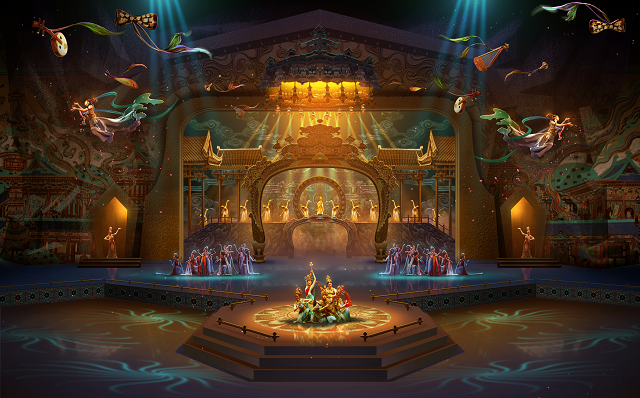
"It feels like the murals in the cave are coming to life right before my eyes," exclaimed an Indonesian tourist after attending the immersive performance 'Weidong Dunhuang' on the evening of July 2 in Dunhuang, Gansu Province, China.
The 70-minute show transported the audience into the world of the Mogao Caves, which are among China's three major cave complexes and a UNESCO World Heritage site that preserves the essence of Buddhist art accumulated over a millennium along the Silk Road.
The performance featured ancient melodies from instruments like the pipa and the xiao, as celestial dancers known as 'Feitian' soared through the air, while the nine-colored deer 'Jiuse Lu' frolicked. Traditional dances depicted in the murals, such as the Hu Xuan Wu (a spinning dance from the West), Yao Gu Wu (waist drum dance), and Pi Pa Wu (dance performed while playing the pipa), were brought to life through holograms and the movements of the dancers.
Dunhuang's ancient art, which flourished along the Silk Road, is now being transformed into new cultural content through advanced technology.
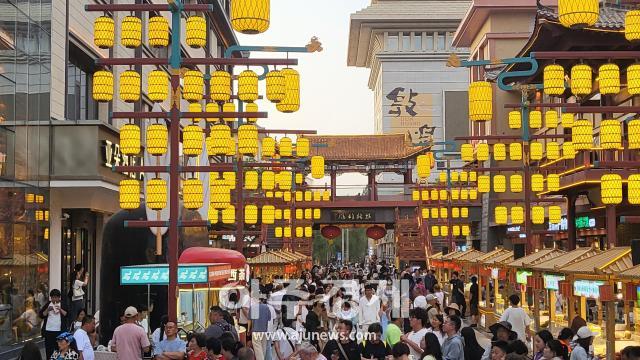
The cultural heritage of Dunhuang permeates everyday life. Camel-shaped traffic lights, streetlights and bus stops adorned with images of Feitian and Jiuse Lu, and building walls featuring the unique colors and patterns of the Mogao murals seamlessly blend the ancient Silk Road heritage with the modern urban landscape.
During my visit, I observed that the entire city of Dunhuang has developed its ancient historical sites into cultural intellectual property (IP), creating a vast cultural ecosystem that connects performances, exhibitions, digital content, gaming, and merchandise.
This small city of 180,000 residents attracted 23.91 million tourists last year, surpassing 20 million for the first time. The tourism industry is a key sector, accounting for about two-thirds of the local economy.
Visiting the Mogao Caves is just the beginning of a Dunhuang journey. The city is cultivating its cultural heritage into digital content and cultural IP, positioning it as a new growth driver for the tourism industry.
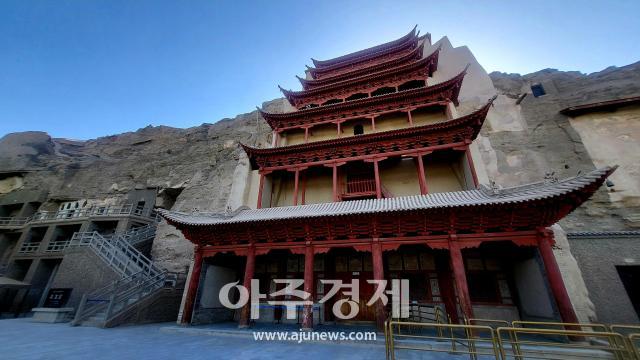
A prime example is the 'Digital Dunhuang' project. To prevent damage to the murals, access to the actual caves is strictly limited in terms of time and lighting. Instead, 735 caves and 45,000 square meters of murals have been digitized in ultra-high resolution. Visitors can vividly appreciate the murals and ceiling patterns that are difficult to see up close at the digital exhibition center before entering the Mogao Caves. I was able to alleviate my disappointment of only being able to explore eight caves in the dim light with the immersive digital experience of Dunhuang.
The influence of Dunhuang's IP is also evident in the gaming industry. Tencent's popular game 'Honor of Kings,' which boasts 260 million monthly active users worldwide, collaborated with the Dunhuang Research Institute to introduce limited skins inspired by the Mogao Caves' Feitian and Jiuse Lu. Notably, the Feitian skin sold over 40 million sets, demonstrating that cultural heritage can thrive in gaming content.
The development team of NetEase's mobile game 'Reverse' also visited Dunhuang to recreate not only the Mogao Caves but also the landscape of the crescent-shaped desert oasis Mingshashan and the Moon Spring in the game. They used motion capture technology to replicate various dances depicted in the murals and consulted experts to expand the cultural heritage into the game's universe.
Feitian and Jiuse Lu have now evolved beyond mere souvenirs from the Dunhuang Museum to characters, animations, and fashion accessories. This shift connects cultural heritage from being solely a subject of preservation to one of consumption and experience. Particularly among tourists in their 20s and 30s who have encountered Dunhuang's enchanting culture through games, these items are gaining popularity.
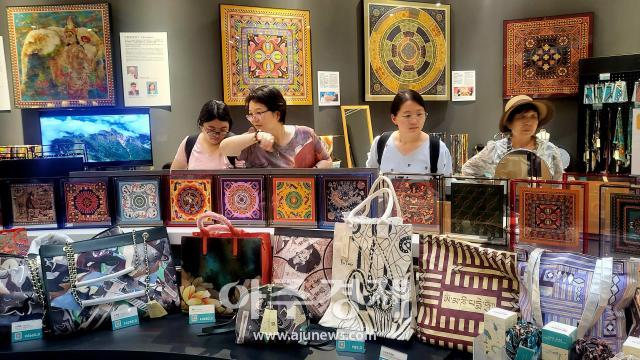
The Dunhuang Museum gift shop is bustling with tourists exploring various souvenirs. From refrigerator magnets and postcards to cups and plates, as well as silk scarves and mouse pads featuring diverse patterns from the Mogao murals, and even skateboards themed around Feitian, Dunhuang has become a major cultural IP in China, achieving annual sales exceeding 10 billion yuan (approximately $2.25 billion) alongside the Forbidden City.
Recently, China has been nurturing its cultural heritage as a source of cultural soft power and content industry amid the trend of Guochao (the modern reinterpretation of traditional Chinese culture). Dunhuang, in particular, is becoming a testing ground for the 'cultural IP industry,' reinterpreting the cultural heritage of the Silk Road from a millennium ago through digital technology and content industries to create new economic value.
* This article has been translated by AI.
Copyright ⓒ Aju Press All rights reserved.