

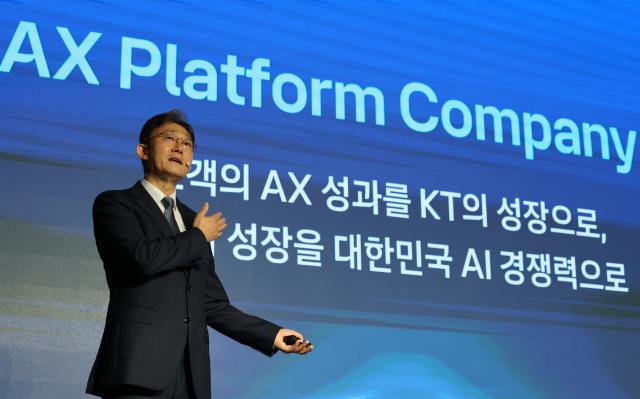
"KT aims to be an AI Transformation (AX) Platform Company, helping customers adopt AI to grow and enhance their competitiveness in the AI era," said Park Yoon-young, CEO of KT, during a press conference held on July 6 at the Pullman Ambassador Seoul East. Park emphasized that strengthening the essence of telecommunications is essential for KT to grow as an AX Platform Company, stating, "Just as KT has connected people and data, we will now connect people with AI and AI with AI."
To achieve this, KT plans to invest approximately 18 trillion won over the next three years to enhance cybersecurity and network competitiveness while expanding its AI infrastructure. The company also aims to foster new businesses in the AI era, including token factories and stablecoins.
KT has identified 'token factory' and stablecoin ventures as future growth drivers. Park noted, "The AI industry is experiencing explosive growth, leading to the emergence of tokens as a new economic unit. As the usage model shifts from flat-rate to pay-per-use, it is crucial for businesses to determine the most efficient way to utilize tokens."
He highlighted the 'token gateway' as a key component of the token factory. "No one does billing better than telecom companies," Park stated, explaining that by combining their billing capabilities with the token gateway and AI Data Centers (AIDC), they can create new business models.
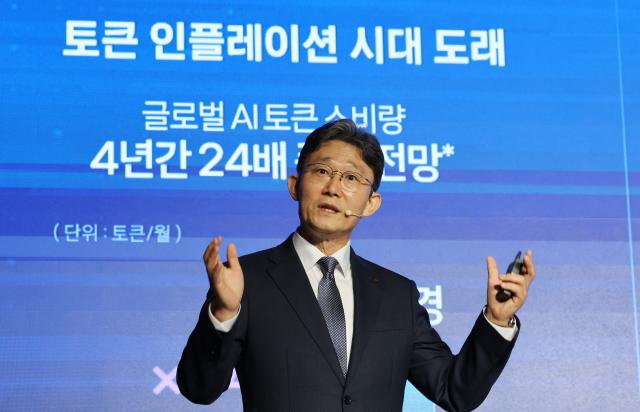
The company is also preparing to enter the stablecoin market. Park stated, "The KT Group possesses all the necessary capabilities for issuance, settlement, and customer ecosystem management. We are currently conducting proof of concept (PoC) internally and will prepare for the business in line with regulatory developments."
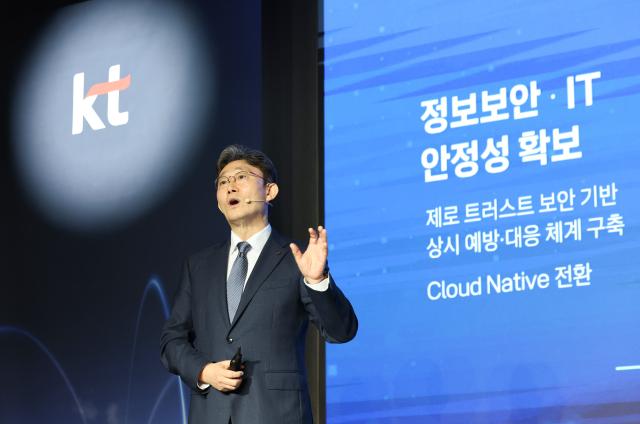
In addition to strengthening its telecommunications core, KT will make significant investments. The company plans to allocate about 12 trillion won over the next three years to cybersecurity, information technology (IT), and network sectors. Of this, approximately 4 trillion won will be invested in cybersecurity and IT to establish a zero-trust security framework and integrate security operations governance. KT's Strategy Office head, Heo Tae-jun, noted, "Investments will begin in the second half of this year, with about half of the total investment expected to be executed next year."
KT will separate the roles of Chief Information Security Officer (CISO) and Chief Privacy Officer (CPO) and double its cybersecurity workforce. Lee Sun-joo, head of KT's Talent Division, announced plans to hire around 140 new employees in September and to establish a collaborative program with Seoul National University to cultivate security personnel in the long term.
The company will also invest about 8 trillion won in network development, focusing on future technologies such as 6G, satellites, and data center interconnections to enhance customer experience.
In the satellite sector, KT SAT will take the lead. Park remarked, "A recent announcement regarding the national low-orbit satellite project indicates that KT SAT must play a significant role in management and operations, as it is the best company in South Korea for satellite control and operation."
KT will also expand its investment in AI infrastructure, planning to invest around 5 trillion won to establish a total of 1 gigawatt (GW) of AIDC. Park stated, "Our investments will be driven by actual demand rather than scale competition. The most important aspect of AIDC operations is operational experience, and KT's strength lies in enhancing efficiency through actual operations."
KT plans to differentiate its AIDC expansion strategy between metropolitan and non-metropolitan areas. Kim Bong-kyun, head of KT's Enterprise Division, explained, "We will aggressively expand in the metropolitan area once power and other development issues are resolved, while in non-metropolitan areas, we will first secure tenant demand before investing. He added, "For AIDC to operate effectively, connectivity is key, and the interconnection between international traffic and data centers, as well as wired and wireless networks, is KT's greatest differentiator."
Regarding the potential merger with KT Cloud, Park stated that it is currently under review.
To respond to the growing global AI traffic, KT will invest about 1 trillion won in submarine cables. The company plans to increase its international submarine cable capacity from approximately 38 terabits per second (Tbps) to over 128 Tbps. Park noted, "As AIDC expands, we expect international data traffic to increase significantly. Given the high investment costs, we will pursue capacity expansion in collaboration with global tech giants."
In the business-to-business (B2B) sector, KT will expand AI services focused on finance, public, manufacturing, and healthcare sectors. The company plans to supply agentic AI to the financial sector and promote sovereign AI-based services in the public sector. In manufacturing and healthcare, KT aims to participate in projects such as the Physical AI demonstration project led by the Ministry of Science and ICT.
In the business-to-consumer (B2C) sector, KT will introduce hyper-personalized services that allow customers to design their own plans and benefits. The company plans to analyze usage patterns to recommend tailored services and digitize the entire process from subscription to customer support.
KT will continue its collaboration with Microsoft, which was initiated under former CEO Kim Young-seob. Park stated, "We are collaborating well in understanding customer needs and optimization, focusing on Azure and KT Cloud resources." The company will also continue partnerships with global AI firms like Palantir and expand collaborations with domestic AI companies such as Upstage, Rebellion, and Saltlux.
Additionally, Park mentioned that the media business restructuring, including the merger of Tving and Wavve, is currently under review.
* This article has been translated by AI.
Copyright ⓒ Aju Press All rights reserved.