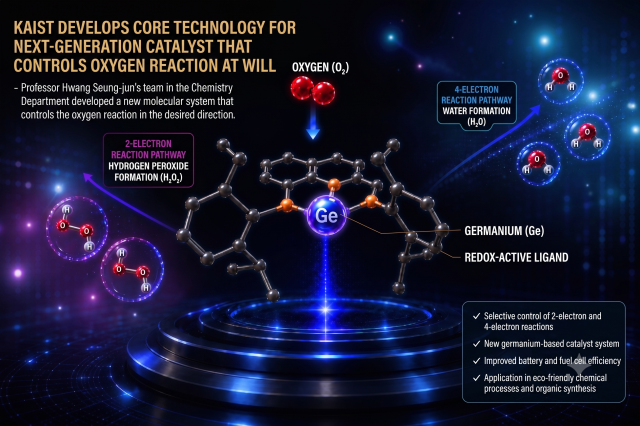
SEOUL, July 22 (AJP) - A new molecular system developed in South Korea can be instructed how many electrons to hand over to oxygen, a switch that decides whether a reaction ends in water or hydrogen peroxide and that sits at the center of fuel cell performance, battery chemistry and cleaner industrial manufacturing.
Until now, that kind of control has belonged almost entirely to transition metals such as iron, cobalt and nickel. Fuel cells depend on the four-electron route, which turns oxygen into water and releases the most energy. Plants producing hydrogen peroxide want the two-electron route and nothing else. Steering a reaction cleanly down one path rather than the other has been one of the standing problems in catalyst design.
The Korea Advanced Institute of Science and Technology (KAIST) said Wednesday that a team led by Hwang Seung-jun, an associate professor in its Department of Chemistry, has demonstrated a single molecular system that can be switched between the two routes on demand. The work appeared online in the journal Chem on July 6.
The switch runs on germanium, an element that was not supposed to be capable of this. Germanium sits in the same column of the periodic table as silicon, among what chemists call the main-group elements, the ordinary elements outside the transition metals. Transition metals dominate catalysis because their electron shells let them absorb and release several electrons at a time. Main-group elements normally manage two at most, which is why they have been treated as poor substitutes for reactions involving oxygen.
Hwang's team got around that by pairing germanium with a redox-active ligand, a surrounding molecular framework that stores electrons and passes them back and forth. The ligand works as a reservoir. Instead of asking the germanium atom to supply everything on its own, the whole molecule shares the load, and four-electron chemistry becomes possible.
Turning the four-electron pathway off proved to be a matter of blocking two electrons at the source. The researchers reacted the germanium compound with iodomethane, attaching a methyl group to the germanium center. That single change shut down the four-electron route and left the reaction running selectively on two electrons. The same platform, structurally modified, produced a different product.
Along the way, the team managed to isolate a germanium intermediate that ordinarily forms and disappears within the reaction. The isolated species showed a rare property. A single germanium atom acted as both an electron donor and an electron acceptor, behavior chemists describe as ambiphilic, and it gave the researchers direct evidence of how the switching works rather than an inference from the final products.
The compound turned out to do more than react with oxygen. At room temperature and without light, it stripped chlorine and bromine atoms from organic molecules carrying halogens on neighboring carbons, restoring the carbon-to-carbon double bond and regenerating alkenes, the feedstock chemicals behind everything from pharmaceuticals to plastics. That reaction is usually driven by heat or additional processing steps. It also did not occur in the phosphorus version of the same molecule, which has an equivalent electron count, indicating that germanium is not simply a heavier stand-in for phosphorus but has chemistry of its own.
"This research shows that catalytic reactions that depended on transition metals can also be achieved with main-group elements such as germanium," Hwang said. He added that he expects the approach to be applied broadly in developing next-generation catalysts for cleaner and more efficient chemical processes, as well as in improving battery and fuel cell performance.
The first authors were KAIST postdoctoral researchers Kim Sung-gyu and Oh Jin-rok, with Choi Dae-eui, a combined master's and doctoral student at Pohang University of Science and Technology, where Hwang taught until this year. The National Research Foundation of Korea funded the work through the Ministry of Science and ICT and the Ministry of Education, with additional support from the Samsung Science and Technology Foundation.
(Reference Information)
Journal/Source: Chem
Title: Germanium ligand redox cooperativity: A key to ambiphilicity and switchable two- and four-electron transfer
Link/DOI: https://doi.org/10.1016/j.chempr.2026.103127
Copyright ⓒ Aju Press All rights reserved.