

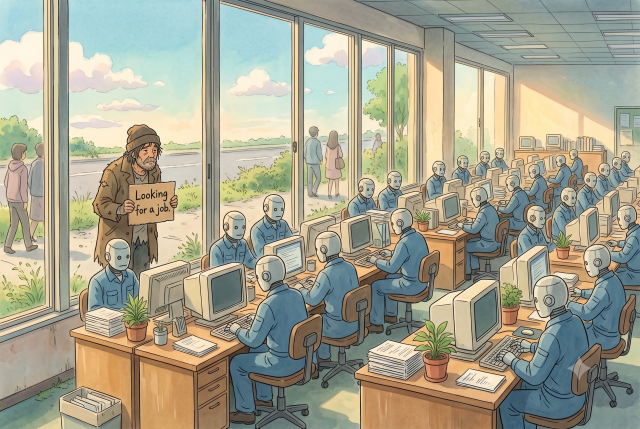
SEOUL, July 22 (AJP) - Artificial intelligence is expected to eliminate roughly 256,000 jobs a year in South Korea within a decade, a report released by the Korea Development Institute showed Wednesday. AI will concentrate pressure on professionals, office workers and sales staff rather than on the manual work that earlier waves of automation displaced.
The scale is easier to read against what the institute expects the labor market to do otherwise. In its outlook published earlier this year, the Korea Development Institute (KDI) projected that the number of employed people in South Korea would rise by about 170,000 in each of 2026 and 2027. The AI effect, as estimated, is larger than that annual gain.
Nam Chang-woo, a senior research fellow at the state-funded institute, released the findings on July 22 in a report on the macroeconomic effects of AI. The estimated losses amount to 2.1 percent of the employed population as of 2024.
The figure comes from a two-step calculation. The researchers first identified jobs exposed to AI automation 10 years from now, then estimated how many of those would be replaced outright, applying quasi-elasticity coefficients drawn from job losses in earlier rounds of production automation.
Exposure grows sharply over the period. At present, the share of the economy where AI automation is commercially viable stands at 1.4 percent measured by jobs and 1.8 percent measured by revenue. Within 10 years, the report puts those figures at 8.1 percent and 10.5 percent.
The report is not uniformly negative. KDI estimated that the spread of generative AI would raise South Korea's total factor productivity by 1.5 to 3.5 percent over the coming decade, or 0.15 to 0.35 percentage points a year. Total factor productivity measures output gains that cannot be explained by adding more workers or more capital, and economists treat it as the closest available proxy for how efficiently an economy uses what it already has.
That figure reflects a multiplier effect. Productivity gains in sectors heavily exposed to AI spread through the rest of the economy by way of supplier and buyer linkages rather than staying where they originate.
At the level of individual companies, the effect is larger and more immediate. Combining corporate financial statements with data on AI adoption, KDI estimated that introducing AI raised revenue per permanent employee by about 20 percent, a result the report describes as statistically significant.
Wage inequality between occupations is expected to narrow slightly or hold steady as measured by the Gini coefficient. The reason is not that lower-paid workers gain. It is wage compression, with pay growth slowing in the high-wage occupations that AI reaches first.
KDI recommended that the government act as a facilitator, drawing in the complementary private investment that AI requires while limiting the employment shock and distributional damage that come with it.
In the short term, the report called for expanded support for job redesign and retraining in highly exposed occupations. It also urged the government to lower the entry barrier for small and midsize firms by operating public cloud services and shared GPU centers, and to build a data-sharing platform.
Over the longer term, KDI proposed spreading labor-complementing AI solutions through public services and establishing sector-by-sector AI governance frameworks.
"We need to run a tripartite consultative body of labor, management and government centered on highly exposed professional occupations to discuss job transitions and wage systems," Nam explained, adding that the social safety net should be strengthened, including by closing the gaps in unemployment benefits that will widen as AI increases non-standard work.

Copyright ⓒ Aju Press All rights reserved.
