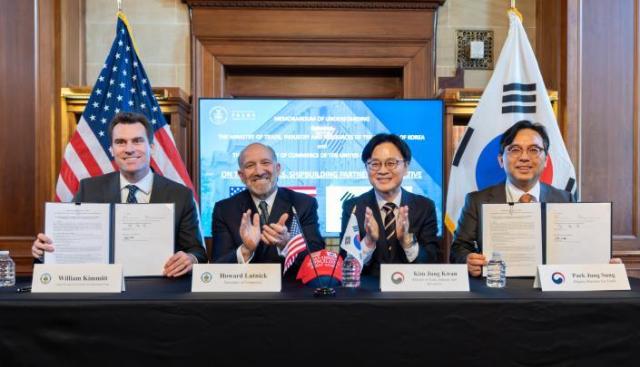
Senior government officials, lawmakers and industry executives from both countries attended the opening of the Korea-U.S. Shipbuilding Partnership Center (KUSPC), which will serve as the operational hub for the "Make American Shipbuilding Great Again" (MASGA) initiative aimed at rebuilding America's shipbuilding industry.
The launch came just two months after Seoul and Washington signed a memorandum of understanding in May to establish the center as part of a broader bilateral shipbuilding partnership.
Industry Minister Kim Jung-kwan called the center a symbol of South Korea's "strong" commitment to supporting the revival of the U.S. shipbuilding industry.
"Korea strongly supports President Trump's maritime action plan. We are ready to work side by side with the U.S. Today is the beginning of a new chapter -- a new chapter for our shipbuilding industry, a new chapter for our maritime partnership and a new chapter for our alliance," he said.
At the heart of that new chapter is the MASGA initiative, which Kim described as a "bold" vision to strengthen America's shipbuilding capabilities, maritime power and regional economies.
"Korea is ready to be America's strongest partner in making this vision real," he said. "Together with (Commerce) Secretary (Howard) Lutnick and our U.S. colleagues, we will deliver results. We will build naval vessels. We will build LNG carriers and we will build them here in America."
Kim said Korean companies are already developing projects to acquire, expand and modernize shipyards across the United States, while Korean financial institutions will work together to support the investment initiative.
He also called on Washington to provide sustained ship orders, investment incentives and regulatory support to ensure the successful execution of the $150 billion shipbuilding cooperation program.
Commerce Secretary Howard Lutnick stressed that the partnership would ultimately be judged by tangible industrial output rather than diplomatic symbolism.
"The center is not an outcome. It is the most important work that produces the outcome of how many ships that are built," he said.
"Talking is not a thing. It sets the stage, but the reality is (that) it is vital for America to produce ships in America. Not talk about producing ships in America, not having meetings about ships in America, but actually building ships in America."
Lutnick said the Trump administration would evaluate the center by the amount of capital deployed, facilities modernized, workers trained, supply chains established and, ultimately, the number of ships built in the United States through bilateral cooperation.
He also pledged Washington's support in removing regulatory obstacles facing Korean companies investing in the United States.
"We are committed to removing barriers to production," he said. "If, when you are building and bumping into roadblocks, or you are feeling that the environment is not completely embracing of you, call the Department of Commerce. We will clear the regulatory roadblocks for you to build in America."
Among the prominent attendees was newly confirmed U.S. Ambassador to South Korea Michelle Steel, who described the initiative as evidence that the alliance is expanding into a "new" and "important" area of industrial cooperation.
"What we have discussed today is proof that our alliance is expanding into a new, incredibly important territory: the vitalization of the American industry, including in shipbuilding," she said.
"This undertaking is part of a much larger vision -- one in which Korea's investment in American manufacturing, shipbuilding and strategic sectors works (for) a fair, reciprocal and resilient trade relationship between our two nations."
South Korea's Ambassador to the United States Kang Kyung-wha called the launch of the KUSPC "a major milestone" and the starting point for building "a safe, resilient and trusted joint maritime industrial ecosystem."
"To this day and into the future, ship production, maintenance and repair remain critically important for national security, global trade and economic stability," she said. "That is why the opening of the KUSPC is such a uniquely important milestone."
The Defense Acquisition Program Administration (DAPA) said it will seek new opportunities for bilateral cooperation in naval shipbuilding and support Korean companies seeking to join U.S. shipbuilding and defense supply chains.
During the ceremony, the two countries signed 15 memorandums of understanding covering four areas: establishing "Team Korea" to promote joint growth of the two countries' shipbuilding industries, strengthening supply-chain cooperation, expanding workforce training and pursuing joint technology development. Team Korea brings together KUSPC, HD Hyundai Heavy Industries, Hanwha Ocean, Samsung Heavy Industries, the Korea Offshore & Shipbuilding Association (KOSHIPA) and the Korea Research Institute of Ships & Ocean Engineering (KRISO).
The Industry Ministry also announced a five-year joint research and development program worth 120 billion won (about $80 million), under which Korean and U.S. companies and research institutions will collaborate on eight projects including AI-assisted ship design, autonomous welding, shipyard automation, intelligent heavy-block transport, smart manufacturing and autonomous navigation technologies.
Based in Washington, the KUSPC will serve as the local command center for the MASGA initiative, coordinating productivity consulting for U.S. shipyards, workforce training, technology cooperation and investment projects while helping Korean companies work with U.S. federal and state authorities, shipyards and industry partners as the two countries seek to translate their shipbuilding partnership into commercial production.
Copyright ⓒ Aju Press All rights reserved.